
The Historic Traveler Interview With James Hyland,
President/Founder, The Lighthouse Preservation Society
Lighthouses have been an important factor in history since the introduction of the earliest recorded lighthouse, the 440-foot-tall Pharos of Alexandria, built in Egypt around 280 BC — one of the Seven Wonders of the World. It lasted 1500 years before being destroyed in an earthquake. Unfortunately, today’s American lighthouses are in much greater danger of disappearing through neglect. Which is where James Hyland comes in. He is the president and founder of The Lighthouse Preservation Society, and history lovers owe him a real debt of gratitude.

The Lighthouse Preservation Society is a nonprofit organization that has made lighthouse preservation a national issue with Congressional hearings, conferences, the sponsorship of National Lighthouse Day and its celebrations, the nomination of 35 U.S. lighthouse stamps, and the raising of nearly $6 million for over 160 lighthouse projects. This prestigious group is also the recipient of a Presidential Achievement Award from the federal government for its efforts to preserve our lighthouse heritage.
James didn’t set out to start a preservation organization. He was working in the media department of an institution where he’d graduated with a master’s degree, along with doing some freelance photography and writing on the side. But one day of kayaking and curiosity changed his life — and the course of lighthouse history.
Jackie: How did you become an expert in Lighthouse Preservation and start the Lighthouse Preservation Society?
James: I became an expert in America’s lighthouse preservation efforts through observation and first-hand experience. It started when I took my kayak out to Straitsmouth Island off the coast of Rockport, Massachusetts in 1978. I had a film major in college and had just finished a master’s degree in a history-related field. I had seen the island from a distance and had become curious. I wanted to photograph the lighthouse out there. I was captivated by the beauty and adventure of being on a remote island on a sunny spring day in May, after surviving the great Blizzard of 1978, that had destroyed Rockport’s famous Motif #1 red lobster shack.
The keeper’s house on the island was an architectural gem with plenty of Victorian-era gingerbread, but I was shocked to see how poorly maintained it was. It was badly vandalized and literally falling apart – the storm hadn’t helped. The lighthouse tower was in terrible condition. Although it was clearly functional as an aid to navigation, it was, nevertheless, severely neglected. The wooden walkway, a kind of elevated bridge to the tower, had fallen into the ocean; the tower was unpainted and rusted; and all the doors were broken into and left wide open to the elements.
Fascinated by the remote beauty of the location and curious as to why the buildings were in such bad condition, I went to the Boston Library to do some research on the subject of lighthouses. I found very little material at that time. It seemed like lighthouses had become a thing of the past, and there was little apparent interest in the subject, as was evident by the lack of publications dealing with lighthouses. I did find two books, however, that whetted my appetite for lighthouse information: The Lighthouses of New England by Edward Rowe Snow – a book written by a former high school history teacher, filled with wonderful tales of adventure surrounding the region’s lighthouses, and America’s Lighthouses by F. Ross Holland, which was a thorough history of the nation’s lighthouses by a national parks historian who would eventually join our board of directors.
As I continued to delve into the subject, I was led to contact the Coast Guard Historian’s office in Washington, D.C., where I learned that the Coast Guard was planning on automating all the nation’s lighthouses by 1990. By this time, I had really caught the “lighthouse bug” and was put in touch with a local maritime museum that was just getting started, called the Hull Lifesaving Museum. Located across from America’s oldest lighthouse, the Boston Light, they were open to working with me to document New England’s lighthouses and create a museum exhibition. Working with the museum’s director, I learned how to write grants.
Our first success was in getting an RV manufacturer to loan us a new RV for two years, so I could conduct a photographic survey of New England’s nearly 200 lighthouses, and interview their keepers. We also got the Coast Guard Admiral to allow us access to the region’s lighthouses and to provide transportation out to the many offshore lights. It was a photographer’s dream assignment, and it allowed me to interview the nation’s last lighthouse keepers before their jobs were eliminated, replaced by automation.
What I discovered while I was out in the field helped me to understand why lighthouses like the Straitsmouth Light in Rockport had fallen into disrepair. The Coast Guard was in many ways getting out of the lighthouse business. New technology was making these historic beacons obsolete. With no plan as to what to do with these newly abandoned structures as they took their keepers out of service, no mission for historic preservation – large numbers of lighthouses were not even on the National Register of Historic Places, although they all qualified, and little money to invest in their upkeep, these beautiful historic structures that stood as shoreline sentinels guarding our coasts seemed doomed to die.
While engaged in my documentation work, I voiced my concern as to what I was seeing to my neighbor, Dr. Valerie Nelson, who had taught at Harvard’s Kennedy School of Government. She grew up in the Washington, D.C. area and her father worked for the Department of Transportation, which at that time had jurisdiction over the Coast Guard. She informed me that our nation’s lighthouses belonged to the American people, not the Coast Guard, and they needed to be held responsible for the demise of these historic buildings. Consequently, she set me up with an interview with a U.S. Congressmen who was on the Coast Guard Committee. After showing him my documentation of decay and neglect of our region’s lighthouses, he asked me to come down to Washington to participate in a Congressional Hearing on the subject. I agreed, but I had no idea what I was getting into.
When I entered the Congressional room where the hearing was to take place, I was overwhelmed by the number of people there. Not only were our nation’s congressional leaders in attendance, but the press was there too. It was standing room only. I was so intimidated that I could hardly think, much less talk, but fortunately my neighbor and now colleague, Dr. Valerie Nelson was there at my side. We were both in our early 30’s and she was an attractive tall Scandinavian blonde, very bright and verbal, and used to going up against Harvard’s best and brightest. I took one look at the crowd and turned to her and said, “I think you’ll do a better job with these folks than I will”. She agreed to the challenge and did a great job of presenting our case, complete with photo documentation.
Afterwards, the Coast Guard Admiral in charge of Aids to Navigation got up and said, “Yes, we’re $7 million behind in maintenance with no hope of ever catching up.” The handwriting was now on the wall and the hearing ended with Congress mandating a policy review of how they were going to handle our nation’s lighthouses going forward. This led to numerous changes within the agency, but Dr. Nelson and I decided to take it further as long as we were in the nation’s capitol. We got in touch with the National Park Service and began working with them on what would be called the Lighthouse Bicentennial Fund. With the 200th anniversary of America’s first public works act coming up in 1989, marking George Washington’s signing of the 9th Act of Congress, establishing a national lighthouse building program, it seemed the right time to get some things done in Washington for lighthouses.
Washington’s 1789 Lighthouse Act has been called “the first great work of the American people”. In an age without major roads, trains, or planes, America’s waterways were of utmost importance, and lighthouses helped to make immigration and trade safe for a growing nation that relied heavily on maritime transportation. We approached the issue of lighthouse preservation on several fronts. The Lighthouse Bicentennial Fund was a matching grants program that would be funded through the National Parks Service. It would distribute the $3 million that Congress was willing to give us to State Historic Preservation Offices around the country. Nonprofit organizations and governmental agencies that were interested in preserving their lighthouses could apply for funding, provided that they were on the National Register of Historic Places.
This prompted the state agencies to get busy documenting their lighthouses for National Register nominations, and it allowed numerous groups around the country to launch restoration efforts for their local lighthouses. Over 160 lighthouses were helped in this way. In numerous cases the government funding was matched many times over, and scores of lighthouses were saved all over the country. In fact, the program was so popular that we were given a Presidential Achievement Award by the federal government.
Then we went on to work with the National Trust for Historic Preservation and hammered out the issues facing lighthouse preservation around the country. Representatives from governmental agencies and nonprofits converged on Washington, D.C. for a series of three conferences we held on lighthouse preservation issues. What came out of those meetings was then incorporated into The National Historic Lighthouse Preservation Act of 2000, which allowed groups to take over lighthouse properties for public use and take care of their historic preservation, while still allowing the Coast Guard access to maintain the functioning automated lights. It was a win-win solution that continues to help lighthouse preservation efforts to this day.
When the 200th anniversary of George Washington’s lighthouse act finally came around on August 7, 1989, we were able to pick up on a dead bill to establish a national lighthouse day, and got it rewritten and lobbied successfully through Congress. We also helped to coordinate lighthouse celebrations throughout the country, a tradition which has continued to this day.
In an effort to promote lighthouse awareness, I also approached National Geographic Magazine in Washington, D.C. and introduced the idea of doing an article on America’s lighthouses. The art director at the magazine felt the subject was too static for them, but he was on the Citizen’s Advisory Board for the U.S. Postal Service and thought it would be a great stamp series. He was able to spearhead a series of seven sets of five lighthouses over a 30-year period, depicting lighthouses from the various regions of the country. This stamp series was recently named the most popular Forever Stamps of all time, and helped promote lighthouse awareness around the country in what the National Trust Magazine called a Lighthouse Revival in this nation.
Other ways that we were able to promote lighthouses was through the introduction of lighthouse calendars and books. I approached all the nation’s major calendar companies with my photos in the early 1980’s, suggesting that lighthouses would be a good topical theme. Prior to that time, lighthouse calendars were non-existent. Numerous publishers, however, jumped on the idea, and now they are standard fare. I also visited a major publisher, the Boston Globe Pequot Press, about doing a lighthouse book. That led to a whole series of lighthouse books on their part, and many other publishers followed suit, often asking me to write the Forwards to their books, and eliminating the dearth of books on lighthouses that I had initially encountered in the late 1970’s.
I think my experience with lighthouses has caused me to reflect on a number of truths I learned with time. First of all, individuals can truly make a difference, especially when joined to other like-minded individuals with complementary sets of strengths and skills. Working together, we can all bring about significant changes in our institutions, our culture, and in the lives of individuals. Secondly, it’s important to follow your passion and persevere if you want to succeed in life. Thirdly, I have realized that the chain of events that happened to me in helping to save America’s lighthouses were nothing I had planned beforehand. I was simply the right person, meeting the right people, and being at the right place, at the right time. This truth has led me to acknowledge that God is able to orchestrate our lives for his purposes. As a person of faith, it has prompted me to take the advice of Proverbs 3:5-6, “Trust in the Lord with all your heart, and do not rely on your own insight. In all your ways acknowledge him, and he will make straight your paths.”
Jackie: How many lighthouses are there in the U.S. still operational? How many of those are in good condition and how many still need repair to be used either as a lighthouse, museum or residence?
James: There were approximately 1,200 lighthouses built in America over a period of 200 years. Of that number, nearly 800 still exist, but only about 400 lighthouses in the U.S. are still operational. The need for upkeep and repair is ongoing for these structures. They range the whole spectrum from being near collapse to being in pristine condition.
Jackie: Are there a variety of different types of lighthouses?
James: There is a large variety of lighthouse types. They vary in size and shape, in architectural style, and in the materials used to construct them.
Jackie: What does it take to restore a lighthouse? What are the biggest challenges?
James: Each lighthouse restoration is somewhat different. It can vary, depending on the location, construction, and structural needs that must be addressed. Erosion can be a big factor with rising sea levels threatening to undermine the lighthouse stations. I was one of the last people to visit the Great Point Light on Nantucket before a winter storm came in and washed away all the sand around the tower, toppling it into the sea. Moisture problems are also very common with rust and mold building up in both the towers and the keeper’s homes. Many of the lighthouses have asbestos and lead paint problems, as well.
Jackie: How can people contribute individually or monetarily?
James: If people want to help, their best bet is to get personally involved with a local lighthouse nonprofit and contribute their time as a volunteer and money, as needed.
Jackie: What do you consider to be the lighthouses that people should put on their must-see list?
James: Each region of the United States has some great lighthouses. I do have some must-see favorites, however. They would include the Portland Head Light in Maine, the Navesink Lighthouse in New Jersey, Cape Hatteras Light in North Carolina, Split Rock Light in Minnesota, and Heceta Head Light in Oregon.
Jackie: Please walk us through some of the most unique lighthouses—and why they are distinctive.
James: To answer this question, I’ll go back to the answers for your previous question:
a) I like the Portland Head Light because of its location and history. It is the image that is most frequently used to represent New England’s lighthouses and seems to be used everywhere, from TV ads to fine art paintings. It was also the inspiration for Longfellow’s famous poem “The Lighthouse”.
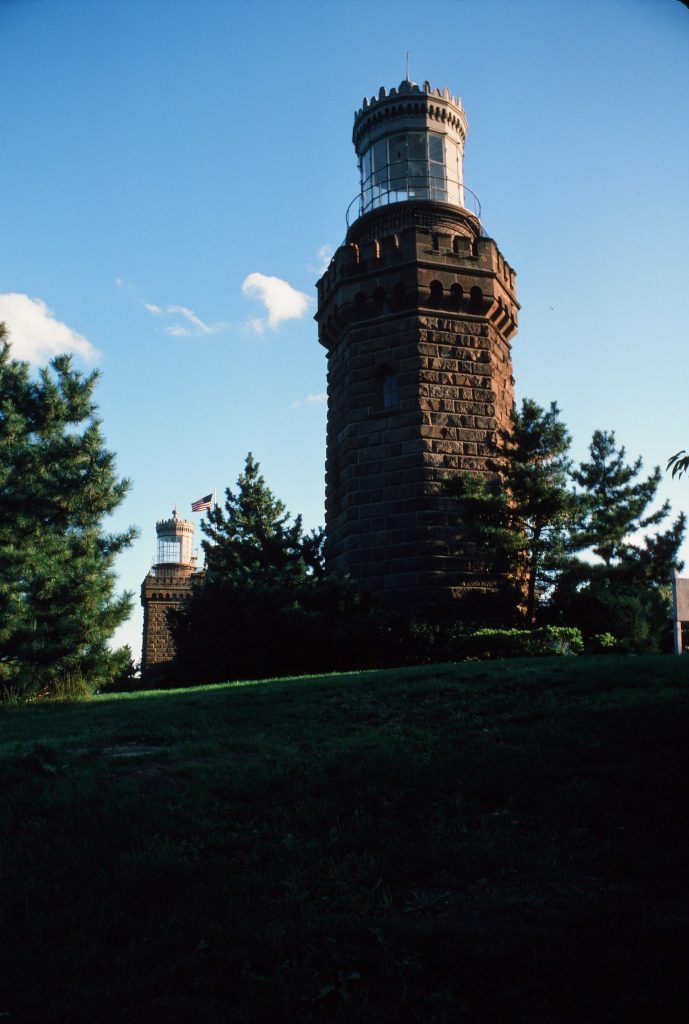
b) The Navesink Lighthouse in New Jersey helps guard the southern entrance to New York City. I’ve often been quoted that “Lighthouses are to America, what castles are to Europe”, and this lighthouse embodies that concept more than any other lighthouse. Built during the Civil War, it is the castle-like emblem of the Army Corps of Engineers, who built it.
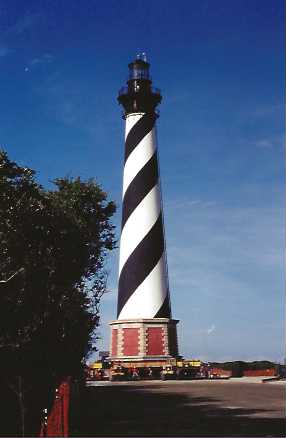
c) The Cape Hatteras Lighthouse on North Carolina’s Outer Banks is the tallest lighthouse in America, and one of the tallest in the world. Two of our board members, Dr. Valerie Nelson and National Parks historian F. Ross Holland were nominated to be on the Academy of Science Committee that studied how to save that lighthouse from the encroaching erosion that was threatening it. In what was called “the move of the century” in 1999, it was lifted up and moved back from the eroding coastline on a tractor similar to what’s used to move space rockets.
d) I’m a Great Lakes boy, and grew up just outside of Toledo, Ohio on a river that feeds into Lake Erie. If you include the Canadian Lights, the Great Lakes has the highest concentration of lighthouses in North America, and none is more spectacular for location than the Split Rock Light, which I was able to include in the U.S. Lighthouse stamp series. The painted image by stamp illustrator Howard Koslow was actually based on one of my photos.
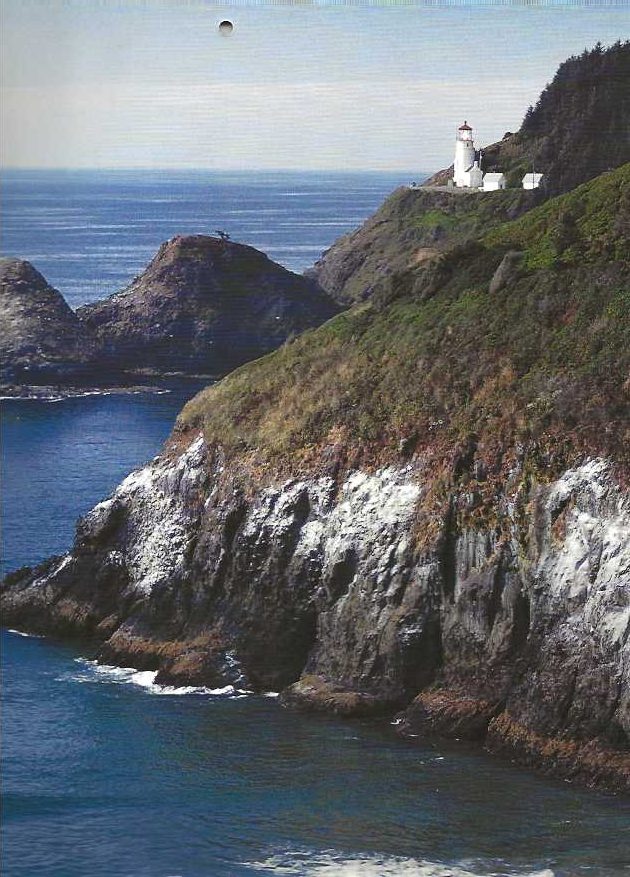
e) About the time I was first “turning on” to lighthouses in the late 1970’s, my great aunt invited my sister and I to visit her ranch in Oregon. Learning of my new interest in lighthouses, she took us on a tour of the Oregon coast, where I was stunned by the dramatic setting of the Heceta Head Light. Poised precariously in a notch of a mountainous cliff along the dramatic Oregon coastline, it took my breath away the first time I saw it. It’s still one of my favorite lighthouse photographs.
Jackie: Are there a lot of lighthouses that have been converted to residential…what’s it like to live in an old lighthouse?
James: There are a few lighthouses that have been converted into private residences. Most of them were sold off around the 1930’s when the lighthouses were transferred from the old U.S. Lighthouse Service, which was largely a civilian organization where keeper’s jobs were often passed down in families from generation to generation, to the more militaristic/law enforcement-oriented U.S. Coast Guard. This change was deemed necessary as World War II was looming on the horizon and lighthouses were beginning to be seen as sentinels that could help protect our coastline from invasion.
I was able to visit one of these private lighthouse homes in the 1980’s that belonged to the Greenlaw family on the remote island of Isle au Haut, which is part of Acadia National Park. It was used as a summer home by the Greenlaws, which had multiplied with successive generations so that they couldn’t all stay there anymore. The decision therefore was made to sell the property, and they contacted our newly formed nonprofit organization, The Lighthouse Preservation Society, to see if we were interested in purchasing it from the family.


I had a good idea of what it could be used for and contacted a couple I had met in my initial lighthouse documentation travels – a young couple named Jeff and Judi Burke, who ran a bed and breakfast in mid-coast Maine. When I stayed at their place, I was impressed with their great cooking and hospitality, and was surprised to learn that Judi was the daughter of a lighthouse keeper. They had told me at the time that if I ever came across a lighthouse that was for sale, they’d love to work with our organization to restore it and turn it into an inn. So when the Greenlaw family contacted me, I knew just exactly who to turn to. Jeff and I met on the docks in Stonington, Maine and took the mail boat out to the island. The lighthouse was a time capsule that hadn’t changed since the 1930’s. It was heated with a wood stove and lit with oil lamps. There was a hand pump at the sink from which to draw water. And there was no electricity or phone service to the island at that time. It was very quiet and very beautiful – a great place to vacation in the summer, but a tough place to live in cold weather. Eventually, Jeff and Judi ended up taking on the project on their own, and it quickly became very popular as one of the first lighthouse B&B’s in the country. When I got married a few years later, my wife and I spent part of our honeymoon there. It was a wonderful experience. Jeff was very handy in fixing the place up and Judi was a fantastic cook who even came out with her own cookbook. Jeff was also a writer and wrote some notable books about their experiences at the Isle au Haut Lighthouse.
Jackie: Are there still lighthouse keepers today, or is all that automated?
James: For practical purposes, all the lighthouse keepers are now gone. There are, however, a few light stations that the Coast Guard still uses for their personnel, but they’re usually employed with the Coast Guard doing other jobs. Senator Ted Kennedy was able to get America’s oldest lighthouse, the Boston Light, designated as the last manned lighthouse in the United States, but in reality, it too is automated.
Jackie: Much of these are now National Park owned—is that right? Do people have to have park passes to see or visit them?
James: There are a number of lighthouses that are on National Parks grounds. The U.S. Fish and Wildlife Department also has some lighthouses. In both federal government situations, there are some locations that you’ll need a pass, but others where you don’t. It all depends. The rules are not all the same in terms of public access at these various locations. It’s best to research before you go.
Jackie: Can you suggest non-fiction books people can read about lighthouses?
James: One of my favorite non-fiction books about lighthouses is The Lighthouses of New England by Edward Rowe Snow. It’s a history book with a human interest slant that captures the romance and adventure of lighthouses, with stories of shipwrecks and lifesaving, war stories, romance, and buried pirate treasure. The other book I’d recommend is America’s Lighthouses by F. Ross Holland, which is a thorough history of our nation’s lighthouses by ‘the dean of American lighthouse historians”. These two books are what first turned me on to the subject of lighthouses and it will probably turn you on to them, as well!
Jackie: Can you suggest fiction books that take place in or around light houses that might interest people?
James: To the Lighthouse by Virginia Woolf is generally considered to be THE classic fiction novel dealing with lighthouses.
Jackie: There have been a few films in the past years that focus on lighthouses or lightkeepers—any that you recommend?
James: I’m pretty picky these days about what films I watch and more recent films haven’t been to my liking. Believe it or not, one of my favorite lighthouse movies is Captain January starring Shirley Temple. It does a great job of depicting the plight of the old U.S. Lighthouse Service’s civilian lighthouse keepers who were being kicked out of their lighthouse homes in the 1930’s to be replaced by a militarized Coast Guard just before World War II. It’s an endearing movie that also has a lot of heart and perhaps more importantly these days, is safe for people of all ages in your family to enjoy.
Jackie: Are you still in full-speed mode?
James: I guess you could call me semi-retired now. I still work a lot of hours, but probably not the typical 40 hours a week, anymore. Much of my current lighthouse work is focused on running our lighthouse dining program at the Newburyport Rear Range Lighthouse—a romantic one-of-a-kind dining experience at the top of the Newburyport Lighthouse. It has gained a reputation as a place for wedding proposals, but is equally popular for celebrating anniversaries, birthdays, and other special occasions. The $350 fee per-couple includes membership in The Lighthouse Preservation Society, and part of it is tax-deductible.
Jackie: Thank you, James. You’ve—please excuse the pun–really illuminated this subject! And I want to encourage people to go to your website for more information, explore membership or get a gift certificates that support lighthouse preservation. www.lighthousepreservation.org.
Recommended Reading
- The Lighthouses of New England by Edward Rowe Snow – A detailed exploration of the history and significance of lighthouses across the United States. The book covers over 200 lighthouses, blending rich historical narratives with beautiful photographs. It highlights the architectural designs, the men and women who tended them, and the role they played in American maritime history.
- America’s Lighthouses by F. Ross Holland – A detailed exploration of the history and significance of lighthouses across the United States. The book covers over 200 lighthouses, blending rich historical narratives with beautiful photographs. It highlights the architectural designs, the men and women who tended them, and the role they played in American maritime history.
- To the Lighthouse by Virginia Woolf – A modernist novel employing stream-of-consciousness centered on the Ramsay family’s summers on the Isle of Skye. Divided into three parts —“The Window,” “Time Passes,” and “The Lighthouse” —it explores memory, loss, creativity, and the passage of time. Not part of a series.
Other Notable Lighthouses (courtesy of Google)
- The Tower of Hercules: Located in A Coruña, Spain, this lighthouse has a Roman core and is said to have been built in the 2nd century.
- Cordouan Lighthouse: Located on a small islet in France, this lighthouse was built on top of an older lighthouse that dates back to the 880s.
- Bell Rock Lighthouse: Located in the North Sea, off the coast of Scotland, this is the oldest surviving oceanic offshore lighthouse.
- Sandy Hook Lighthouse: Located in New Jersey, this lighthouse was built in 1764 and is still in operation today.
- Alcatraz Island Lighthouse: Located in the Golden Gate National Recreation Area, this lighthouse was the first navigational lamp lit on the West Coast of the United States
This Article was featured in the Summer 2025 issue of The Historic Traveler Magazine.
