A Hidden Jewel Amid the Gilded Spires
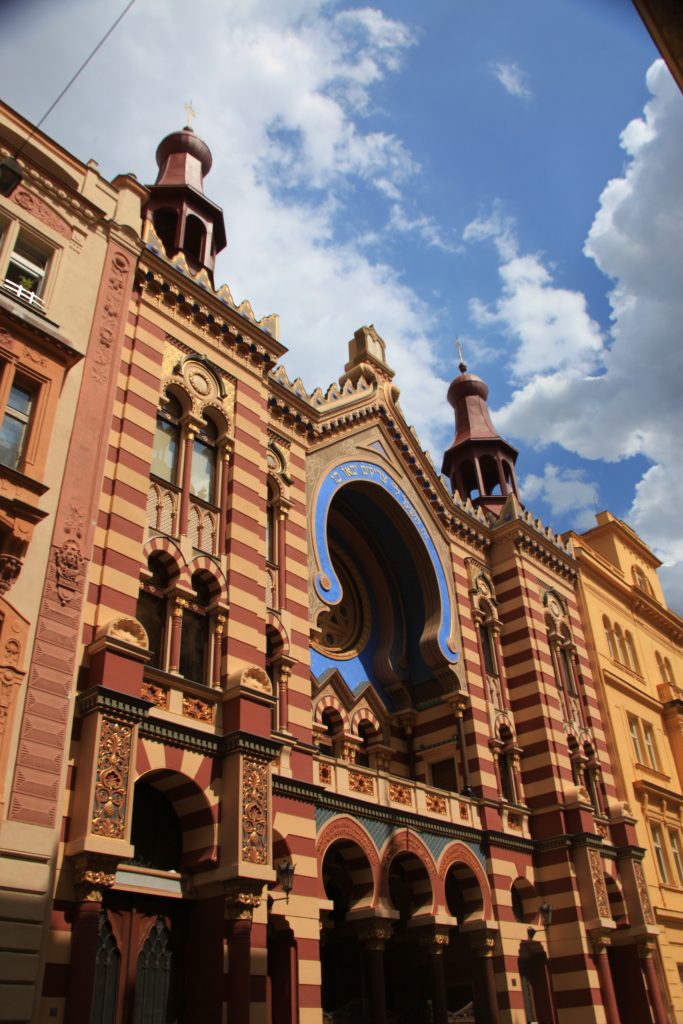
Prague’s Jubilee Synagogue, known locally as the Jerusalem Synagogue, stands apart in this city of Gothic stone and Baroque gold with its ornate decoration distinct from the heavier architectural styles around it. With its candy-striped Moorish façade and lyrical Art Nouveau flourishes, it is a soaring, defiant hymn to faith, beauty, and the survival of a people who endured unimaginable horrors.
A Sanctuary Born in an Age of Hope
The Jubilee Synagogue was built between 1905 and 1906, during a brief period of Jewish emancipation under Austro-Hungarian rule. It was named to honor Emperor Franz Joseph I’s Silver Jubilee, a symbol of loyalty and gratitude from the city’s flourishing Jewish community.
The architect, Wilhelm Stiassny, a Viennese master known for his Jewish institutional designs across Europe, conceived the building in the exuberant Moorish Revival style, honoring the architectural traditions of Sephardic Jews expelled from Spain centuries earlier. Yet true to Prague’s emerging modernist spirit, he infused the design with Art Nouveau’s flowing, organic motifs, blending color, pattern, and devotion in a singular way.
The new synagogue was built to replace three smaller synagogues demolished during the redevelopment of Prague‘s Jewish Quarter. It was to be not just a house of prayer, but a glorious affirmation of presence: “We are here, and we belong.”
A Feast for the Eyes and the Spirit
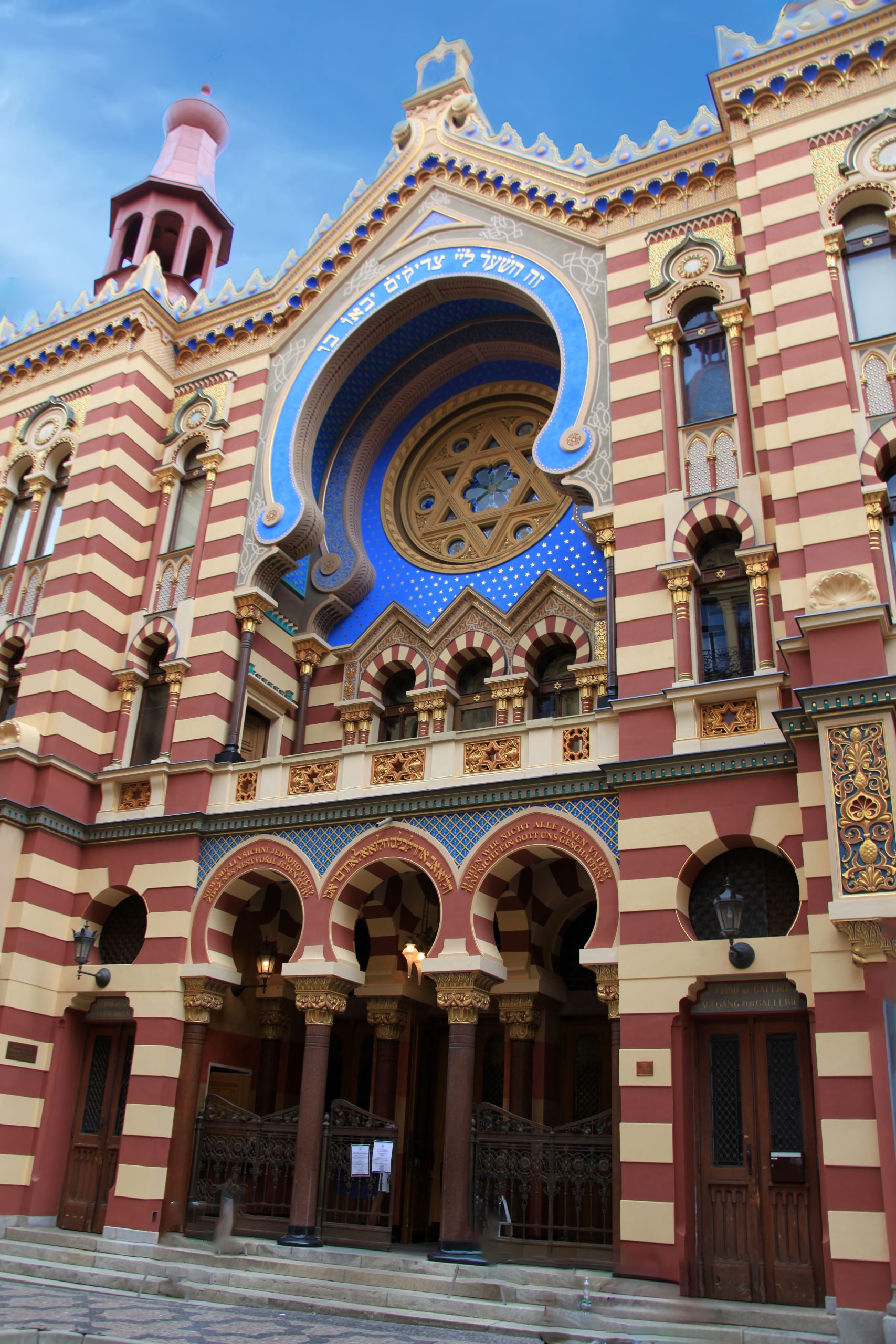
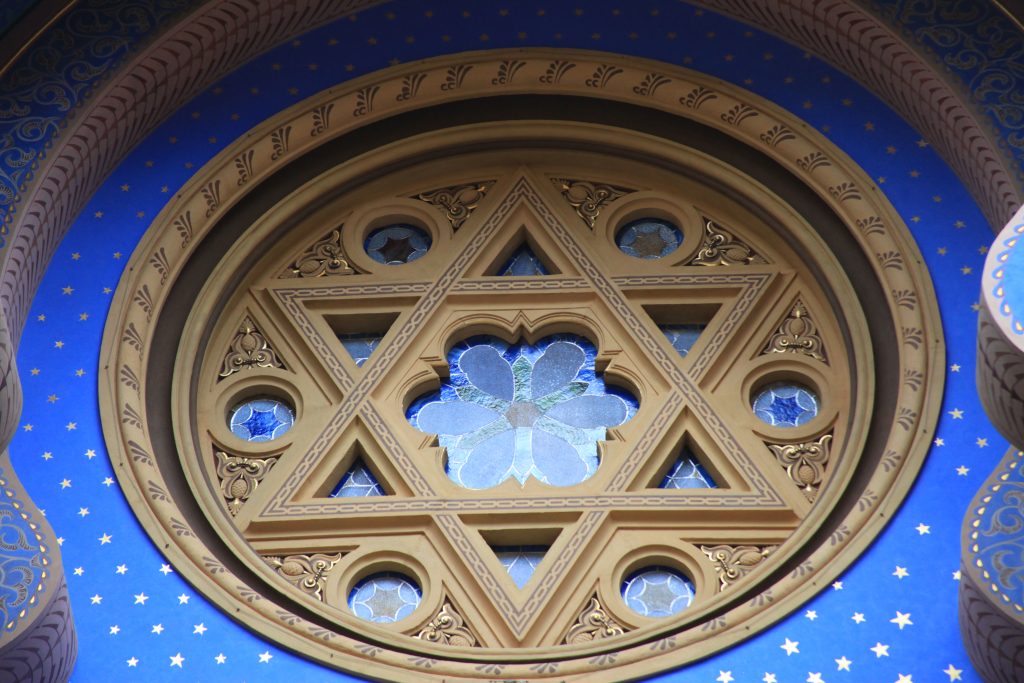
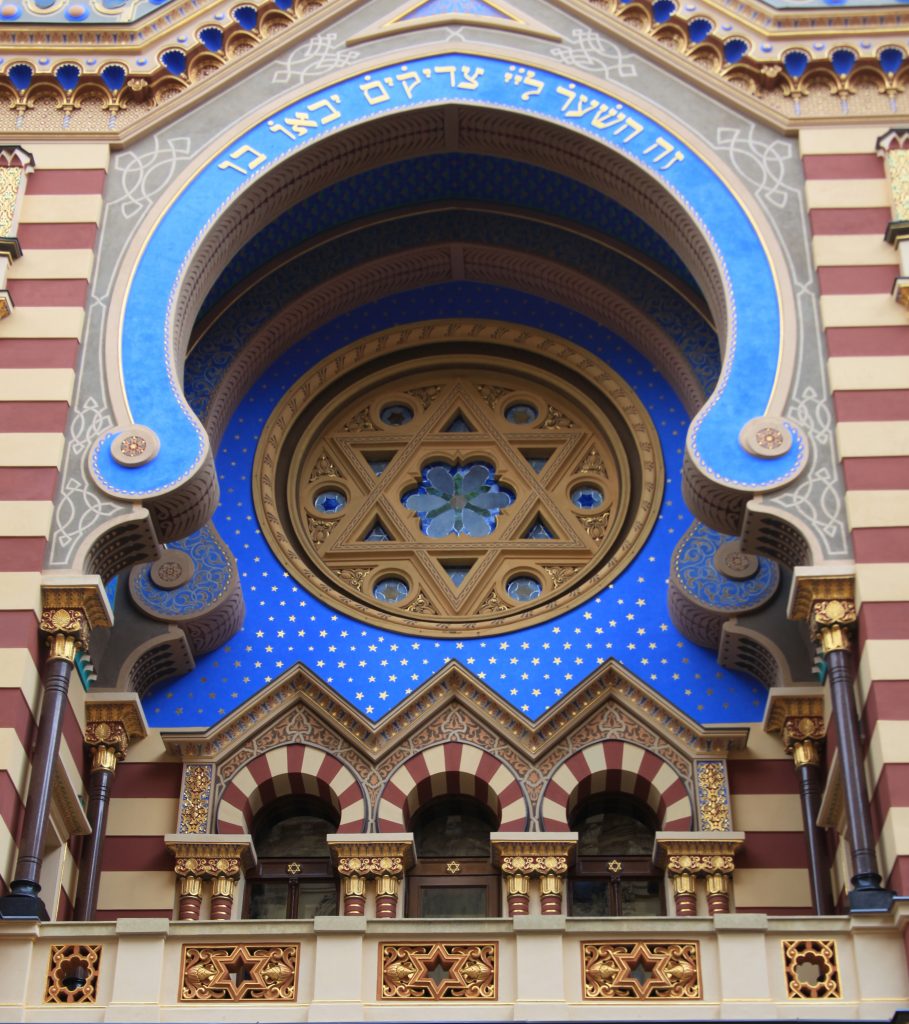
Approaching the synagogue along Jerusalem Street feels like discovering an exotic jewel box set amid beige stone and careful ornament. The horseshoe-shaped arches, bright red and cream horizontal stripes, and elaborate polychrome tiles create an inviting yet dignified façade. A grand rose window, star-laced and luminous, gazes down upon the street like a blessing in glass.
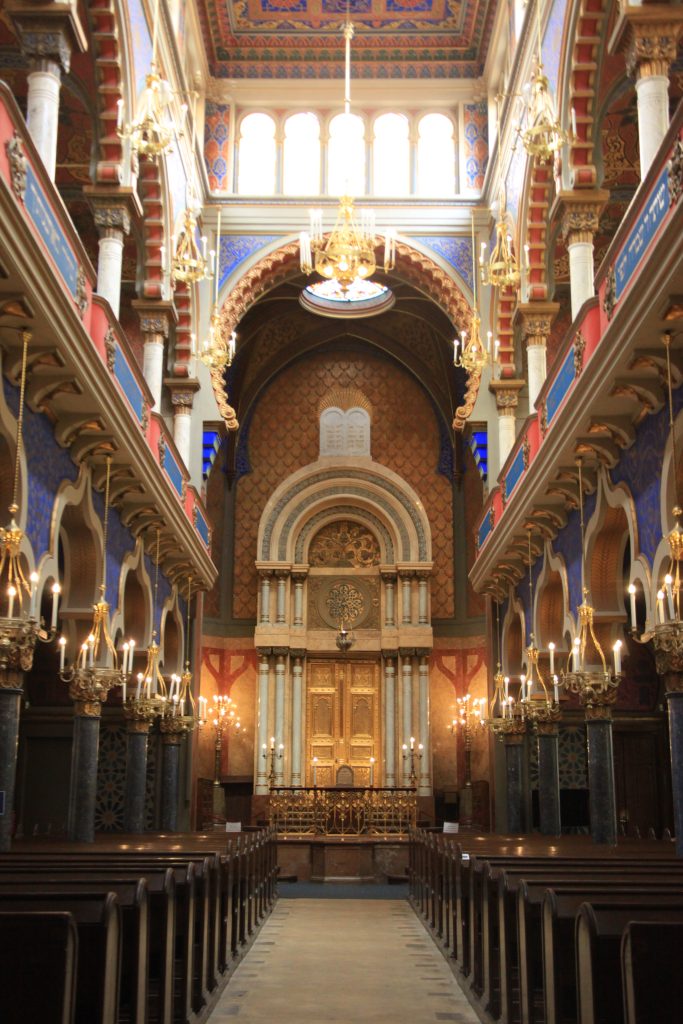
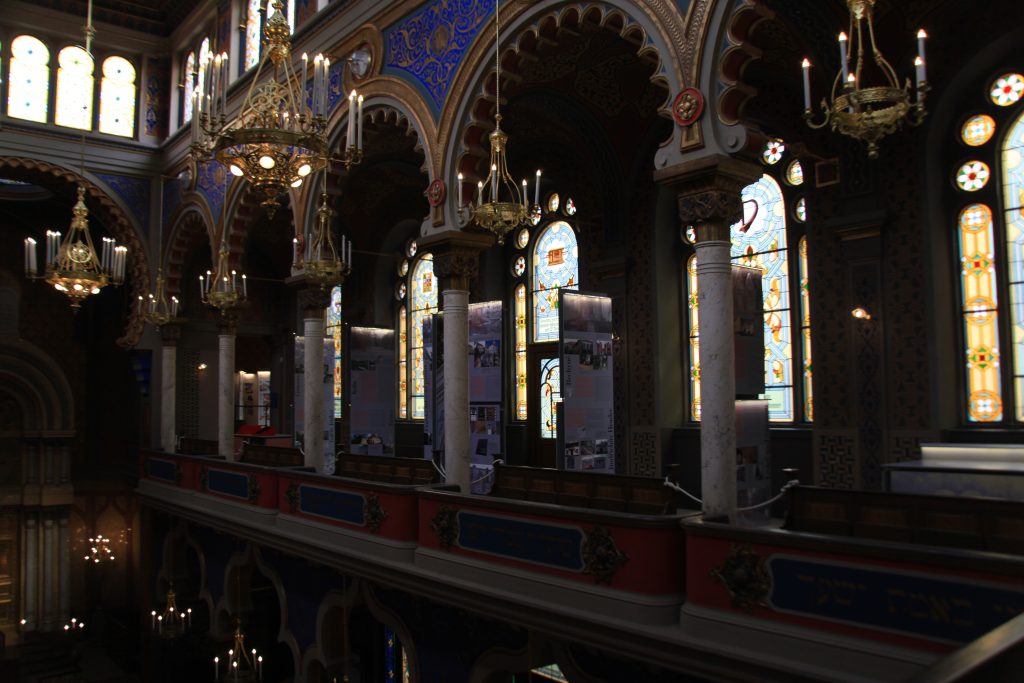
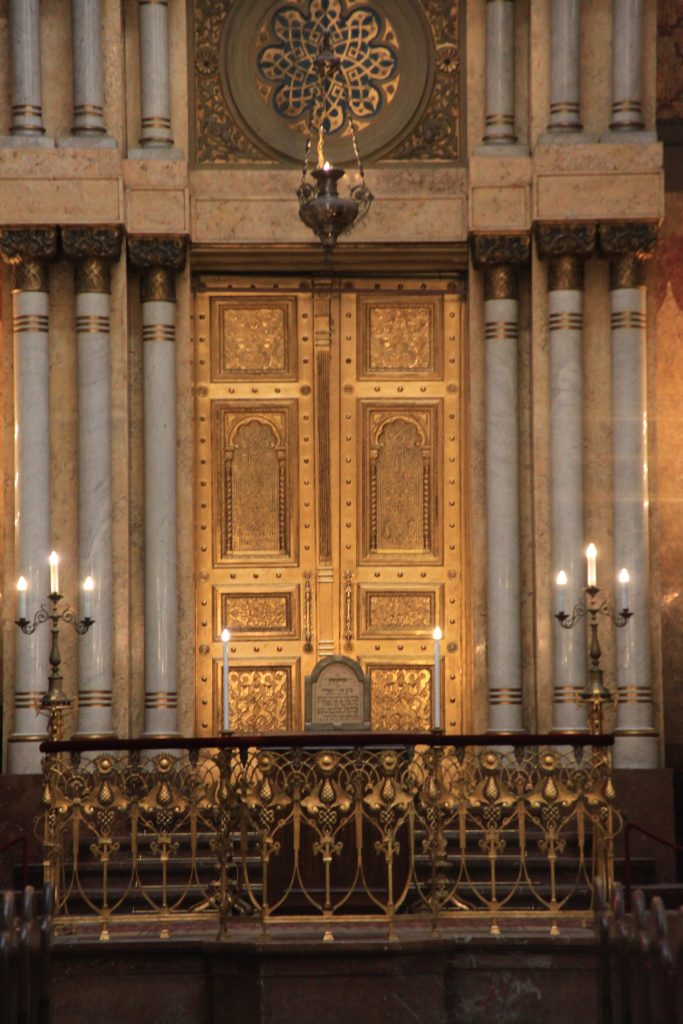
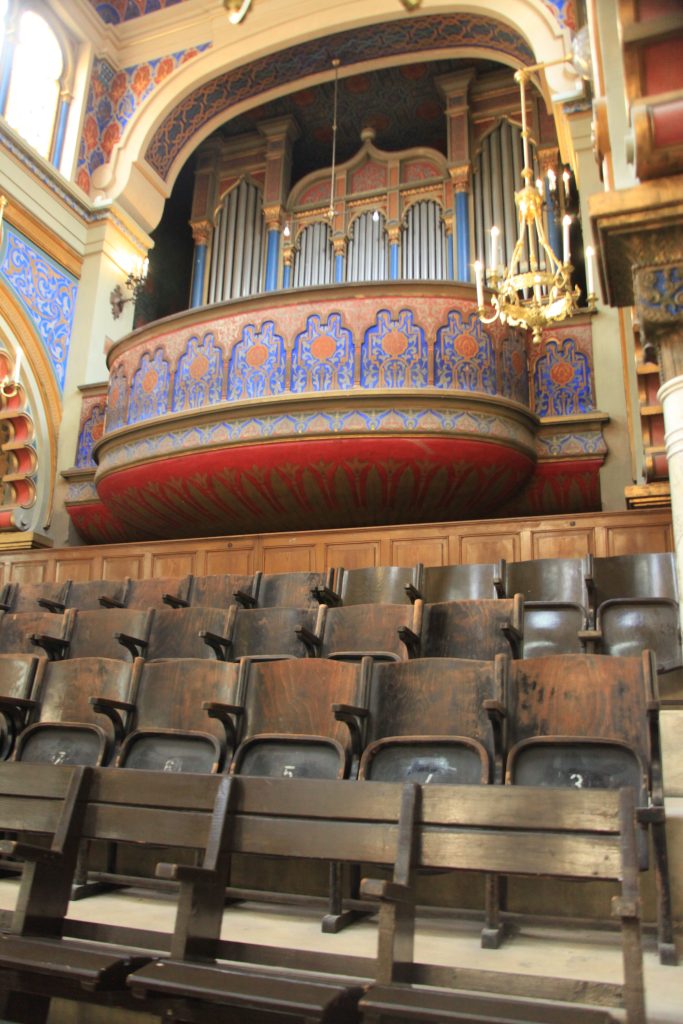
Inside, the sanctuary unfolds in a riot of color rarely found in religious spaces. The soaring vaulted ceilings display deep blues, golds, and rich greens adorned with swirling floral and geometric motifs. Delicate Moorish tracery adorns the balconies and windows, while ornate columns support the galleries with graceful confidence.
One feels almost palpably the joy embedded in every painted surface, every curling vine. It was meant to uplift the spirit, to offer a place where beauty, faith, and community converged against centuries of hardship.
A Silent Witness to Survival
When the Nazis occupied Prague during World War II, they gutted and desecrated the Jewish Quarter. Miraculously, the Jubilee Synagogue survived not because of kindness, but because the occupiers found it useful. The synagogue served as storage for confiscated Jewish property, a dark irony that ultimately preserved its physical structure.
After the war, the building returned to religious use but fell into neglect during decades of communist rule in Prague. Only in the early 1990s, after the Velvet Revolution and Prague’s restoration of its Jewish heritage, did serious work begin. Today, the synagogue stands proudly restored, its colors renewed and its artistry lovingly protected.
The Jubilee Synagogue Today
The Jubilee Synagogue serves as an active house of worship for Prague’s Jewish community and as a cultural venue welcoming visitors from around the world. Services are still held here, especially during High Holy Days, but concerts, exhibitions, and tours also fill its magnificent halls.
To step inside today is to touch Prague’s Jewish history and a universal story of endurance, faith, and artistic triumph over adversity.
Visitors are welcome to admire the synagogue’s interior, learn about its history, and perhaps catch an ethereal performance under its star-speckled ceiling if they have a discerning ear.
Where to Stay in Prague, Czech Republic
For the Jubilee Synagogue area, you’re in the Jewish Quarter (Josefov), a compact and walkable neighborhood on the Old Town side of the Vltava River. Hotels here tend toward upscale and boutique options; the Quarter draws visitors for its history and cultural sites, so lodging caters accordingly. You’ll find solid four-star properties and smaller heritage hotels within walking distance of the synagogue, though prices reflect both the location and the crowds. Staying here puts you steps from the synagogue, Old Jewish Cemetery, and the Jewish Museum’s other locations.
If the Jewish Quarter feels too touristy or expensive, the adjacent Old Town Square offers more variety. Hotels and guesthouses line the narrow streets radiating from the square, ranging from budget hostels to mid-range family-run properties to higher-end establishments. This puts you a five to ten minute walk from the Jubilee Synagogue while keeping you in Prague’s historic core where most visitors want to be anyway. The trade-off is noise and foot traffic, especially near the square.
For a quieter base with good transit access, consider Mala Strana (the Lesser Town) just across the Charles Bridge, or Prague 2 neighborhoods like Vinohrady slightly farther out. These areas offer hotels, pensions, and apartment rentals at more moderate prices than the Old Town center. Trams and metro connections reach the Jewish Quarter in ten to fifteen minutes, placing you in genuine residential areas where locals actually live and eat. This approach works well if you want to feel less like a theme park visitor and more like a city explorer.
Most travelers book accommodations several weeks ahead, especially during warmer months. Prague’s tourist infrastructure is mature and reliable, so any major-site-listed hotel will competently meet basic expectations. The real choice is proximity, price, or atmosphere: stay in the historical center near everything, or trade a short commute for lower costs and more breathing room.
Recommended Reading
For those seeking to deepen their appreciation of Prague’s Jewish heritage and the beauty of this rare architectural treasure, here are selections to savor:
- Prague: The Mystical City by Angelo Maria Ripellino
A luminous, labyrinthine exploration of Prague’s haunting beauty and layered spiritual history, including reflections on its Jewish soul. - The Synagogues of Europe: Architecture, History, Meaning by Carol Herselle Krinsky
A definitive and gorgeously illustrated work on the evolution of synagogue architecture across Europe, with a chapter dedicated to Prague’s dazzling Jubilee Synagogue. - Prague: A Cultural and Literary History by Richard D. E. Burton
Part history, part literary meditation, this book captures the atmospheric magic of Prague’s neighborhoods and sacred spaces, illuminating the spirit that nurtured houses of worship like the Jubilee Synagogue. - Insight Guide: Prague – Has a weather-proof fold out map of the country with top attractions listed. Ideal for taking on holiday. This Prague Flexi Map is drawn to a scale of 1:12500 and shows the entire city complete with a comprehensive index. This is an ideal on-the-move companion when you’re exploring Prague It includes separate maps of Prague Environs and the Czech Republic Outlines Top Attractions and places of interest Includes useful facts for people visiting Prague Information on how to get around the country Key facts on the sights Insight Guides/Apa Publications are one of the UK’s leading overseas road and travel map publisher.
This article was featured in the Summer 2025 issue of The Historic Traveler Magazine.