
So much of the celebration of America 250 focuses on the patriots of British and European descent. But often overlooked are the contributions to the country’s freedom by those of African descent–whether they were born here in Africa, arrived from other territories; whether they were free, enslaved, or escaped from being slaves; men or women. So today, let’s shed some light on those often overlooked Black heroes of the revolution and the years following in the infancy of our nation.
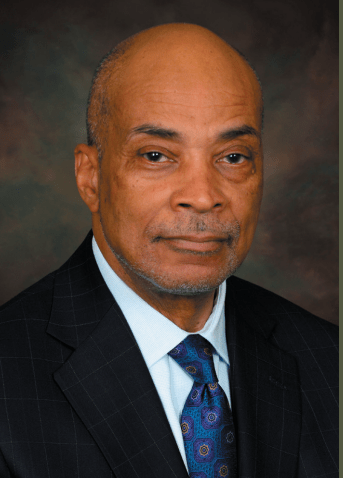
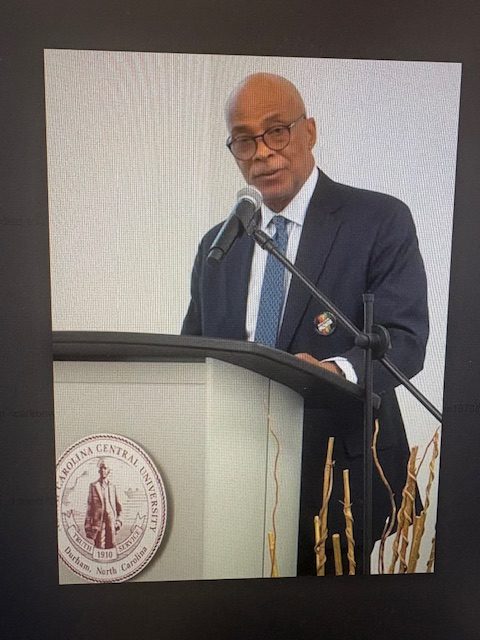
Our expert Q&A is with Dr. Carlton Wilson. Dr. Wilson is a member of the faculty at the Department of History at North Carolina Central University in Durham, North Carolina, where he is the former dean of the College of Arts, Social Sciences and Humanities and chair of the Department of History. NCCU is one of the historically black colleges and universities founded at the turn of the 20th century. Dr. Wilson has also held positions in the American Historical Association, the Southern Council on British Studies and the Durham Museum of History. He’s currently chair of the Board of Governors of the University of North Carolina Press and a member of the Executive Council of the Association for the Study of African American Life and History. Dr. Wilson received his undergraduate education at NCCU and graduate degrees in European and British history at Ohio State University and the University of North Carolina at Chapel Hill.
Jackie: Dr. Wilson, what drew you to this particular field of history?
Dr. Wilson: I’ve always been intrigued with the study of history, and starting off as a young student, many of my colleagues studied American history or African American history, but I was intrigued with European history. I had some early teachers who were Europeanists, and they introduced me to the subject matter, the complexity of it, the variety within the study of European history, in particular social history.
I became interested in working-class movements. I did my master’s degree on the workers who constructed railways in Great Britain in the 19th century. I really got involved with the issue of labor and the laboring population. When I began to consider doctoral studies, I continued that interest, noticing the significance of African seamen in Great Britain. I had a colleague who was studying that subject, and she led the way for me in taking a closer look at the presence and status of African seamen in places like Liverpool and in London. My work focused on the creation of a black presence in Britain during the interwar years, the 1920s and 30s, specifically in the port city of Liverpool. So, it’s European social history, but it also incorporates the African diaspora, the dispersion of Africans and people of African descent throughout the world.
Jackie: So today, we’re going to focus on the Revolutionary War period in the United States, and I know that you can give us a great look at those people who made a difference. Maybe we may have heard of them, but we may not. Let’s start our exploration of America’s early Black patriot heroes. The one that most people are familiar with is Crispus Attucks.
Dr. Wilson: Crispus Attucks is a good beginning because in many ways he symbolizes the contradictions, the hypocrisy associated with the whole notion of liberty and freedom during the age of revolution. The colonists are beginning to agitate for their emancipation and freedom from Great Britain, yet they have a sizable Black population here in colonial America at this time that was definitely unfree. The contradictions are there. Many of the early patriots, when they began to write about inalienable rights and constitutional rights, either disputed or affirmed the inalienable rights for Black people.
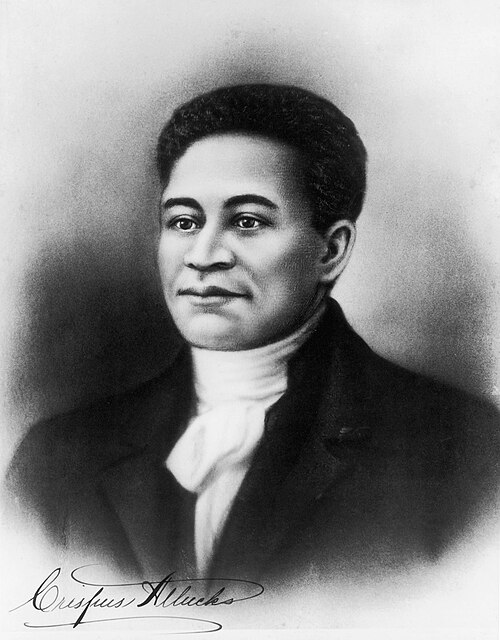
So here you have Boston in the center of much of the dissent at this time. On March 5th, 1770, Crispus Attucks was involved in the Boston Massacre. Attucks was a runaway slave. He was working as a seaman on the ports there in Boston, so he was probably aware of some of the restrictions and limitations imposed upon colonial seamen and shipping at that time by the British. Thus, on that evening, he was caught up in that ruckus that took place in Boston and was one of the five who fell.
But the conversation quickly turned to why he was there. Was he just walking down the street and got caught up in it? Was he conscious of what was going on? And interestingly, John Adams– who defended the British soldiers for their actions that night in their defense — Adams assigned a rather prominent role to Crispus Attucks. He argued in court that it was Attucks who was a leader of the rabble, one of the boys who confronted the British soldiers and forced them to fire into the crowd. Adams assigns a historically prominent role to Crispus Attucks. He was not just someone who was just caught up in it. In one of the first confrontations of this period, we have the contradiction coming clearly to the forefront of Black participation in this situation at a time when the position of other leaders of the Continental Congress and other revolutionary leaders were very unsure and inconsistent about the position of slaves and slavery at this time.
Jackie: Let’s explore some of the other men or women who played a role in the revolution that were of African descent. Can you tell us some more about the individuals that stand out?
Dr. Wilson: Yes. There were several early on, both enslaved and free, and slaves who became free, because of their participation in the conflict.
In June 1775, in one of the early battles of the war at the Battle of Bunker Hill, you had Peter Salem, who had been enslaved, who participated in the battle and in some records is given credit for eliminating a major British general. He was accompanied by Salem Poor, another individual who had been a slave, eventually purchasing his freedom and participated in that battle, along with several other battles, and received commendations for being an excellent soldier behind enemy lines.
So, Salem Poor and Peter Salem are names that are rather well known. But also, in that age there are others who are not as well known. Take for example, Barzillai Lew, who was a fifer and drummer, who led and marched soldiers into battle near Bunker Hill. Titus Cockburn enlisted into the military, served years, got out, reenlisted, and was a very capable soldier mentioned in many records, accompanied Washington at Valley Forge, where he died in December of 1777.
In this early stage, when George Washington and others were contemplating what to do with Black soldiers– whether to enlist them, whether to enlist slaves — there were individuals who were already having agency. They began to advocate and operate on their own behalf at this time.
Jackie: Wasn’t there also some Blacks who joined the British?
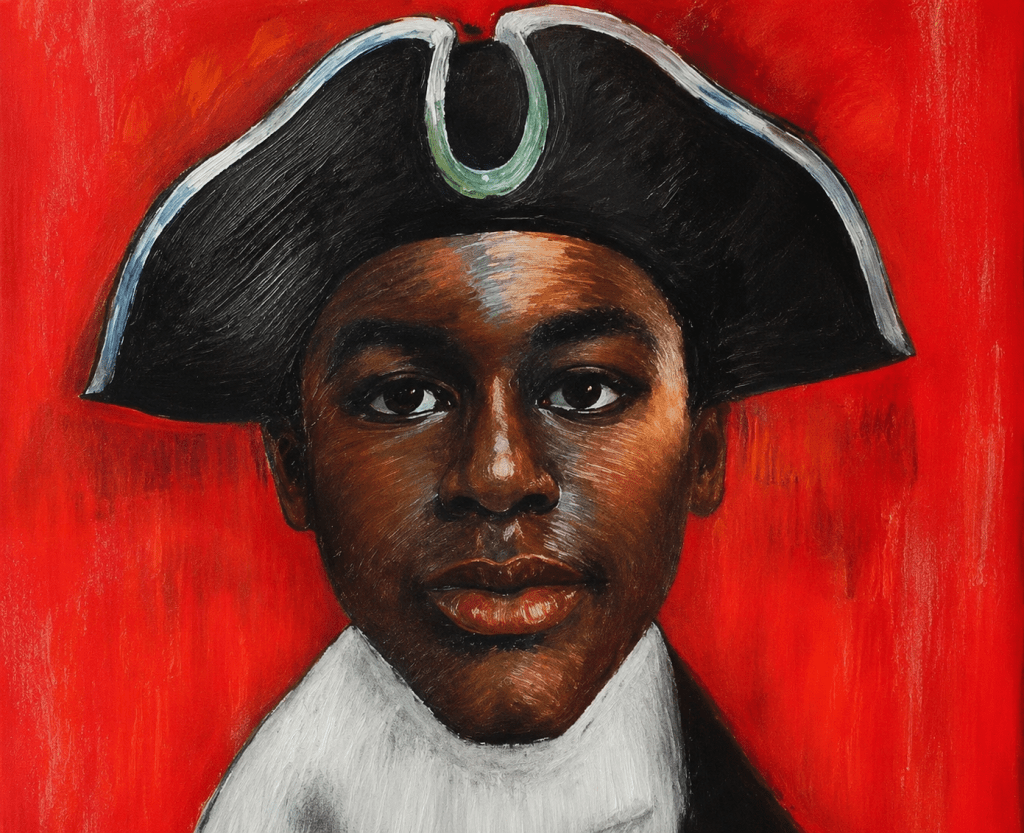
Dr. Wilson: Yes, in the early stages there was a turning point that would perhaps lead to more Blacks participating in the conflict, and this came from the British. The British governor of Virginia, Lord Dunmore, issued a proclamation to the slaves of Virginia that if they would emancipate themselves and run away from slavery, they could join with him in a fight against the patriots. He referred to these individuals as Lord Dunmore’s Ethiopian Regiment. A continency of Blacks took him up on that and began to flee slavery in the search for freedom behind British lines. This action on behalf of the British, prompted the patriots to be more aggressive in recruiting and enlisting Blacks into the military. At the end of the day, there were about 5,000 total Black individuals who participated on behalf of the Continental Army during the Revolutionary period, and many distinguished themselves.
Jackie: Who were some of them?
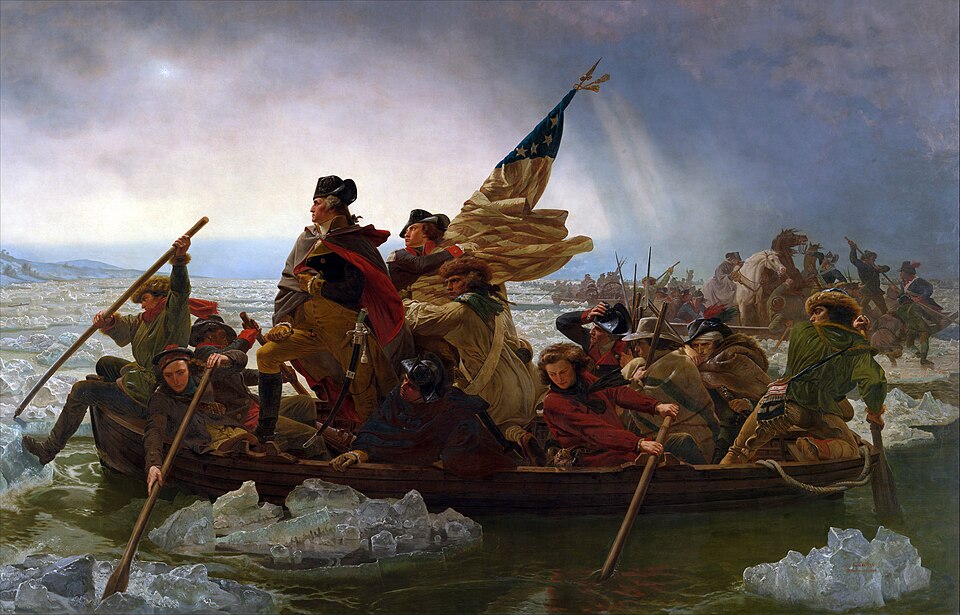
Dr. Wilson: We hear about individuals like Prince Whipple, who actually came from Africa to be educated here in America. Unfortunately, he was sold into slavery, and ultimately, he became part of the Continental cause. It was Prince Whipple who accompanied George Washington on that Christmas night in 1776, when Washington crossed the Delaware. In many depictions of that historical moment, if you look very closely at the artist’s renditions, you can see a Black person in the corner of that small boat making its way across the river.
Another figure, Oliver Cromwell, who had been given a very distinctive name in English history, was from New Jersey. He was a free Black, spent six years in the Continental Army, was discharged after the surrender at Yorktown, and received commendations for his participation in the Continental cause.
At this time, there was also an undercurrent of activity going on in Haiti. Haiti was a major colony of the French, and there were Haitians who actually aided the Continental cause. One of those Haitians, Henri Christophe, participated in the Siege of Savannah. Later, Christophe became a crucial lieutenant to Toussaint Louverture in fighting the French for independence, before governing northern Haiti from 1807 to 1820, Christophe played a role as a major military leader bringing about independence for Haiti, the first independent Black nation in the Western Hemisphere.
Jackie: There were some who also distinguished themselves as spies, yes?
Dr. Wilson: There were individuals who served as spies, because we should understand that Blacks, who were enslaved, were accustomed to the land and the waterways. They had worked for both the colonials and the British, so they were in position to provide valuable information about the movement of British troops or, occasionally, vice versa. There were even some double agents, as well, because of their situation.
There’s one spy by the name of Quaco Honeyman, who some records note may have been the first spy for the revolutionary cause. He operated in and around Rhode Island, providing valuable information for the patriots, information that eventually led to the capture of a major British general, General Richard Prescott.
James Armistead Lafayette, named after the French General Lafayette, was a slave who became notorious as a double agent. He served under General Lafayette and was particularly effective in Virginia around Yorktown in the outcomes of several battles. He also served under Benedict Arnold and participated on both sides as a spy.

Due to their position as slaves these folks were privy to logistics, they understood the lay of the land, they had access to certain positions and to certain company of soldiers. They listened and reported.
There was a woman who serves as a good example of that. Her name was Mammy Kate. She was enslaved in Georgia and received credit for participating in the rescue of a patriot in Georgia who held a very important position. He had been captured by the British. Because she was a laundress, she had access to the British quarters. The records note that she smuggled him out in a laundry basket and brought him to freedom.
Deborah Squash is an interesting woman, a loyalist. She was a slave born around 1763, and in fact, was one of George Washington’s slaves. She escaped from slavery after Lord Dunmore issued his proclamation, then went to New York, and operated alongside the British. She was one of several former slaves who evacuated with the British, and who eventually ended up in Nova Scotia as a free person.


Jackie: What motivated these people to step up?
Dr. Wilson: There is always a question about what the reward would be. If they formally enlisted, would they gain their freedom later on? Would they gain a pension later on? Some did, but the majority did not, because as all of us know, there was a conservative reaction that came into play after the war, during the Constitutional Convention with the adoption of the United States Constitution. The three-fifths compromise was a conservative reaction. The slave trade continued for 20 years. There was a strict fugitive slave law introduced post war. These were not the types of rewards that those who had an expansive view of liberty were hoping for at that time.
In 1790, entering into the period of the early republic, the 1790 census showed that there was a Black population of about 750,000 here in early America. Of that number, nearly 690,000 were enslaved. Only about 60,000 were free. You’re coming into a very critical period. How would this new republic view the Black population?
Cotton cultivation was not decreasing. It was increasing when the colonies began to move further west. The Louisiana Purchase opened up additional territory for the cultivation of cotton. Slavery is becoming even more dominant. I always talk to my students about Eli Whitney’s cotton gin. I say Eli Whitney’s cotton gin did not make it easier–it made it more difficult for slaves in the American South, because now planters could plant more cotton, so they needed more slaves. The development of the cotton kingdom really added to the difficulties of the early republic period.
Jackie: How did the Black leadership begin to exert itself toward greater freedom in these earliest republic years?
Dr. Wilson: So, if we look at Blacks during that period, we are looking at those who are trying to seek what we can call spiritual and intellectual independence. Individuals like Jupiter Hammon are a prime example. Jupiter Hammon had been a slave in Long Island. He was influenced by the teachings and writings of Charles Wesley, leader of the Methodist movement and composer of 6500 hymns. Hammon began to write poetry. Today, some may refer to him as the founder of African American literature, with his first poems published in 1761. He becomes an example of individuals looking at spiritual and intellectual independence. Hammon was the first African American published poet in North America. His poems became extremely well known.
We also know of Phillis Wheatley, one of the most accomplished Blacks during the colonial and early national period, born in Africa in 1753, brought to America. Wheatley was given an opportunity to cultivate and develop her mind. She was an avid reader of the Bible and began writing poetry. Her book, published in London in 1773, a few years after Hammon, brought her into prominence. Phillis Wheatley was not an aggressive outward advocate against slavery, yet her writings reflected this type of personal freedom and independence that was so important at this time. She was well known and communicated with George Washington and others, who praised her work.
Benjamin Banneker was another critical personality, an extremely accomplished individual during the early national period. He was born in 1731 in Maryland, received a private school education, became extremely interested in mathematics, science, astronomy, and engineering. He had a benefactor who cultivated his abilities in the sciences and engineering, and he became a writer of a very popular almanac. Through that, he could spread his ideas and became an accomplished mathematician. Benjamin Banneker was invited to serve on the team that helped to design the city of Washington, D.C. When you drive around Washington, D.C. today, you can think about Benjamin Banneker and the way he helped map the grids of the city.


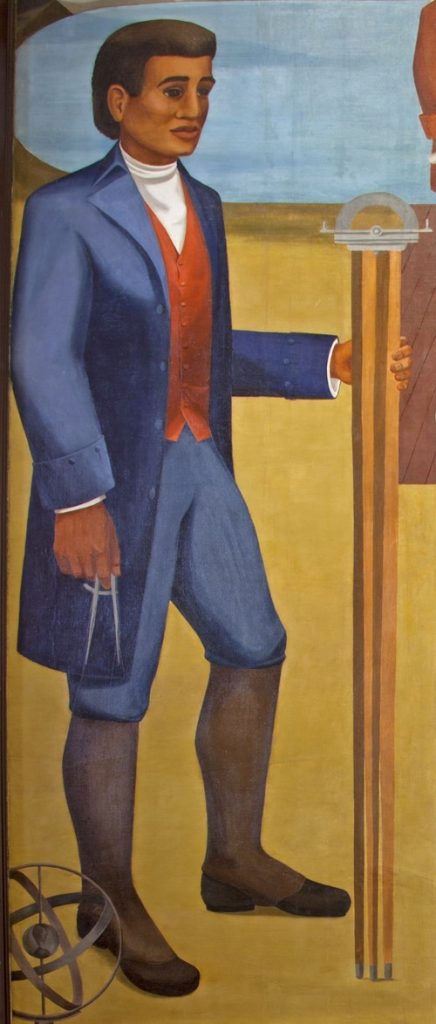
Banneker also communicated with major personalities of his age. His letters to Thomas Jefferson are interesting because he questioned and challenged Jefferson about the abilities of Blacks, and whether individuals like Jefferson could, in this age of liberty and nation-building, continue to withhold liberty from those who were of equal abilities. Banneker put those arguments out there to show the hypocrisy and contradictions that they were part of.
Paul Cuffee was one of the most noted Black businessmen of the early national period and a perfect example of economic uplift. He was interested in entrepreneurship and commerce. Originally a seaman, he got into shipbuilding. He began to build his own ships and made a lot of money as a ship owner. During the Revolutionary War, Cuffe delivered goods to Nantucket by slipping through a British blockade on a small sailboat.
Interestingly, he opposed paying taxes because he argued the same principle that the patriots had argued—no taxation without representation. He argued that if Black people were not allowed to vote or be represented, then why should they pay taxes?
He became a Quaker because Quakers were anti-slavery. Cuffee also became part of the colonization effort. He believed that free Blacks could return to Africa. In 1815, on his own ship, he transported about three dozen Blacks back to Africa. But as a businessman, he quickly learned that this was a very expensive enterprise that would need further support. Cuffee is important because he was a seaman, a shipbuilder, and part of the broader story of Black maritime life. The sea became a symbol of emancipation, a way to learn what was happening in the world and provided a sense of freedom.
So, if you look at Hammon, Banneker, Wheatley, and Cuffee, you can see how they viewed the Black presence during the late colonial and early national period, and how freedom had to be constantly redefined. Independence for the patriots was one type of freedom. Ending slavery was another.

Jackie: Let’s talk about the emerging spiritual movement in greater depth.
Dr. Wilson: One of the areas where it continued very aggressively and importantly is in the development of Black independent churches. This became very important from a spiritual direction–from a sense of identity–but also for leadership, because the Black church became an institution where Blacks could cultivate leadership.
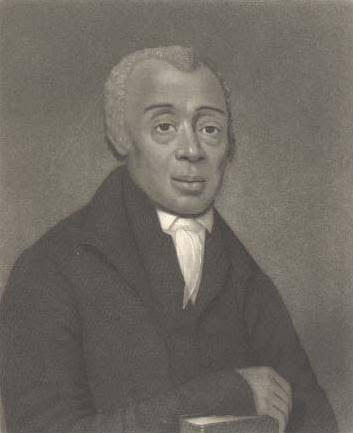
Richard Allen was a leading figure in the development of the African Methodist Episcopal (AME) Church, which he established in 1787. He was a Methodist, like many Blacks at that time, but Allen and his followers began to question how they could attain salvation in a church that was segregated. On one occasion, when Allen and his colleagues were kneeling and praying in front of the altar, someone pulled them up and pushed them to the back of the congregation. From that moment on, Allen believed there had to be a separate church. He developed the Mother Bethel AME Church in Philadelphia, which became the first of its kind. The Black Methodist movement grew and became a very important institution. It represented self-help, leadership, spiritual independence, and uplift. Around 1820, there were about 4,000 Black Methodists in Philadelphia and 2,000 in Baltimore.
In the fraternal area, Prince Hall and the Masons also began to exert leadership. Prince Hall, who came from Barbados, helped establish the Prince Hall Masons in 1775, which became an important institution in the Black experience in the United States and beyond.
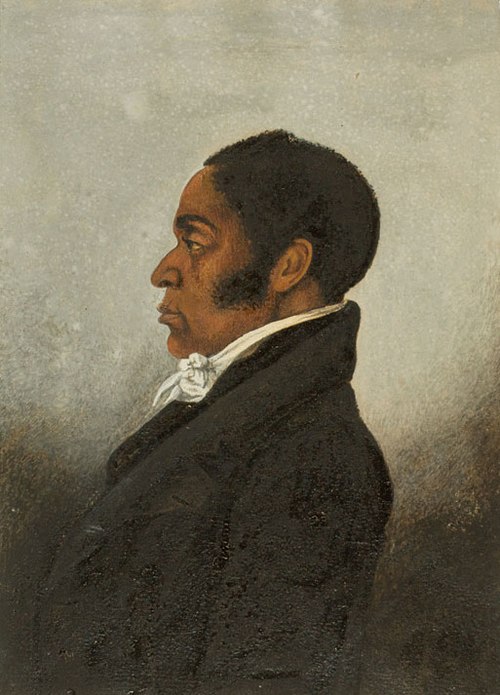
When the War of 1812 came, there were Blacks in a position to aid the American cause again. Individuals like Richard Allen and James Forten, who made money creating sails for ships, helped defend Philadelphia when there were fears of a British attack.
Jackie: Your closing thoughts on this period?
In the first draft of the Declaration of Independence, Jefferson included a clause blaming King George for slavery, but it was removed because his colleagues did not want slavery to become an issue in the fight for independence. Thus, the position of Blacks is a very interesting one. Some took freedom into their own hands, some had their own interpretation of it, and some participated with the hope of emancipation. Some achieved it, many did not, but they still made their mark on history by their actions.
