

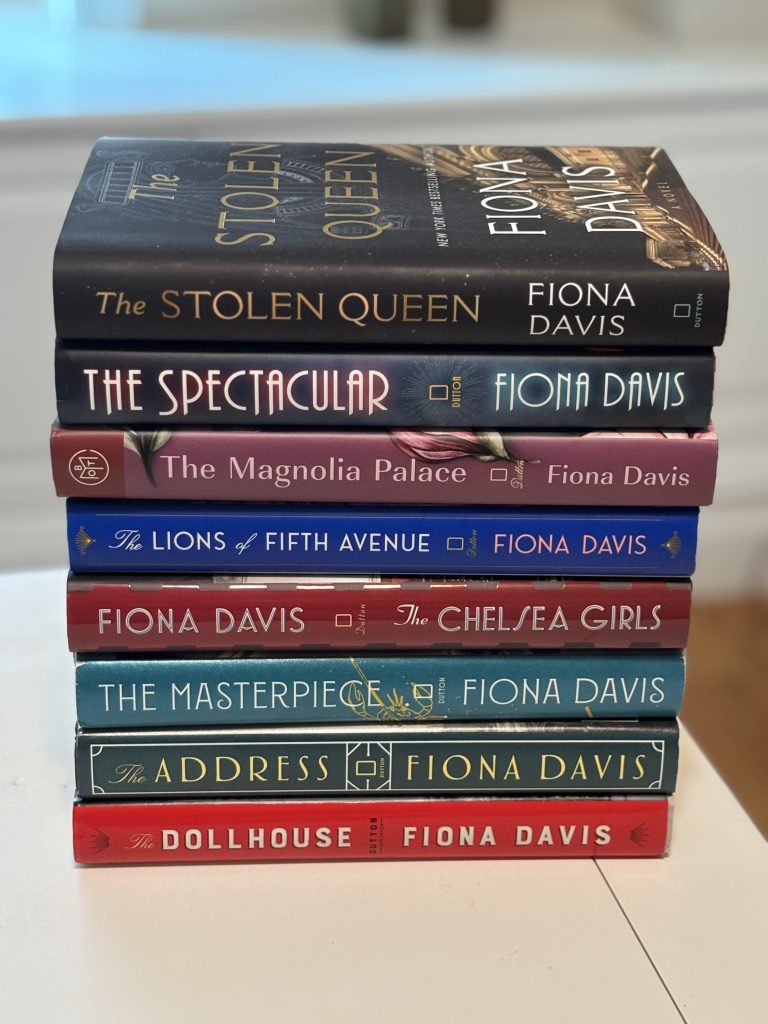
In New York City, there are innumerable historic masterpiece buildings. Internationally bestselling sensation Fiona Davis has made eight of them the cornerstones of her incredibly immersive dual-timeline novels that portray the struggles, triumphs and destinies of women in two eras, tangentially connected through the buildings where the stories take place.
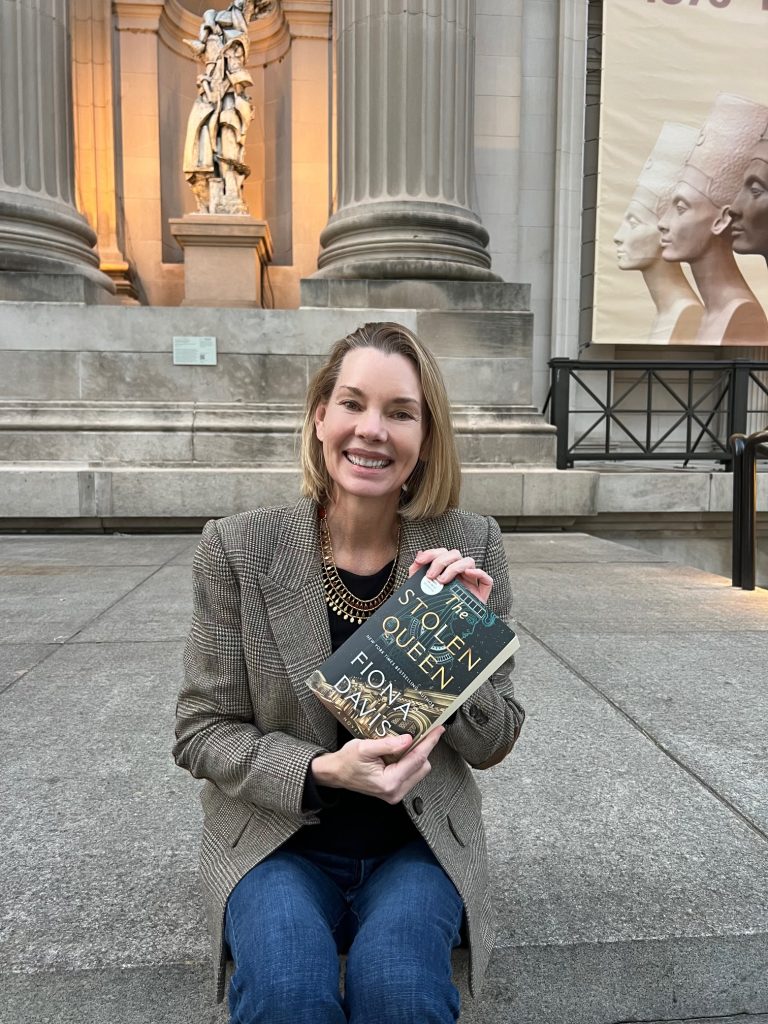
This unique focus on NYCs historic landmarks has provided a tremendous momentum to her career and made her individual books stand out in the vast field of historic novels. Having a GMA Book Selection and NY Times bestseller status have demonstrated the huge appeal of her books. Her books, like the buildings, can be considered modern day masterpieces. In fact, she has one book called The Masterpiece. Fiona is probably best known for The Lions of Fifth Avenue, which takes place in New York Public Library, and her newest book The Stolen Queen, set at the New York Metropolitan Museum and 1930s Egypt.
Jackie: Your life has been a series of transformations—much like your heroines. You moved around as a child, became an actress after college, then a graduate student in journalism, and finally an author. Give us a quick journey through those changes—and I love that a Myers-Briggs test played a life-defining role.
Fiona: Yes! I always say it’s a good idea to change careers every ten years—you might end up with something you truly love. I was born to English parents, so we traveled to England often, and lived all over the U.S.—Utah, New Jersey, Texas. Growing up, I never quite knew where I was or even what accent to use. That kind of constant relocation makes you alert to what’s different in a room—the mood– which helps as both an actress and an author.
I went to William & Mary for college, which was great fun down in Virginia, then moved to New York to work as an actress for about ten years—Broadway, Off-Broadway, regional theater, commercials, you name it– whatever I could get.
Jackie: What was the biggest production you were in?
Fiona: Probably the most surprising one to make it to Broadway: Wilder, Wilder, Wilder, by Thornton Wilder. We started Off-Broadway with the small theater company I worked for, Willow Cabin. We all did everything—hung lights, sold tickets—and then we went to Broadway and were nominated for a Tony, which was really, really exciting. That was a high point.
Jackie: And then?
Fiona: In my late twenties, I realized things change as you get older as an actress. As a woman, the industry’s focus is on youth—especially that was true in the ’90s. It meant I didn’t want to keep doing this forever. I craved stability and hated not knowing where I’d be next week. Though I love the people I’m working with, it’s just not all that fulfilling. I’m more of a homebody, so that didn’t really suit my nature. So I went down to NYU, where they have this career services center. There I took a Myers-Briggs test. The next day, they told me I should be either a journalist or a cop. Easy choice! I applied to Columbia Journalism School, was accepted to the master’s program, spending an intense, but wonderful year learning to write and report. It was very challenging. I’d never written before. I didn’t know how to write a lead for an article.
After graduating, I worked briefly in TV, then for a theater magazine, and freelanced in health, culture, and the arts. And then I got the idea for my first book about the Barbizon Hotel for women, which had been a very storied hotel here in New York City and later became a luxury condo. I first thought it would be a good article, but the women who lived there were very private at that time and wouldn’t grant interviews, but I just couldn’t shake it. And I started thinking maybe I could write a book — because then you can make things up and then it’s so much easier. It’s not! Writing a book is so hard. And then on top of that, I decided that I love dual timelines where you go back and forth between periods. I thought–I’ll do that because that’ll be really fun! And again, I had no idea how hard it is to make a dual timeline work so that one timeline is just as interesting as the other. There’s an element of mystery. You want to keep people turning the pages. It’s really hard, but I just didn’t know what I didn’t know. I wrote that book and that eventually became The Dollhouse.
Jackie: So tell us a little bit more about how the story emerged for you.
Fiona: When the Barbizon became condos in 2005, a dozen women in their eighties and nineties—residents since the ’40s and ’50s—still lived there. They’d seen the building evolve from a women’s hotel to co-ed to luxury condos. They’d been there when Joan Didion was there and so many other famous women…Joan Crawford, I think was one of them, just incredible people. These older residents watched it change over time. And when the condos were completed, the management moved the remaining women into studio apartments on the fourth floor with kitchenettes. They paid something like $100+ month. And meanwhile, someone else was living in the $17 million penthouse! I just thought, what’s it like when those two people meet in the elevator? What an interesting mix — showing how the city, the building, and the residents have changed over time. I thought that would be a good story to tell.
Jackie: After that, you knew something clicked there, and then subsequently you wrote The Address (set at The Dakota), The Masterpiece (Grand Central Terminal), The Chelsea Girls (Chelsea Hotel), The Lions of Fifth Avenue (New York Public Library), The Magnolia Palace (Frick Collection), The Spectacular (Radio City Music Hall), and your latest, The Stolen Queen (The Met). Did you consciously decide to focus on landmarks? Or did you just have a love of New York history. How did this really become “a thing” beyond your first book?
Fiona: Not at first. I just loved researching the Barbizon. Then, while that manuscript was in production, I walked past The Dakota bathed in sunlight—it seemed to say, “Choose me.” And I thought–I love that building. Wouldn’t it be great to get inside? It would be so much fun to write about that building! That’s when I realized I might be onto something. That’s where the first idea came to me of, this could be “a thing” about buildings. It was just a natural progression. Eventually, I noticed no one else was doing this kind of landmark-based historical fiction.
At first, I just want to know more. I thought the Dakota was incredible. But I didn’t know anyone who lived there, so I wasn’t sure how to research it, how to get inside. And eventually I did get inside by going on a tour of Lauren Bacall apartment, which was having an estate sale. It was beautiful. It had all of the original millwork, the fireplaces– you really felt like you stepped back in time!
I just love walking around and imagining what the building was like 20 or even 100 years ago. To me, that’s fascinating. Who are the ghosts who live there? Who are the generations of people who endured here? That’s what I’m trying to do. I’m just trying to go back in time to imagine what it was like in the 50s or the 1880s or whatever–regardless of what I’m working on.
Jackie: So tell us about discoveries you’ve made, about the buildings in your books that really spark these inspirations.
Fiona: So whenever I’m doing the research, I’m looking for the surprises. Exactly what you said. What sparks inspiration, what jumps out at me as I’m doing the research. Because I think, like a lot of New Yorkers, we feel like we know these buildings pretty well. So, you have to dig a little deeper to find something really interesting. For example, with Grand Central, I discovered that in the 1920s, the painter John Singer Sargeant co-founded an art school there called the Grand Central School of Art. It was there for 20 years with 900 students a year … and was really, really successful. No one knew about it! And then I found this article in The New York Times from the 1920s, describing art school students running across the concourse in fancy dress on the way to this masquerade ball that the school held every May. And I thought, that’s rich! That’s where that The Masterpiece idea originated.
Jackie: When you research, you’re looking for surprises?
Fiona: For The Lions of Fifth Avenue, I learned the library’s superintendent lived inside the building for thirty years with his family beginning in 1911, a seven-room apartment that was deep inside the library. His daughter was born there; the kids raised pigeons on the roof. I knew then that was the book. That’s what I’m doing with each one, finding something that really jumps out at me and that I can get emotionally revved up about.
Jackie: So how do you do this research? What kind of sources are you looking at? Where do you start? Give us a look at all that.
Fiona: The internet’s great, but it only takes you so far. I will go to libraries. I have a wonderful man named Andrew Alpern. He’s an incredible architectural historian in his 80s, and he knows every street in Manhattan. You can name any building, and he will tell you the history or have something to help me. I have a couple of big books here borrowed from him for the project I’m working on now, and they’re just so valuable because he knows what I’m looking for and where to find the information. So, the first thing I do once I pick a building is take him out to lunch and ask him questions.
But really, it’s finding people who are experts in whatever I’m looking at and reaching out to them, asking if they could do a quick interview. That’s the gold—talking face-to-face if I can, because that’s where all the good stuff arises.
Jackie: How much time do you actually have to spend in a library?
Fiona: With the New York Public Library book, it was great because I learned that if you have a book contract, you can get a desk at the Allen Room. You can have books delivered to your shelf, so there I was working on a book about the library in the library. I spent a ton of time there, which was magical.
The librarians were really helpful. At one point in an early draft, I had a dead body—it’s not there now—but I needed to know where to hide it. I reached out to a librarian and said, “I’m sure you’ve never gotten this question, but where would you hide a body in the library?” She wrote back, “Oh, right in the basement. Here’s a floor plan—right over here behind this room.” That kind of direct interaction makes the books come alive.
Jackie: Your books have two major characteristics: the dual timeline, and women fighting against the oppression of their day to be who they truly are. Why is that important to you?
Fiona: As I do my research, I often get outraged at what I read about the treatment of women—or I find someone fascinating and realize no one’s ever heard of her. Much of history was written by men, so there are a lot of men’s voices — but not women’s. Also, society moves forward, then backwards. You have the suffrage movement, then setbacks, McCarthy hearings, then progress, then setbacks again.
Jackie: Which is how you end up with a dual timeline.
Fiona: Exactly. It’s fascinating to compare and contrast. That’s the heart of the book—looking back and thinking, “Look how far we’ve come, but we still have far to go.” There’s always something linking the two stories. I want women who are dynamic, who have agency, who face problems and try to fix them. Even if not every story ends happily—because that’s life—there’s still strength and resilience.
Jackie: And that’s one of the interesting things to me—there’s not always a happy ending.
Fiona: Yes. I want to surprise readers. Even though they know the setting will be a New York landmark, I want the decades, characters, and arcs to be different, to push readers and make them think about history’s impact on women and how their contributions have been lost.
Jackie: How long does it take you to conceive and write a Fiona Davis novel? I want to learn more about your process.
Fiona: It takes about a year and a half to two years now. It used to be one year between books, but that was fast. I usually research for three to four months—reading everything I can find, watching documentaries, interviewing people, going to the location. For The Stolen Queen, I went to Egypt. I try to inhale everything about the time period and characters.
From that, I get a sense of the story and characters. I plot it carefully. I’m the daughter of engineers, so I can’t just wing a book. I figure out the characters—what they want, their weaknesses, strengths—and create the story. I use the synopsis as a jumping-off point. I usually know the twists and ending, but things change as I write.
The first draft is tough—I hate writing it—but I love editing. I go through about ten rounds of revisions, showing it to my agent, editor, and beta readers. Every book has its own challenge; you’re starting over each time.
Jackie: How do you feel when you finish one?
Fiona: By the tenth revision, I’m ready to let the copy editor take it. But because of the lag between turning in the manuscript and publication, when the book launches, I’ve usually been working on something else. It’s like meeting old friends again. Touring for The Stolen Queen after six months away from Annie and Charlotte was so much fun.
Jackie: Tell us about The Stolen Queen. This is your first with two distant locations.
Fiona: Yes! When I set a book outside New York for the first time, I didn’t just go to New Jersey—I went to Egypt. I wanted to set something at The Met, but it’s huge and overwhelming. Then I read Lynne Olson’s Empress of the Nile about a French Resistance fighter turned archaeologist. That inspired me to create a 1978 Met curator, Charlotte—sixty years old, set in her ways—teamed unwillingly with Annie, a 19-year-old Met Gala assistant. They track down a stolen artifact. It’s about female friendship, mothers and daughters. I call it “Indiana Jones meets Thelma and Louise meets The Devil Wears Prada.”
Jackie: .One of your other books really seemed to rise above in terms of exposure. The Lions of Fifth Avenue was a GMA Book Club selection. How did that feel and how did that impact you as an author?
Fiona: That had a huge impact. It was summer 2020, during COVID, so it was all on Zoom. I remember getting the call from my agent and she said, “You can’t tell a soul!” So, I didn’t even tell my mother. I was so terrified it would get out. It made a huge difference! It resonated with readers because this is something we love–the smell of old books and an old library. And the timing was great. too. It was my fifth book and I knew by then how hard it is to get attention as an author. I really, really appreciated every moment of it. It was such an enormous boost!
Jackie: Are there any of the other books that really stand out in your affections — which ones jump out? I know it’s like asking somebody “which is your favorite child?”
Fiona: You know, The Stolen Queen I really love. I think it’s a little more complex. There are a lot of different angles, The structure is different from the other books, and that was challenging, but very rewarding by the time I figured it out.
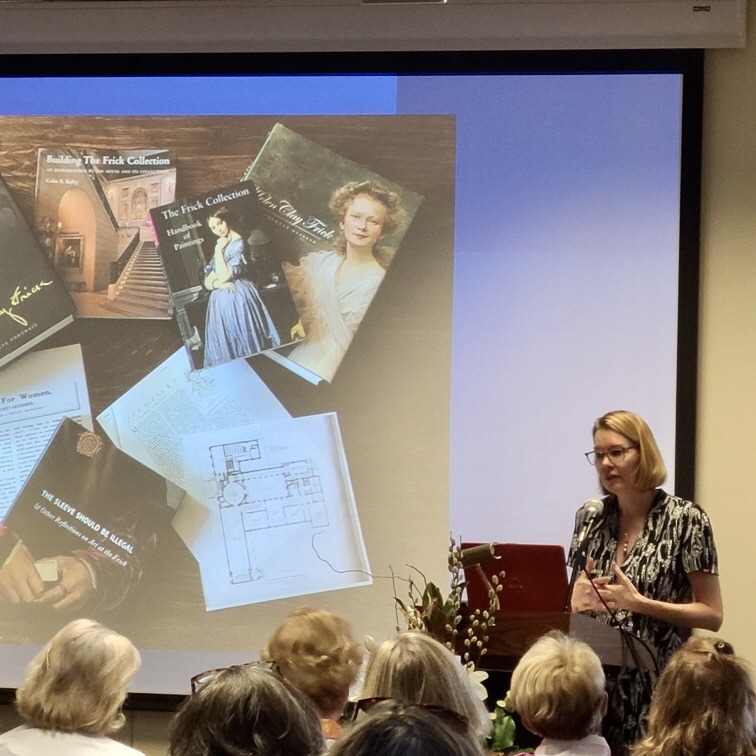
I also loved the book set at the Frick Collection, which is The Magnolia Palace. The character there, Lillian, was inspired by a real woman named Audrey Munson. She was really interesting to write, and her history was fascinating. Plus, the Frick family was just so dysfunctional! I didn’t include half the things in the book that I read about them. There was just a lot to play with on that one. And I love that the Frick has just reopened after a long renovation. So, for the first time, readers can get inside and see it, which is very exciting. All those characters had something that really sang to me.
Jackie: Apparently you can still see the image of Audrey Munson all over New York City? Is that the case?
Fiona: Yes, She was the “It Girl” of the 19-tens, the supermodel. She posed for the figure found above the door to the Frick. There she is, carved in stone. That’s where I first learned about her. There’s three of her at Columbus Circle. She rises above the fountain in front of the Plaza Hotel. And she’s even on the Brooklyn Bridge and the at New York Public Library. She posed for all of these famous sculptors. And then, there was this huge scandal where her landlord killed his wife very violently. And the police, when they were investigating, found a black and white photo of Audrey in a bathing suit from a magazine. They surmised there must have been a love triangle, even though that wasn’t true. And they hounded her, until she and her mother escaped to upstate New York. And eventually she ended up in an asylum, where she died in 1996 at the age of 104. At that time, she was buried in an unmarked grave. Yet, this is a woman who most wouldn’t know or recognize her name, but we knew all the sculptors she posed for. I thought, that’s not right. And so, the character of Lillian is inspired by her. It ended differently in the book, but I just wanted to write about a character who was a very well-known model who has to kind of go “underground.” And so she takes a job as the private secretary to Helen Frick. And mayhem happens, which is as it should.
Jackie: I’ve noticed that there seems to be a sisterhood of sorts–of leading women historic novelists, many of whom I had the privilege to meet at the Historic Novel Society of North America conference this past summer, including you. And you seem to be a member of good standing of that group. What does that sisterhood bring to you?
Fiona: Many of us started in our 40s or 50s, after other careers, so we appreciate being published. We share resources, celebrate each other’s successes. A group of us do a zoom every so often just to check in, and it’s great to be able to say, okay, I’m having a problem with this. How did you handle it? Historical fiction isn’t competitive the way some genres are—if a reader likes my book, they’ll probably like Kate Quinn’s or Allison Pataki’s, too. So, we just are eager to share resources to help each other out. If someone has a cover reveal, we’re all over it.
Jackie: Your first novel came out at 49. What would you say to a woman who thinks it’s too late?
Fiona: It’s never too late. I couldn’t have written a book in my twenties; I hadn’t lived enough. I didn’t know how to express myself or to understand what was going on around me. I was just an innocent kid in New York City trying to figure it out. But once you hit your 40s, you’ve gone through things, right? You’ve lived life and you’ve suffered losses, and you’ve also accomplished things. You have something to draw on when you’re writing characters. So, I say it’s never too late. You know everybody has a story in them. And why not try it?
Jackie: And your life now?
Fiona: I live on the Upper West Side and also have a home just north of the city. New York gives me energy and sparks creativity just seeing people on the street when you go out for milk; the country is where I can focus and write. It’s nice to get away to somewhere quiet, especially if I have to really put my head down and write. So my boyfriend and I run off to whenever we can. It’s interesting being with another writer, but someone in a different genre. His name’s Greg Wands and his last book was called Trust Issues. It’s great, because we each have a study and we meet for lunch where we often solve each other’s stuck plot points. In fact, we ended up doing an audio and ebook together called The Gimlet Slip. It’s a prohibition era New York City story about a woman who runs a criminal empire from the top of the Plaza Hotel and her getaway driver, who’s a young girl–and the detective trying to bring them down. And it was so much fun to write together! We had a blast.
Jackie: Are you at liberty to say what building might be next?
Fiona: Yes! I’m working on the Morris-Jumel Mansion, the oldest house in Manhattan. It was George Washington’s headquarters for a month during the Revolutionary War, and later home to Eliza Jumel—born the daughter of a prostitute, she became New York’s richest woman and married Aaron Burr. She’s fascinating. And it’s nice because, you know, the Met doesn’t really need me to write about them. They’re doing just fine financially. But the Morris-Jumel Mansion is a museum, and it doesn’t get the attention it deserves. I just love the idea of bringing readers uptown, because it’s full of ghosts, it’s full of history, and it deserves to be to be lauded.
Jackie: I promise I’ll be reading it and making that pilgrimage.
Fiona: Thank you!
Jackie: There’s another issue that has risen in your life. If you don’t mind talking about it. I think you’re so incredibly inspiring on all of these different fronts, but especially you were diagnosed with Parkinson’s at 53, and you’ve not let it stop you. You’ve become engaged in helping to make a difference.
Fiona: Yes. Here it was –the day Lions of Fifth Avenue hit the New York Times list — I was so excited! And the very next day I was diagnosed with Parkinson’s. But I am lucky. It’s slow-progressing, and exercise is key, so I work out daily. I’ve gotten very involved on the Michael J. Fox Foundation’s patient council. You go there and meet 40 people with Parkinson’s. We all have completely different symptoms. We’re all dealing with it in different ways, but it’s really inspiring to see, as well, all the money that the foundation raises that goes to research and development — and finding a cure. Being an advocate for people with Parkinson’s is very important to me. Many people hide their diagnosis due to fear or stigma, but I speak openly. At signings, people often tell me privately that they or their spouse have it. Connecting with them is important to me.
Jackie: And you still have many more books in you.
Fiona: I hope so!
Jackie: Are there other landmarks you’d love to write about?
Fiona: I don’t plan far ahead; I wait for the next idea to drop into my lap. After The Magnolia Palace, a former Rockette emailed, offering to share secrets of Radio City. That led to The Spectacular. Readers often suggest the Flatiron Building or Carnegie Hall—there’s a lot of great buildings out there. We’ll just have to see…

Where to Stay While Exploring Fiona Davis’s New York
For a trip centered on Fiona Davis’s New York, consider staying in Midtown Manhattan near the major museums and landmarks she wrote about. The Plaza Hotel on Fifth Avenue is iconic and has hosted countless notable guests, though budget alternatives like chain hotels around Times Square offer proximity to theaters and cultural institutions. If you prefer a quieter base, the Upper West Side near the American Museum of Natural History and Central Park has residential charm and easier access to the neighborhoods Davis explored in her novels.
The Financial District and Lower Manhattan offer a different perspective on the city’s layered history. Hotels here tend to be less expensive than Midtown and put you walking distance from historic sites like the 9/11 Memorial and the neighborhoods that shaped early twentieth-century New York. The area around the New York Public Library’s main branch on 42nd Street is well-positioned for literary history and provides good subway connections to explore various parts of the city.
For travelers interested in the residential side of Davis’s New York, the Greenwich Village and SoHo neighborhoods have boutique hotels and bed-and-breakfasts that reflect the artistic character these areas held during the periods she chronicled. These quarters are walkable, full of the narrow streets and historic brownstones that appear in her stories, and offer easier access to smaller museums and galleries than Midtown locations.
Budget-conscious visitors should consider hotels in the Murray Hill or Kips Bay neighborhoods on the East Side, or in Long Island City across the East River. These areas have reliable chain and independent hotels at lower rates than central Manhattan and maintain easy subway and walking connections to most major historic sites and institutions Davis referenced in her work.
Recommended Reading
- The Dollhouse (2016) – Set at the Barbizon Hotel for Women
- The Address (2017) – Set at The Dakota
- The Masterpiece (2018) – Set at Grand Central Terminal
- The Chelsea Girls (2019) – Set at the Chelsea Hotel
- The Lions of Fifth Avenue (2020) – Set at the New York Public Library
- The Magnolia Palace (2022) – Set at the Frick Collection
- The Spectacular (2023) – Set at Radio City Music Hall
- The Stolen Queen (2024) – Set at The Metropolitan Museum of Art and Egypt
