
We are pleased to feature this exclusive interview with Tony Riches in the new Summer edition of The Historic Traveler Magazine

Tony Riches has established himself as one of the leading historical novelists of the current day with a dozen books that focus on the leading figures surrounding the monarchs of the Tudor and Elizabethan years. These beautifully researched books offer the personal stories of people who have often been overlooked by history or by historical novels. They each made their own impact on history, now brought to light by Riches.
Tony was born in Pembrokeshire, West Wales, UK, and spent part of his childhood in Kenya. He gained a BA degree in Psychology and an MBA from Cardiff University. After careers in the Royal Air Force, the British National Health Service and Local Government, he became a full-time author of historical fiction. His Tudor Trilogy launched his status as international bestseller and Bess, Tudor Gentlewoman, the last of six books on Elizabeth I’s era, has just been released. A sought-after speaker, Tony’s blog, The Writing Desk, has more than 1.4 million visitors, and his popular podcast, Stories of the Tudors has had over 270,000 downloads.
Jackie: Tony, your series, the Tudor Trilogy, the Brandon Trilogy, and the Elizabethan series of six novels have been really incredibly successful over the last ten years. And there is a lot written on The Tudors and Elizabeth’s time by historic novelists. What really makes your books jump out from the crowd? What do you think is your “secret sauce?”
Tony: I think I hit on it early on — instead of writing from Henry VII’s point of view or Elizabeth’s — the first point of view–I explore their character from the point of view of the people around them. In the Elizabethan series, three of her favorite men, each of whom saw a very different side of her. Drake worshipped her as Gloriana, and Essex was the son she never had. Raleigh was the captain of her guard–an employee. Each of them see her differently. It was originally going to just be a trilogy. But I became intrigued by these ladies – for example, Essex blamed his sister for inciting his rebellion. So I looked into her life story and discovered she was a real character. Lady Penelope was his elder sister, and she certainly was a woman very ahead of her time. And then I thought, why not have three of Elizabeth’s ladies as well, all with a different take on her. Then you’ve got six views of Elizabeth I — which truly begins to deal with the complexity of her personality.

Jackie: You are just focusing on these individual characters who are not the sovereign, just slightly off stage.
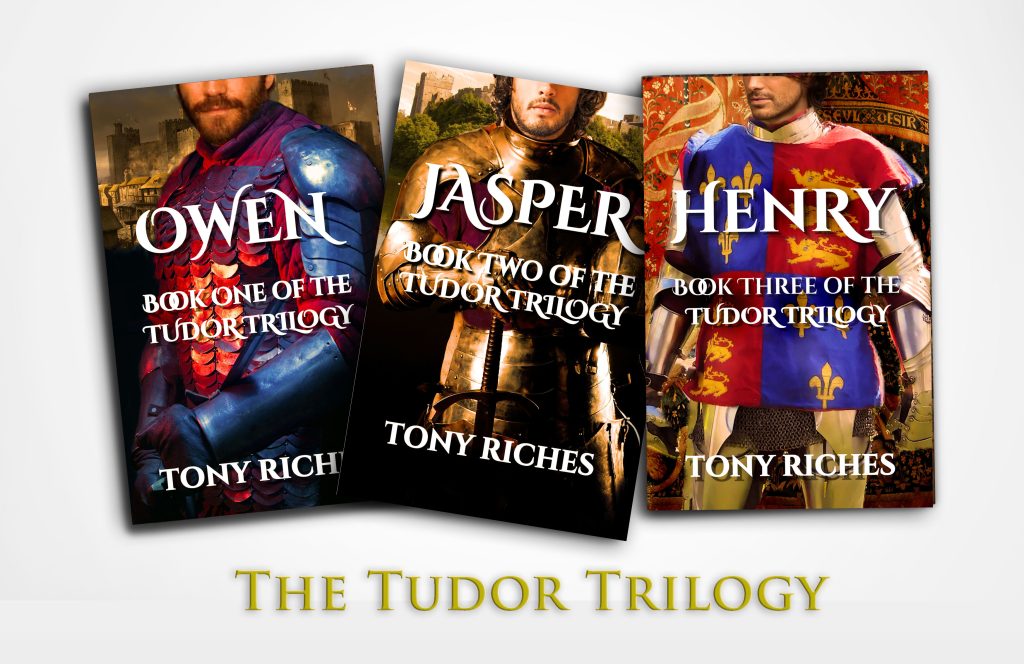
Tony: And the other thing, of course, is that I start off at the beginning of the Tudor Trilogy with Owen Tudor’s first meeting with Catherine of Valois, who is the widowed queen. And that really is the very, very start of The Tudors. It occurred to me that I could continue the story all the way through to the last days of Elizabeth, which is what I did. What readers have, if they choose to start from the beginning, is the entire story of the Tudors, always from a particular real person’s point of view. I think the clever thing about historical fiction is that it fills in the gaps. I am very faithful to history and do a lot of research. But I also like to think, how would it have felt to suddenly realize that your next-door neighbors had all just died of the plague the previous night? And how would it feel to suddenly have a knock at the door and be told, “Don’t bother packing, you are going to the Tower of London, you are not going to need much.” That was where I was coming from–how would that feel?
We—my wife and I– have visited the Tower of London. We stood in Walter Raleigh’s cell, where he spent quite a lot of time. You could go up the stairs and by complete chance, the upstairs room is where it is reputed the princes in the tower met their end. It is it is now called the Bloody Tower. But in Walter and his wife Bess’s day, it had a much nicer name. It was called the Garden Tower. That’s because Walter had a little herb garden outside. He grew his own tobacco, because he could not afford to buy it since it was shipped in from abroad. He also grew all sorts of herbs and exotic plants. To this day, if you go to the Tower of London, there is a tiny little herb garden about two meters by a meter, which is a recognition that this story is true.
Jackie: The incredible depth that you go to bring to light things that we wouldn’t ordinarily know…that is what for me makes history and historic novels fascinating. I am piggybacking on the research that you did, feeling like I was there.
Tony: Our biggest adventure is that my wife and I followed in the footsteps of the Tudors from Pembroke Castle all the way to remote forest in Brittany, where Henry Tudor was on exile. And once again, I was able to stand in his room and look out the window of this remote chateau. My wife said to me, “You’ve got cobwebs all over your back.” And I said.” At least that shows that not a lot of people make this pilgrimage!” You do get a real sense of the time and the place because the views out of the window have not changed over all those centuries since it is still a forest.
Jackie: Is there a formula for a Tony Richards historical novel?
Tony: I am afraid there is, because I hit on this idea. One of the challenges when you are writing about somebody’s entire life story is that, for example, with Walter Raleigh, he outlived the Queen. But the book ended with the death of Elizabeth and his reaction to it. Yet, I thought there was a lot more to be said about him. You have to find a start and an endpoint in somebody’s life. With Bess, the starting point was when Walter Raleigh started making advances to her in the presence of the Queen. And the endpoint is when she reaches the age of 82, which is quite a grand age for an Elizabethan lady. So, each chapter advances by one year. With most of my books, when you start a new chapter, you are in a new year. Quite often it starts with New Year’s gifts to the Queen and things like that, following a pattern as you go through the seasons. If Walters in the Tower of London, he’s peering over the wall to get a sense of what the season is. I find that annual pacing quite a useful device because there are websites on the Elizabethan Court, day by day, where you can see what happened in the court within any year of the reign of Elizabeth I. It means that I have a framework where I can pick a year and look up what happened. Where was the Queen? Where was she traveling to and from? Who was visiting her? And then I can weave all that into my narrative.
Jackie: With you, we are not going to see a lot of flashbacks! It’s going to be strictly chronological.
Tony: It’s relentless progress. And the best thing you might say is, “What about years where nothing much happens?” There must be years when there is no Spanish Armada attacking and there is no outbreak of plague. Those years are the ones I enjoy most, because they gives me a chance to think about the day-to-day life of these people.
With Bess Throckmorton (wife of Walter Raleigh), the subject of the last book in the Elizabethan series, a lot of ladies of her time were only given enough education to manage a household. She could knock up a set of accounts and knew how to recruit the right servants. But beyond that, she did not know how to read or write properly. So, I portrayed those spare years as the time to improve her reading and writing skills. It is what I believe she would have done. I’ve had her letters, and you can see the progress within my book, where it is almost phonetic when she starts off. And towards the end, she’s getting more eloquent.
Jackie: Tony, is there anything specifically that you are looking for when you decide which characters to feature, besides their proximity to Elizabeth or Henry or whomever?
Tony: What I really enjoy is the crossover of relationships with characters from previous books who I have spent the best part of two years with. A year of research and a year of writing. In the Elizabethan series, for instance, we have the Earl of Essex, then we have his sister, and then we have his wife. They all had very different relationships, but there is a lot of crossover. You see the same events from completely different perspectives, which is quite fun to do. But what you end up with is a composite view –which is richer. With a trilogy, you can do a whole lot more than you can in just a single book. Obviously, you can really show the breadth and scope of the times, and with a six-book series, you can really go to town, developing things in book one, which slowly make their way right through to the final book.
Jackie: I want to step back a little bit and talk about your experience and how you got to this point. Give us a capsule view of your history. And what inspired you to start writing historical novels?
Tony: I was born in Pembroke, which, of course, is the birthplace of Henry Tudor, pretty much within sight of the castle. I started researching Henry Tudor because I did not know very much about him. And I gathered enough material for three books! I thought I could have a trilogy, which started off with his birth. Then a second book, which was a coming-of-age novel in the traditional spirit of novels. And then the third book, where he becomes king and really does not know at first how he’s going to cope. He’s quite a successful king, but that was not assured from the start. He’s often dismissed as miserly and dull, when in fact, nothing could be further from the truth. He spent a fortune on his clothes and thought nothing of traveling around on royal progress, sparing no expense. He also spent a lot of money on his palaces.
Jackie: But let’s fill the gap from when you were born to when you began writing. You went into the service, yes?
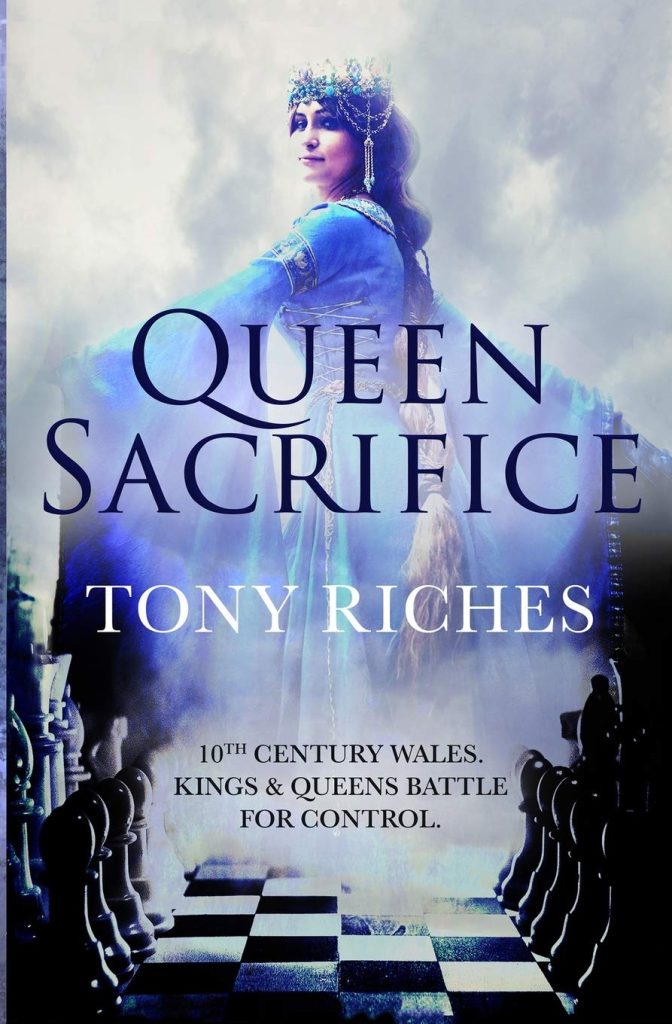
Tony: Yes, my father was in the Royal Air Force, I grew up in Nairobi, in Kenya as a child. And then when we came back to this country, my ambition was to follow my father into the Air Force, which is what I did. I had a great career in the Air Force. I really enjoyed it and achieved quite a lot, really. But then, I always felt I might be able to write a book. My first book was an intellectual challenge, taking a very famous chess game called Queen’s Sacrifice and writing a novel where I documented every move, creating characters that stood for each of the chess pieces—each had a back story. I had 16 characters to play with, and what was fun was figuring out the plot based on the game. For example, a pawn takes a bishop, and then I had to work out how would that come about. Why would he kill the bishop? I really enjoyed doing that. It was not a great success, but it was my way into writing. I learned a lot about writing with a lot of characters and trying to keep on top of all of them.
Jackie: There is another interesting book on your list that is not part of your series, and The Secret Diary of Eleanor Cobham, and it is positioned as a first-person account of uncovering a diary. Is that something you experienced, or is that something from your fertile imagination?
Tony: What happened is quite intriguing. If you don’t know the story about Eleanor Cobham, her husband was Humphrey, Duke of Gloucester. They’re real. He was getting very close in line for the monarchy. He could have been king, and his enemies were trying to find ways to bring him down. They did it by accusing his wife of witchcraft, since she had an interest in astrology. She was imprisoned as a witch—and while not burnt at the stake, she was moved from one prison to another and eventually died. Sadly. Spoiler alert. But in the course of looking at her, my wife, who is very keen on doing her family tree, discovered that she could be a descendant of Eleanor’s daughter, Antigone. So, we went to Beaumaris Castle on the island of Anglesey in north Wales. And the staff there had never even heard of Eleanor Cobham. But what we were able to find exactly where she was imprisoned and the little chapel she worshipped in. That’s where she ended her days.
We stayed in the pub across the road on a summer day, and I realized that the sounds that I could hear of seagulls and the wind in the trees, would have been exactly the same sounds that Eleanor would have heard when she was imprisoned just across the road.
I spent three years researching that one. I dug up everything I could about Eleanor Cobham. And traced her journey, from before she met Duke Humphrey right through to her last days. The fictional bit is that I turned it into a diary which was discovered under the floorboards of Beaumaris Castle. She’s quite candid in the diary, because she does not think that anybody is going to read it during her lifetime.
Jackie: What made you want to write?
Tony: I started writing articles for magazines, and they’d send me a check for £70 on something that I’d spent half an hour on. And at the time, that was a nice little bit of money, and it was nice to see my things in print. So, I started doing book reviews for journals and newspapers. I specialized in doing reviews of new books about computing. And that is what started me thinking about writing the Queen’s Sacrifice.
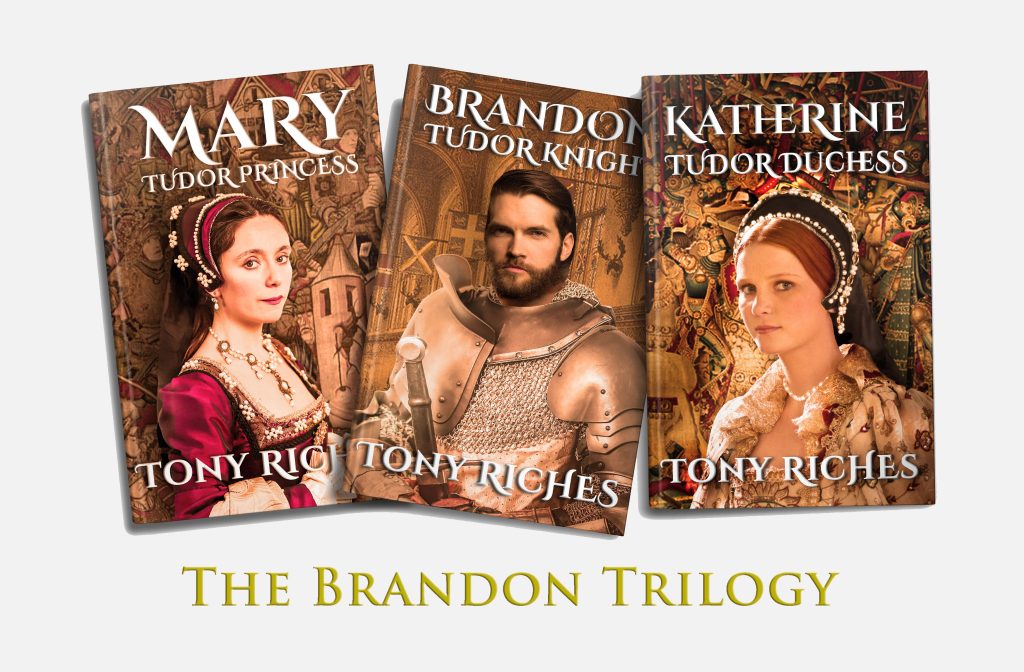
Jackie: Now, let’s discuss each of the series individually. Let’s talk first about the Brandon Trilogy, beginning with Mary, the younger sister of Henry VIII. And why did that group attract you?
Tony: In the end of the Tudor Trilogy, I decided that the person who nursed poor Henry VII did not have an easy time. It was lingering death where he might have had throat cancer or something equally painful and debilitating. His young youngest daughter Mary took it upon herself to nurse him in his last days because his surviving son–a chap called Henry –was too busy to take much interest. And with his other daughter, Margaret, gone off to Scotland, Mary stepped in, happy to help her father. I started learning quite a lot about Mary. Eventually her brother married her off to the King of France, who was getting on a bit. And I thought, I wonder what that was like? She was 18; he was considerably older and with not long to live. However, it made her the Queen of France. We visited her tomb in Suffolk, where it is proudly emblazoned on her tombstone– Mary, Queen of France. After the King of France died, she married Henry VII’s best friend, Charles Brandon.
The two men, Henry and Charles, were very much alike and to confuse the ambassadors, Charles Brandon would deliberately pretend to be the king and vice versa. Brandon was sent off to France to bring Mary back with the strict instructions not to form any relationship with her. Nevertheless, they married in secret and risked the king’s anger, and I thought that was a great story. A true story, which I could do a lot with. The way that became a trilogy is after Mary’s death, Charles Brandon promptly married his ward. The nobles used to take on a ward, to educate them in the ways of court. This ward was only 14 years old, but she happened to be a wealthy heiress. That was Catherine Willoughby, who is again a fascinating woman, the daughter of Maria de Salinas, who was Catherine of Aragon’s lady in waiting and companion. Catherine Willoughby knew every single one of Henry VII’s wives and could easily have become the seventh wife of Henry, because after Charles Brandon died, Henry was eying her as his next potential.
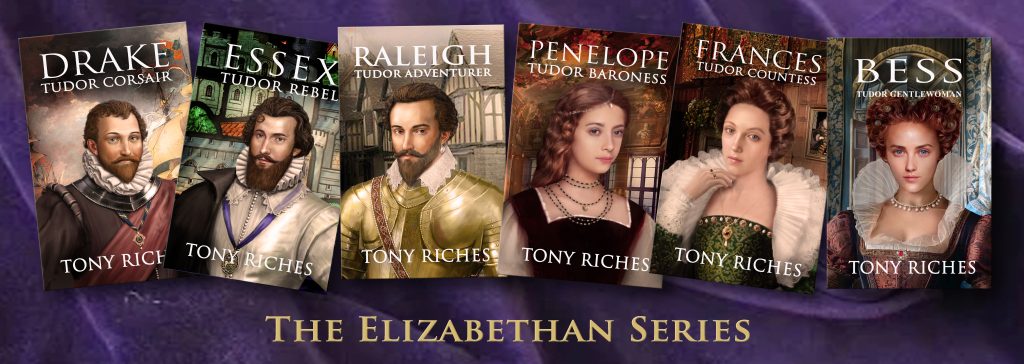
Jackie: So that accounts for books Mary , Tudor Princess; Brandon, Tudor Knight; and Katherine, Tudor Dutchess. I love the circles that you create, Tony. It’s really amazing, how you keep people wanting to read more. Let’s talk about the Elizabethan series and where you started and, and why that unfolded the way it did.
Tony: I had a spreadsheet, and I put the three men in – Drake, Essex and Raleigh. When I started with Drake, he’s a young chap trying to make his way…he was not a noble, he had a massive chip on his shoulder and he was a Devon sailor, really in debt. The book starts with him begging his way onto a ship. His father was a minister in Chatham dockyards, so Drake knew about ships and sailors, but he’d never really been to sea. Once on board, he kept to himself, eventually working his way up to captain. Drake was very efficient with his crew and because his father was a minister, he was very religious, assembling the crew for prayer daily. You can imagine this rough, unruly crew. I have that in the book, the actual prayers that he would have read to them. That’s what he knew.
It’s fascinating that when he finally gets to meet the Queen, he is totally awestruck. Fair enough, because you can imagine he was a commoner. Invited to a private meeting with the Queen of England, he was almost struggling to form sentences. She made him a privateer, which is a pirate, really, and he promised her a fortune in jewels and gold because the queen would get half of what was seized. He eventually came back from a sea voyage with so much treasure that it took several caskets carried in and then flung open for the Queen to admire. He became what we would probably call a billionaire today, because there was no estimating his actual wealth. However, he never got over the fact that he came from humble origins.
It was then fun to move on to the Earl of Essex, whose father I think was poisoned, based on his servant dying the same night when they drank from the same cup. Suddenly, Robert Devereux finds himself the Earl of Essex, but, unfortunately, he does not have a clue as to how to conduct himself as an earl. And the book really follows his adventures as he blusters his way through court, completely misunderstanding the etiquette. I found a two-volume set of the Devereux letters and papers. And when you’ve got two volumes of their letters and papers, it is not hard as you might think to get a sense of who they were and who they were writing to? How were they speaking to them? Were they deferential or were they quite cheeky? Thats good fun. I try to find the voice of these people.
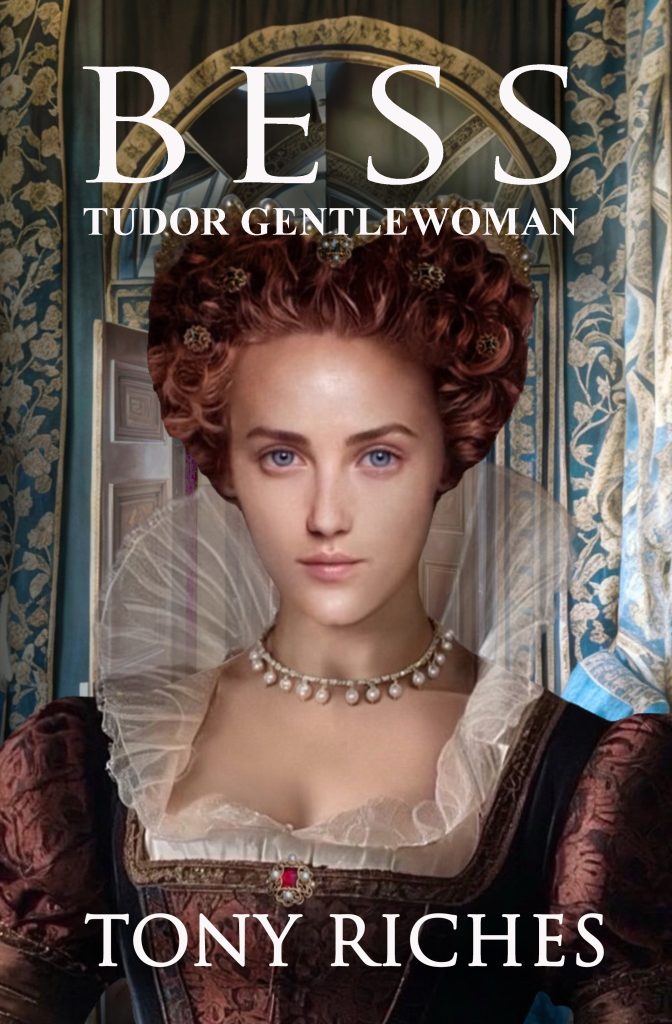
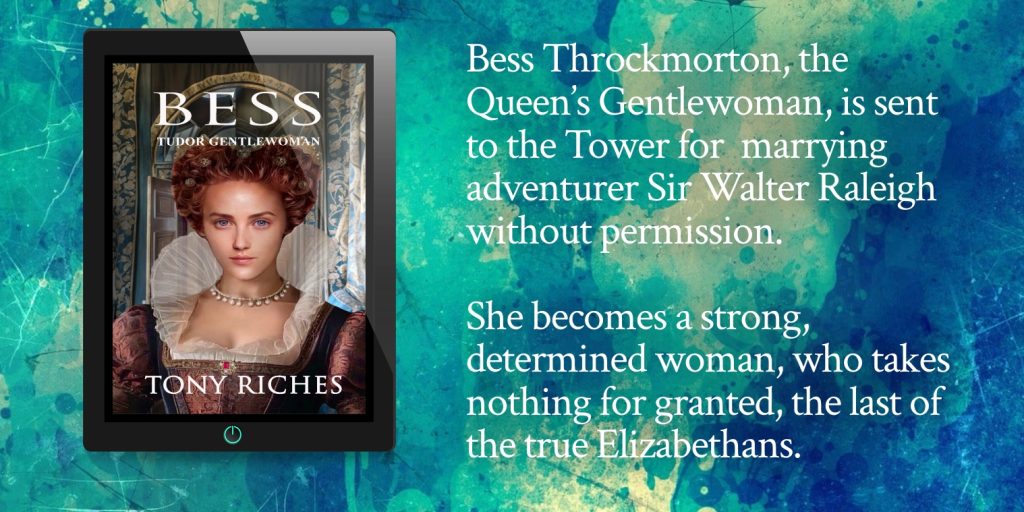
Jackie: Let’s talk about Bess, Tudor Gentlewoman. clarifying for our readers that we are talking about Bess Throckmorton, Sir Walter Raleigh’s wife and Elizabeth’s confidant.
Tony: One of the intriguing things about Bess, as I have already said, was that she was poorly educated, but not for the time. People had low expectations of her and obviously underestimated her intelligence, including her husband, who was really quite condescending to her because he fancied himself as a poet. When he was locked up in the Tower, he decided to write the entire history of the world. That is even more ambitious than me, really, isn’t it?
What Bess did was literally teach herself to read and write well enough that she would write to people like William Cecil, the most powerful man in the land. And then his son, Robert Cecil, who took over when William died. Nor did she hold back at all, being really quite forthright in her letters. But the other thing that is so interesting is that she is a Throckmorton. You’ve probably heard of the Throckmorton plot to kill Elizabeth and put Mary Queen of Scots on the throne? The more you delve into Bess’s family background as one of leading Catholic families aligned against the Protestant Elizabeth, it is really a miracle that Elizabeth even dared to have her at court! The Throckmorton’s were constantly plotting the downfall of the Queen. It left Bess in a very difficult position all of the time. Not only was she some way or other associated with just about every single plot against the Queen–even after the Queen’s days, I discovered she was related to, or in some way acquainted with all of the Gunpowder Plotters; Robert Catesby was a distant cousin. Bess can never shake off this association. Completely innocent herself of anything, she was the great survivor. She outlived virtually everybody that she knew.
Jackie: And that is why you picked her? Because she was at the center of all of these plots?
Tony: It was more because I like getting back to writing about somebody from a fairly modest background. All she had was £500, which had been lent to somebody– she did not even have it herself. That was her dowry, and she had a bed, which had been bequeathed to her by her family. That was all. And then, when you add that together with her poor education, she was vastly different from the previous two ladies I’d written about because Penelope Rich was literally rich (Penelope, Tudor Baroness). Her mother was Lettice Knollys, who was married to Robert Dudley. There was a lot of money in the family and a lot of property. And in fact, it was so vast it was almost impossible to get to the bottom of exactly what property they had. The other one was Frances Walsingham (Frances, Tudor Countess), whose father was Sir Francis Walsingham, the Queen’s spymaster. She was extremely connected, but also extremely educated, because she was his only surviving child, and he made it his business to give her the best education that he could manage.
Jackie: I am looking at these wonderful cover images. How close are these images to the real people they portray?
Tony: I commissioned two artists, a man to do all the men, and a woman to do all the women, because I think that works best. I gave them direction that they have to base it as closely as they can on a composite of all the known portraits. I also wanted the face to be engaging –direct eye contact. When you look at the cover of the book, the person is making eye contact with you. I thought that would be quite fun. I also gave them an extra challenge, which was to try and achieve an enigmatic look. I can imagine these poor artists desperately googling enigmatic to see exactly how you translate that into an artwork! None of them are in any way using AI or anything like that. These are actual works of art originally commissioned by me for my books. The reason I did not use the actual portraits is because there’s a trap for historical fiction authors that somebody buys your book mistakenly thinking that it is non-fiction.
Jackie: Let’s talk a little bit more about this research. We understand that you’ve gone to these places so that you can get a sense of the locations. What about other resources like the two-volume set of the Devereaux letters? Where are you finding them and how are you doing your research?
Tony: On the internet! When I started off, there were no letters for Owen Tudor at all. But you do get some letters for Henry VII. It’s only a fraction of them that remain, compared, for example, with somebody like Devereux. When I can download these documents from online, they are extremely thumbed and full of bookmarks, because the worst thing that happens is that you remember a really good line that you want to use in the book, but you cannot remember exactly which letter it was in. That happens to me quite a lot! But it’s a treasure if you come across something that is authentic, actual, verbatim words used by the character–which I think is great, because you cannot get better than that for having a sense of their voice.
Jackie: You are able to incorporate, not just your imagined dialogue, but actual dialogue based on historical fact.
Tony: That’s right. There’s another strange thing that happens when I have immersed myself in a character, studying them over several books — they are sitting somewhere in the background all the time. As a result, some mornings, I wake up with entire passages of dialogue in my head. I keep my laptop by the side of the bed, and I can quickly get down a stream of consciousness. I think some of my best work has come that way, where I wake up and the idea is fresh in my mind — a conversation between two characters, whether it is Bess and Walter or whether it is Charles Brandon and Katherine Willoughby. And I have to quickly capture it because it is ephemeral and you could lose it, if you aren’t careful.
Jackie: Do you have a writing procedure? Do you have a time of day? Tell us about your methodology.
Tony: I have a great system that I have been doing for 14 years. Let’s say you write one book a year. I read somewhere that if you can write one page a day, that is a book a year. And anybody that says they haven’t time to write a book–they only have to write one page a day, which does not take that long! So, that is where I am at. If all I achieve is one page, then I am happy with that. If I achieve a whole chapter, then I am ahead of myself. Therefore, what I do is research through the summer, when it is pleasant to visit places like the Tower of London or wherever. And then I start writing in the autumn and through the winter. (I give myself Christmas Day off.)
My wife does an edit first. She’s edited all of my books and cross-referenced what I have said in book two with what I have said in book six to make sure it is consistent. The names and the titles and the events and the dates. And she does find mistakes that I have made.
Then I get the book to my editor. I hope to release a new book in the spring. Then I commission the audio book, as soon as the paperback is released. The audio book normally comes out around the end of the summer and the whole sequence starts over again! It works extremely well for me.
Jackie:, Do you have a personal favorite of any of these books, and if yes, why?
Tony: It’s a question I do get asked, and it’s like saying,” Which of your children is your personal favorite?” The answer is no. None of them — or all of them. But the truth is it’s whichever one I am writing at the time, or I have just written. I am very, very fond of Bess because I have spent the last three or four years with her, and I feel I understand her. With Jasper Tudor, who was the second book in the Tudor trilogy, it was 10, 12 years ago. And, although we visited his chateau, Château Josselin in Brittany, the memory has started to fade a little bit. Whereas with Bess, it is very fresh.
Jackie: You’re really getting into that personality, and mind, like an actor that takes on a role during that period of time.
Tony: That’s a good analogy.
Jackie: Is there one person you would have loved to have met or been, that would have stood out for you.
Tony: I think it would have been quite good fun to have been Charles Brandon, or to meet him. Because poor old Henry VIII, he tried his best, but he did not have many real friends that were truly loyal to him for the right reasons. But Charles Brandon was. And he did not want favors. He did not want money from the king. When the King was a boy, Charles Brandon was the one who taught him how to joust, for example, not because he had to, but because he thought it would be fun, something they could do together.
Jackie: Speaking of leisure activities– jousting for fun– you do kayaking and sailing, right? Does any of that provide insight or inspiration for the books?
Tony: My wife and I are both qualified yacht masters. And we have had many sailing yachts. Of course, that is really handy when you are writing about any Drake or Essex. When you are talking about life at sea, I have it grounded in reality. It has been very useful to know the nautical terms and what it is like when you are in a storm or a rough sea. We’ve been in rough seas that have been extremely dangerous. I can draw on that for a bit of authenticity. But, I wish that I knew more about riding horses. I have ridden horses, but I am no expert, and there is much riding of horses in my books, so that I have to keep checking facts, Googling things to see what parts of the horse are called and how the horse reacts, how long it takes to ride a horse, for example, from London to Kent. That is something I wish that I did have more time to understand.
Jackie: Your books have been enormously successful. Why do you think they’ve been so well received?
Tony: I was lucky. I was in the right place at the right time because, when Owen, the first book of the Tudor trilogy came out, it was quite easy to get a number one on Amazon Kindle because it was new — and had to be coded in HTML. I was skilled in that and very much in the minority. Furthermore, there were no other books about Owen Tudor–historical fiction novels which were authentically based on sound research that I could find. There were various romantic books about Owen and his relationship with Catherine of Valois, but nothing going to this depth. I did a deep dive into his life and was astounded! The first month after release, I sold more than 10,000 copies and was number one in the UK, US and Australia. I did not know how to cope with that!
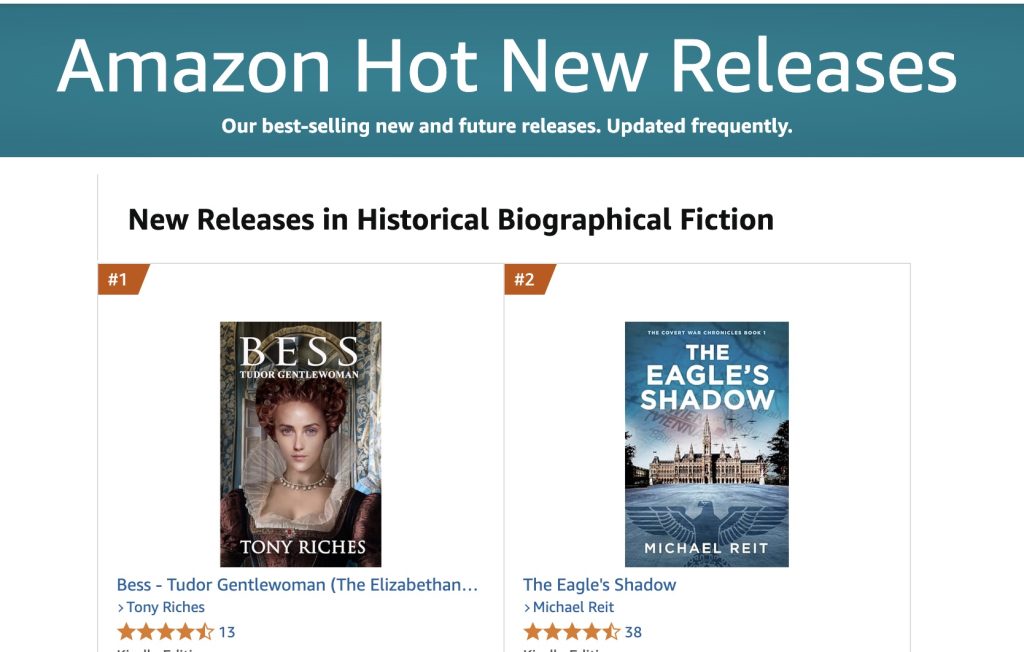
That’s with almost no marketing. But today, many years later with much more competition from individual authors and major publishers, I was really pleased when Bess, in the same week she was released, rose to Number 1 in all of her categories, including Hot New Release in historical fiction.
Jackie: What’s next?
Tony: I have a plan for the next six years if I live that long! In Bess’s story, of course, Elizabeth I dies halfway through the book. So, by default, we get into the Stewarts. Bess has to appeal to the nicer side of King James and finds that he does not really have one. But his wife, Anna of Denmark, is much more sympathetic towards the Raleighs, visits them in the Tower of London, and they become acquainted. That provides a really nice crossover from the Elizabethan series into my new Stuart Trilogy.
Now, I don’t know about you, but I knew nothing about Anna of Denmark other than she came from Denmark. I didn’t remember anything about the Stuart Queens. I find it fascinating to realize that they were very clever, very artistic, very articulate, very influential. Anna of Denmark had her own court in Scotland, to rival that of her husband. And I am enjoying the research of this and learning a lot about Anna of Denmark.
Jackie: We can look forward to another three-book series! Is there anything that I haven’t asked you that I should?
Tony: What I would add is that, while I might have given the impression that you really need to read the books in order, I have written them in such a way that each works as a standalone book. If you picked any one out of the 12 now in the in the Tudor and Elizabethan series, then you should be able to enjoy it just as the story of somebody’s life. But if you do start off with Owen, which is the first book of the Tudor trilogy and follow it through, then you have a richness in terms of the breadth and the scope of what the Tudors are really about.
Recommended Reading
To easily locate Tony Riches’ books, go to The Historic Traveler Book Directory, and in the search bar, submit: Tony Riches or click on each of these below:
To read the first in these series, click on these links:
The Tudor Trilogy
The Brandon Trilogy
- Mary – Tudor Princess (2018)
- Brandon – Tudor Knight (2018)
- Katherine – Tudor Duchess (2019)
The Elizabethan Books
- Drake – Tudor Corsair (2020)
- Essex – Tudor Rebel (2021)
- Raleigh – Tudor Adventurer (2022)
- Penelope – Tudor Baroness (2023)
- Frances – Tudor Countess (2024)
- Bess – Tudor Gentlewoman (2025)
Standalone Novels
- Queen Sacrifice (2012)
- The Secret Diary of Eleanor Cobham (2014)
This Article was featured in the Summer, 2025 issue of The Historic Traveler Magazine.
