
The following passage is an edited version of a chapter from one of my many books taking place in the city of Rome. The Basilica of San Clemente is a rarely visited medieval church, hardly distinguishable from the countless churches in this great pilgrimage city until viewed with the eyes of an architect, art historian, or archaeologist. Once the visitor descends the strata of the great city, lying beneath the church, does one understand the passage of time and the countless human lives lived in this location. It is an inspiring visit.
by Rebecca Branch
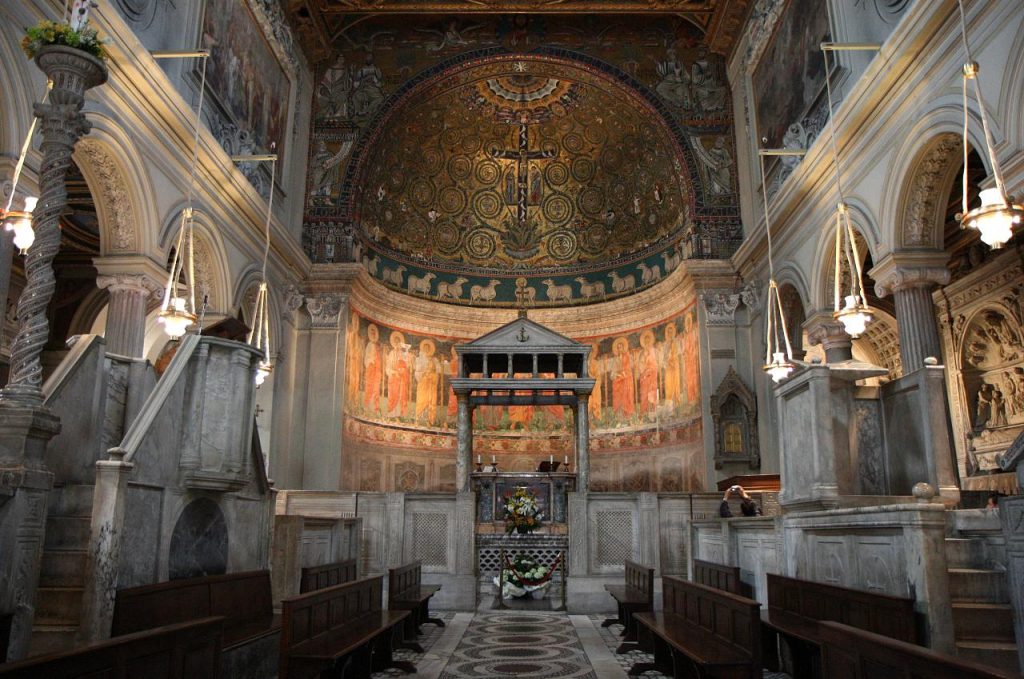
Slightly off the beaten track and a few blocks past the Colosseum, is a small twelfth century church, set low in the adjoining street. It is a beautiful little church, its apse decorated with Byzantine-style mosaics with plenty of gold leaf applied behind small glass tiles surrounding the painted figures on the walls. The ceiling is carved wood and gesso, the floor a combination of five types of inset stone called opus sectile. Typical of floors from ancient times, this floor’s inset stone is much like a geological sample kit and came from Egypt, Tunisia, Sparta, and Chios.”

This floor is original to the church and was built around the year 1200. International trade remained at a low point at that time even though the Dark Ages were soon to be at an end. We know the quarries which supplied this type of stone in the classical world, and many stopped functioning after the fall of the Roman Empire in 410 AD. Were these stones quarried from ancient monuments? We do know that Rome had become its own quarry. Why import costly stone when you could disassemble an older monument which had fallen into disuse?”
Rome at its Peak
Imagine the empire at its height, around the year 180 AD. This was a city of over a million and a half people. There was literally an army of artisans and tradespeople maintaining the infrastructure of this city. Florists and arborists woke at dawn each morning to maintain the vast array of public gardens everywhere you looked. Thousands of laborers maintained the eleven aqueducts and hundreds of fountains throughout the city. A huge sanitation department walked the streets with brooms and buckets to clear them of refuse.
Food carts sold sausages, poultry, milk, eggs, and fresh produce. Stalls sold textiles, spices, toys, tools, footwear, and anything desired by the community. Priestesses washed and decorated the temples, hanging garlands, making the morning sacrifice, and conducting the morning prayers. The dozens of courts set up thousands of stools, chairs, and benches for the day’s cases, all on public display. Hundreds of thousands of poor lined the streets to be given grain, bread, and foodstuffs at the government expense. Children made their way to schools. Roads, bridges, and aqueducts took the attention of hundreds of engineers. Architects surveyed new building projects, and an army of slaves moved soil, rock, wood, brick, and marble. Cranes lifted giant blocks of stone and concrete and stacks of brick. Lines of huge ships approached the warehouses on the Tiber to supply the city’s needs. The mall at Trajan’s Markets opened its 155 stores and employees and slaves set up shop.
Blacksmiths fired up furnaces, cobbler shops displayed shoes, wine merchants received shipments of huge amphorae from all over the Mediterranean, olive merchants displayed their variety of foodstuffs and grocers accepted cartloads of produce from the countryside wagons. Soldiers drilled on the Campus Martius. Leaves were swept; grounds were groomed. Statues were polished. Buildings were freshly painted.
The hustle and bustle of the city were immense. Rome was a combination of contemporary Mumbai in India with its ghettos, poverty, and crowds and Fifth Avenue in New York with its elite retail stores, churches, businesses, and cultural hotspots.
Vast Empire
At the time, Rome controlled the entire Mediterranean basin, and the areas from Britain to Arabia, from parts of the Caucuses in Ukraine to deep into North Africa. Roman law was the national pride, as were architecture, engineering, literature, sport, and government. The army was unbeatable and moved and fought mechanically with precision and uniformity, armed and armored by factories set up throughout the empire. Unlike other armies, they were full-time professionals, not farmers who campaigned for their king until it was time to harvest. Because the state protected and provided, vocational specialization was common, and every imaginable trade and occupation took hold.
This church did not exist back then. The area was mainly residential with a smattering of public buildings. The state religion was paganism, a religion of the natural order paying respect to the land, the sky, and the water…to love, and children and gods who represented all the ecological and environmental things we cherish today. It was a religion…many religions, which celebrated mankind and the genius of the human race. There was no faceless omnipotent god. There was no washing away of sins through absolution. There was no afterlife, with the exception of the cult of Isis, imported from Egypt. The temples and congregations were tolerant of one another. The religious rites went back to the founding of the city and further back to archaic times when explanations of life on earth could not be found in science and so were clouded in myth.
Beginning of the End
After the reign of Marcus Aurelius, political trouble took hold and the line of succession was broken, generals fought generals, multiple claimants to the throne popped up, Romans fought Romans and the State was weakened. Holding back the barbarians in Germany and the Balkans, and the Persians in the east ate up the public treasury. Plagues wiped out ten million of the seventy-five million citizens. Inflation made everything outrageously expensive and the emperor, Diocletian, set an unmovable cost for products and services and especially for wages around the year 285. This tied people to their jobs and location. It was the end of upward mobility for the common man, and a form of serfdom took hold.

Christianity Arrives
Now, it is the year 395. The Christian religion has replaced paganism and is harsh and completely intolerant. People who wish to believe in other religions are burned alive or tortured. Women suffer a holocaust as rules of chastity take hold and the priestesses, midwives, herbalists, and artists are punished and often killed just for their gender. The old state temples of the pagan religions are boarded up and abandoned, statues of the gods are defaced in a frenzied burst of iconoclasm. Germanic tribes roam the countryside unchecked while multiple military emperors fight each other for control of the state. Romans are killing Romans, Christians are killing pagans and other sects of Christians, and many emperors rule for only months before they are assassinated by their own troops.
The army can no longer be paid and falls into bands of poorly trained and unmotivated men. Those imperial armies, who in the past were willing to travel untold distances to fight, no longer wish to leave their farms and families. Local populations who once paid their taxes to the imperial treasury now pay the local barbarian warlord as borders are crossed and recrossed by Germanic forces. The barbarian warlords, be they Franks or Goths or Burgundians, or Lombards, need the local provincial bureaucrats to run the cities, maintain some civics, trade and agriculture. In the city of Rome, fires, floods, earthquakes, and disease vanquish the population. Rome goes from a city of one and a half million to thirty thousand.

The Great Loss
There is no more emperor, no more army, no more specialized occupations or banks, civics, or law. Trade of manufactured items across the Med stop entirely for the sea is full of pirates. The population is now illiterate. All they have are the promises of the church that their suffering on earth is temporary, and the kingdom of heaven is nigh. The old temples and public buildings, abandoned long ago, crumble and fall. The ground level seems to rise because of all the uncollected refuse in the streets, then the streets themselves disappear, covered in dirt, they become fields and pastures and most significantly, vineyards…for the water has become poisonous with waste. Wine is what you drink. Its alcoholic content kills off the bacteria.
The ancient city is forgotten. Its neighborhoods lie unnamed beneath your feet. You have no memory of Caesar, or the Republic, the Empire, or the arts, sciences, or literature. The remaining monuments are pilfered for their marble and bronze. The few new structures are ecclesiastic. Only churches and hovels are built now, with mortar made from burning thousands of crushed classical marble statues, and people who can still see the monumental structures like the Colosseum, stand in awe, and wonder at what giants must have built them.
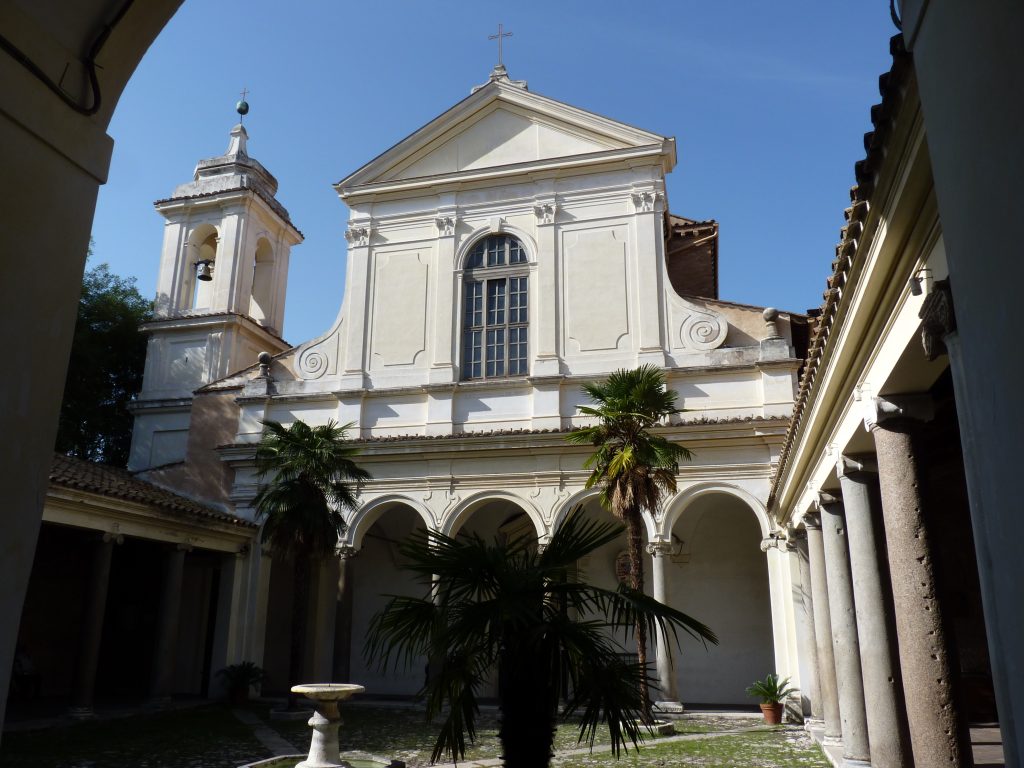
The Basilica of San Clemente
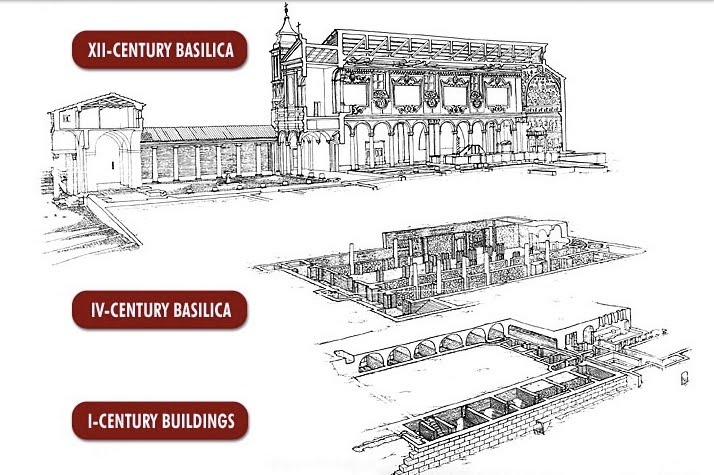
In 1857, the pastor of this church, Father Joseph Mallooly, charged with restoring the sinking floor upstairs, sent engineers below to see what could be done about the sagging foundation. What they found was this, filled with stone, and unrecognizable as what you see today. This was an entirely different church, buried under the twelfth-century church above us. This is the original fourth-century church of St. Clement, thirty feet below the medieval structure by the same name.
We descend a staircase beside the gift shop. Nearly thirty steps take us down into the depths. The walls are irregular stone, some covered in cracking plaster, a few ruined paintings here and there. It is dark and damp, electric lighting on tripods illuminating this space beneath the street level above.
Here we are, ground level in the year 395 AD. This church, at one time, had windows facing out to the street. Built at the time of Theodosius, Christian emperor of Rome, this basilica, now nearly thirty feet deep in the ground, enjoyed the sunshine and the shade of trees. Rome fell in 410 and again in 455 and again in 476 to barbarian invasions. Earthquakes tore apart what was left of the city in the ninth century, leaving this church to be restored and the surrounding area covered in rubble. Evidence, by that time, of the Roman Empire, was gone. This church was in the middle of a vineyard, sunk deep into the surrounding ground-plain, and susceptible to constant flooding. That is why the new church was built above it in the twelfth century. The original fourth century structure was filled with rubble to act as the new church’s foundation.
Going Deeper
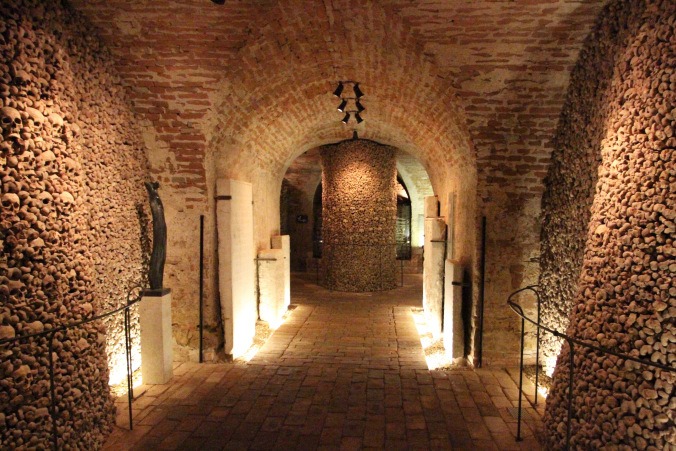
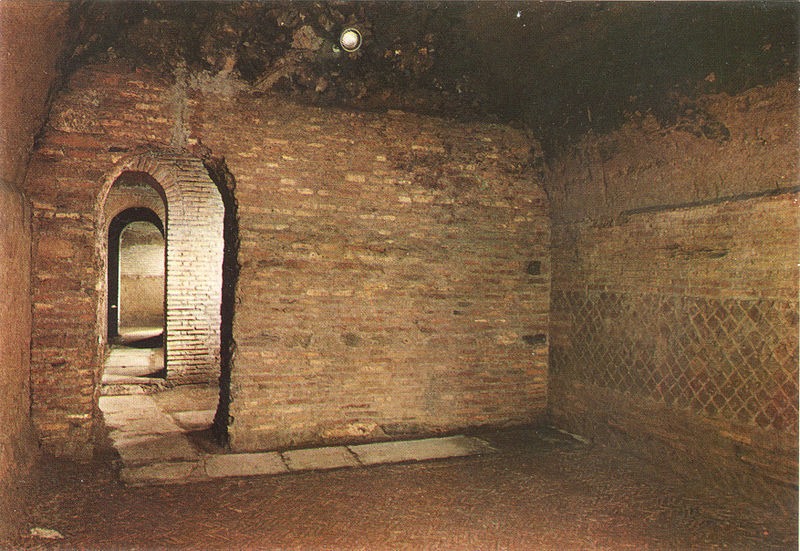
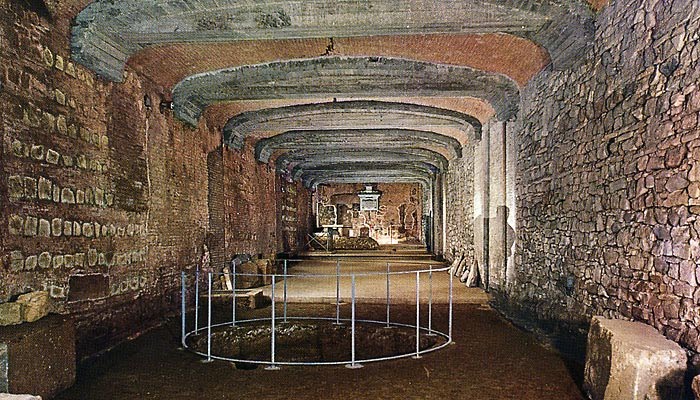
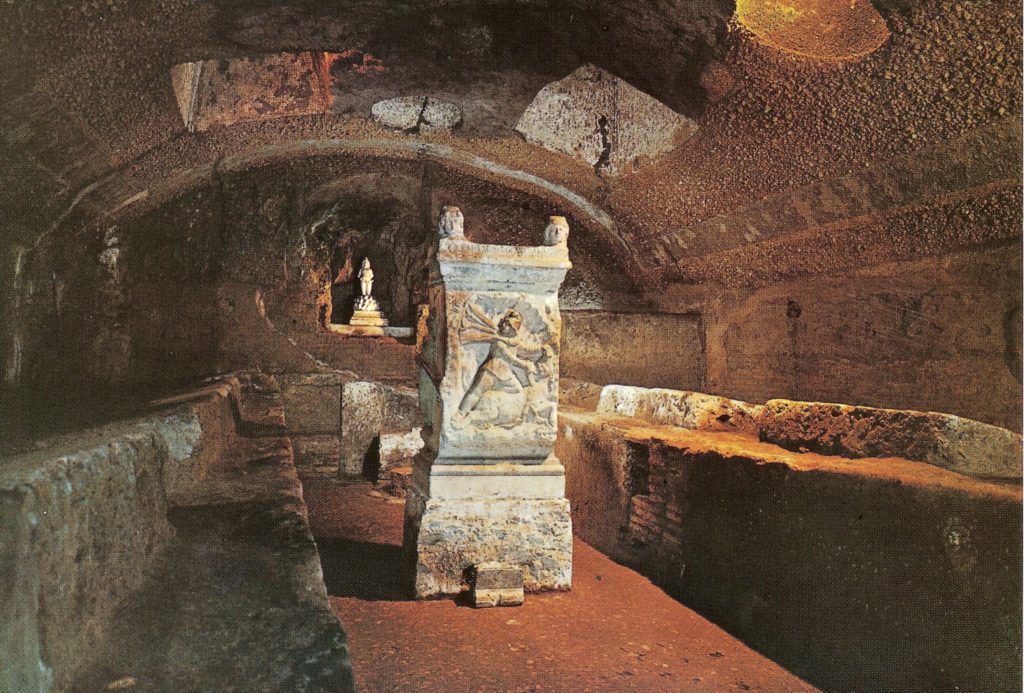
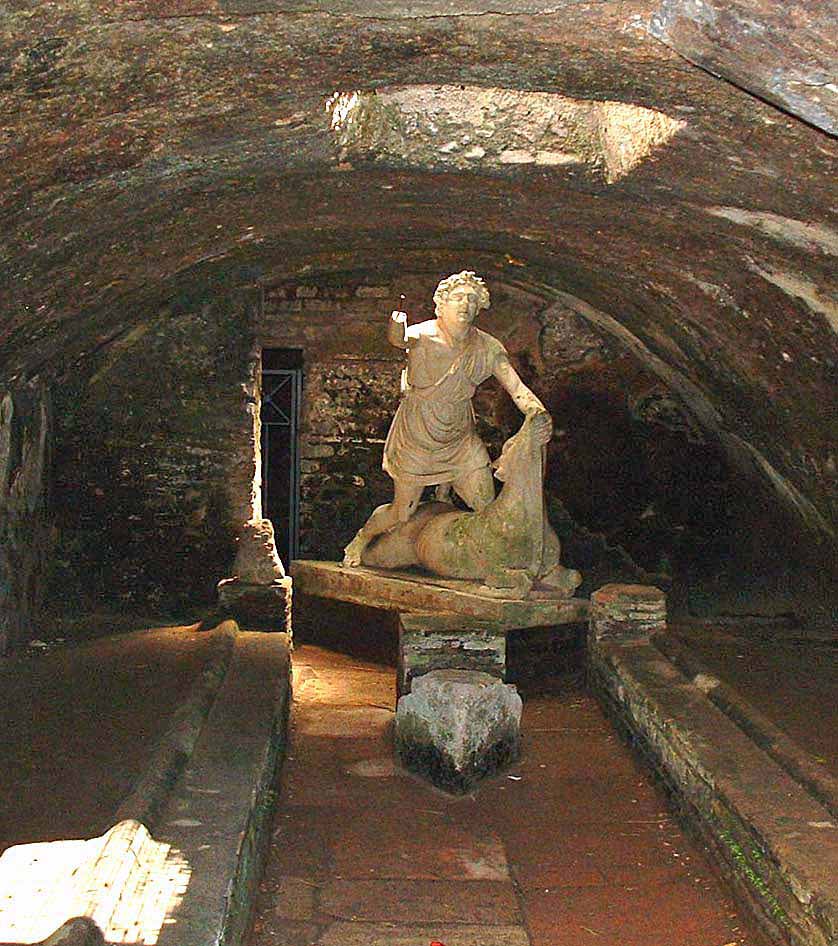
Descending another staircase, we are now an additional thirty feet below the modern street level. To the left is someone’s private home and a meeting place for those initiated in Mithraic rights. We are looking into the doorway to a home beside an ancient street. Now, look to the right. Notice how substantial these adjacent stone walls are compared to the private house. This was a government mint. Here, government officials struck coins. That is why there seems to be only one entrance and exit as well as thick stone walls for security.
Below us are parts of Nero’s Golden House, the Domus Aurea, and below that, the homes of the republic. They date to before 69 AD. We are sixty feet below the modern ground level, looking down another ten feet, knowing another era lies unearthed below that. This descending timeline of history is one of the most fascinating things to me about this city. You stand above layers of many cities from many periods; each built upon the ruins of the other.
This is not the only example of such things in the city of Rome. The Crypta Balbi, Vatican Necropolis, and Nero’s Golden House are incredible visits and should not be missed. Be sure to pre-book visits with qualified English speaking guides to experience the ancient city and what lies below.

Rebecca Branch is the author of eleven published books and lives with her girlfriend of eight years, top model Jessica Rossi, in New York City and in Hudson, New York. She writes romance, time-travel romance, contemporary women, and memoir. She is the mother of two young women, one a scientist, the other an educator. Professionally, she is an architect, but she trained in art history and archaeology in her youth at UC Berkeley for her undergraduate degree and did her post graduate work at Columbia. Although she modeled occasionally for Donna Karan and Calvin Klein up into her early thirties, her first professional job was as an assistant to the curator of Greco-Roman Art at the Metropolitan Museum in New York. She lectures on the architecture and town planning of the Roman Empire and practices interior design and architecture at an international firm based in New York City.
Where to Stay in Rome, Italy
If you’re planning to stay in Rome, the centro storico (historic center) offers the most walkable experience, though rooms come at a premium price. Hotels and guesthouses near the Pantheon, Trevi Fountain, or Spanish Steps put you within walking distance of major sites, but expect to pay accordingly and book well in advance. The neighborhoods around these landmarks fill quickly during peak season, so consider staying slightly outside the immediate tourist core in areas like Campo de’ Fiori or Trastevere, where you’ll find a better mix of local life and still be a short walk from major attractions.
The Trastevere district works well if you want to balance sightseeing with a neighborhood feel. Narrow streets lined with ivy-covered buildings and small restaurants give this area an authentic Roman character, and the Tiber River crossing puts you ten to fifteen minutes by foot from many key sites. Hotels here tend to be smaller properties, often family-run, with rooms at mid-range prices compared to the very center.
For budget travelers, look at neighborhoods just outside the tourist zone like San Giovanni, Esquilino, or Testaccio. These areas have functional hotels and hostels at lower rates, reliable public transit connections, and real neighborhood character without the markup. The trade-off is a fifteen to twenty minute metro or bus ride to the Colosseum or Forum, but the time investment often saves you money.
Stay away from hotels advertising immediate views of famous fountains or monuments unless your budget allows for it. The same neighborhood, one street over, will offer comparable comfort at a fraction of the cost. Rome rewards walking and exploration, so proximity to a metro station or major bus line matters more than being steps from any single famous sight.
