Today, we offer a little something different at The Historic Traveler. Since The Lord of the Rings (JRR Tolkien books and Peter Jackson movies) purport to take place in some historic past and- since we celebrate “historic” novels, we bring you a delightful swing through the world where these classics were brought to life!
By Patricia Bernstein
“Set-jetting” is a popular craze in tourism these days, and there are many opportunities to re-experience your favorite movie or TV show by dropping in on memorable settings, indoors or out, all over the world where important scenes were filmed. Red Carpet Tours in New Zealand, however, offers something unique, a 12 to 14-day total immersion in the settings, lore and artistry that created The Lord of the Rings and Hobbit movies based on the J.R.R. Tolkien classics.
I don’t mean to suggest for a moment that only “Ring” fans will enjoy New Zealand or that there aren’t other equally valid ways to experience the magnificent North and South Islands of “Kiwi” Country without exploring Lord of the Rings film sets. New Zealand is a paradise for sailors, skiers, hikers, climbers, outdoor enthusiasts of all kinds, and also a fascinating cultural milieu, heavily influenced by Europe but also by the history and customs of the original Maori people, who are 17% of the population today.
But for the Tolkien fan, or should I say the Tolkien fanatic, New Zealand is a kind of heaven on earth, the nearest we will ever get to living inside of The Fellowship of the Ring, The Return of the King, The Desolation of Smaug, or any of the three Hobbit films. Tours will vary based on factors such as the weather and the availability of various sites. Our Red Carpet Tour took us all the way from Auckland on the North Island to Queenstown on the South Island, and from workshops to natural landmarks to actual film sets and settings.
Because of the vagaries of international Air New Zealand schedules, my youngest daughter and I actually arrived in Auckland a day before the rest of the tour group, visited a couple of the dormant or extinct volcanos that surround the city, and enjoyed an elegant high tea at the top of Auckland’s tallest building, Sky Tower, before the Red Carpet Tour even started. But I digress.The next day my oldest daughter arrived, along with two or three dozen other Tolkien fans and our official tour began with a visit to Weta Workshop in Auckland.
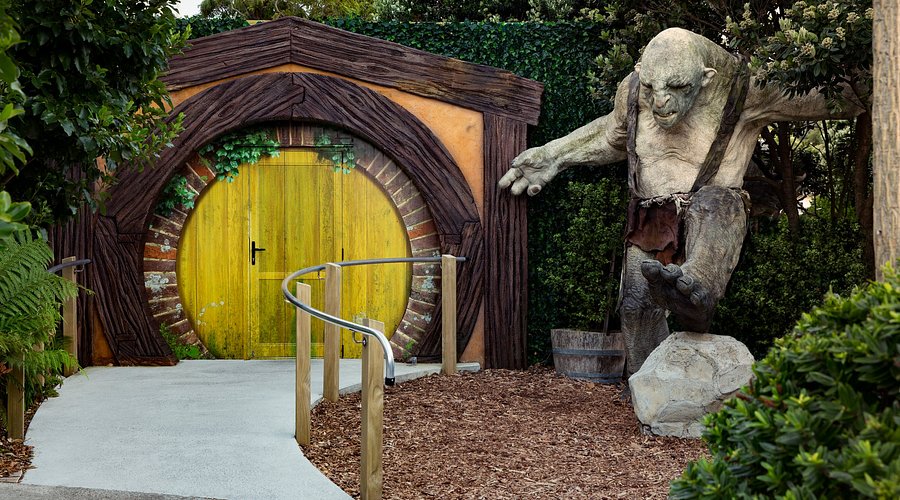
When we visited, Weta Workshop featured a glimpse of three new sci-fi/ fantasy landscapes and props that have no connection to Tolkien at present but showcase the unleashed creative imaginations of Weta designers. For me, the showpiece of the tour was the buildout of a highly detailed “bigature” (large miniature) world exhibiting two contrasting civilizations existing side by side, a primitive, bare-subsistence kind of camping ground with teepees, on the one hand, versus an exquisitely detailed castle on the other with towers, pavilions, sculptures, bridges, and a green profusion of landscaping.
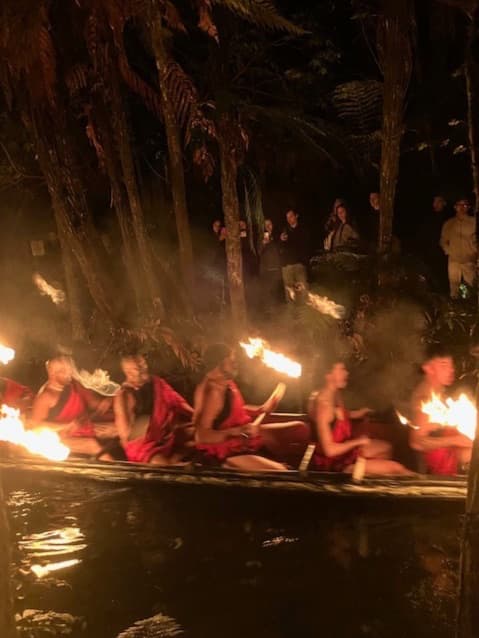
From Auckland we took off to Rotorua to the south. I will skip our visit to Hobbiton for the moment, which I think was the high point of the entire tour for most of us, and dwell for a moment instead on our “Maori experience” in Rotorua. It was our privilege to be guests at a traditional Maori hangi dinner prepared in an earth oven, catch a glimpse of a torchlit procession of Maori war canoes coming down the Wai-o-Whiro stream, and finish up by enjoying a series of traditional Maori dances and songs performed by dancers in traditional costumes.
New Zealand has a large proportion of citizens (17% and growing) who are Maori. A historical treaty grants Maoris specific rights and there is significant Maori representation in New Zealand’s Parliament. Where once British colonists sought to repress the Maori language and culture, now Maori traditions are celebrated. Maori MPs don’t hesitate to demonstrate their anger over efforts to restrict their rights, through hakas (traditional performance rituals) acted out on the floor of Parliament. International rugby matches for men and women’s teams often begin with a fierce haka. Watch it HERE
In Wellington we visited filmmaker Peter Jackson’s original Weta Workshop and reveled in displays of props from the LOTR movies and opportunities to purchase our own LOTR souvenirs. Our tourmates were serious lovers of everything Tolkien. Some wore hobbit-type cloaks and inscribed copies of the One Ring, and some wore even more elaborate costumes on the day we visited Hobbiton. Making decisions on which samples of Tolkien lore to bring home, from a large selection of statues, prop replicas, armor, helmets, jewelry, art prints, books, stationery, etc., required lengthy consideration but was such fun! I still grin whenever I look at my small replica of a hobbit house complete with Hobbiton street sign.
In succeeding tour days, we met Chris Menges, Weta Workshop’s senior swordsmith, learned about the creation of swords for the movies, and also enjoyed a presentation by Daniel Reeve, artist par excellence, who explained and made available to us art, calligraphy and cartography associated with the LOTR movies and the Hobbit trilogy. It seems that director Peter Jackson created a huge, invisible “magnet” which drew superior artists of all kinds to him, and somehow managed to harmonize their visions to create the complex world of Middle Earth where the events of The Lord of the Rings and The Hobbit take place.
But for me, the most exciting part of our Red Carpet Tour was visiting settings where scenes from the movies were actually filmed. Filming of the first of the six movies, The Fellowship of the Ring, officially began on October 11, 1999, on Mt. Victoria outside of Wellington. Jackson placed the actors playing the parts of four hobbits, Frodo, Sam, Pippin and Merry on the mountainside, on a path under a dense canopy of trees. While Sam, Pippin and Merry are consulting with each other, Frodo grows uneasy, sensing the approach of a Ringwraith, a sinister, faceless creature dressed in black, riding a black horse.
“I think we should get off the road,” Frodo says hesitantly. When he is ignored, his fear growing, he shouts, “Get off the road!” and the hobbits all jump off the path and hide in a depression underneath the road bed just in time to avoid being seen by the Ringwraith. We Tolkien addicts got to take turns filming portions of the scene starring ourselves.
We also had the privilege of visiting the jagged limestone “Trollshaws,” otherwise known as the Mangaotaki Rocks near Piopio, where a number of scenes were filmed, including the famous troll campfire scene where the dwarves and Bilbo are held captive while the trolls argue how best to eat them. But before the little folk can be dispatched, the first rays of dawn strike the trolls, turning them to stone. Bilbo also finds his sword Sting in this location. In fact, it serves as the setting for more scenes in An Unexpected Journey than any other spot.

On the South Island, where it was very cold (We visited in June, in the heart of New Zealand’s winter), we saw the field where the Riders of Rohan encounter and destroy a tribe of orcs, and our heroes Aragorn (man), Gimli (dwarf) and Legolas (elf), arriving after the battle, enter fabled and fearsome Fangorn Forest. Some of the beautiful beech woods in Mt. Aspiring National Park on the South Island suggested the inspiration for Jackson’s recreation of Lothlorien where the High Elves live in Middle Earth. Towards the end of our tour, we stood on the pebbly beach at the end of Mavora Lakes Road on the South Island, taking turns pretending to be Frodo, as he dangles the One Ring by its chain before his eyes, making the painful decision to abandon the “fellowship”and go on to the grim land of Mordor alone.
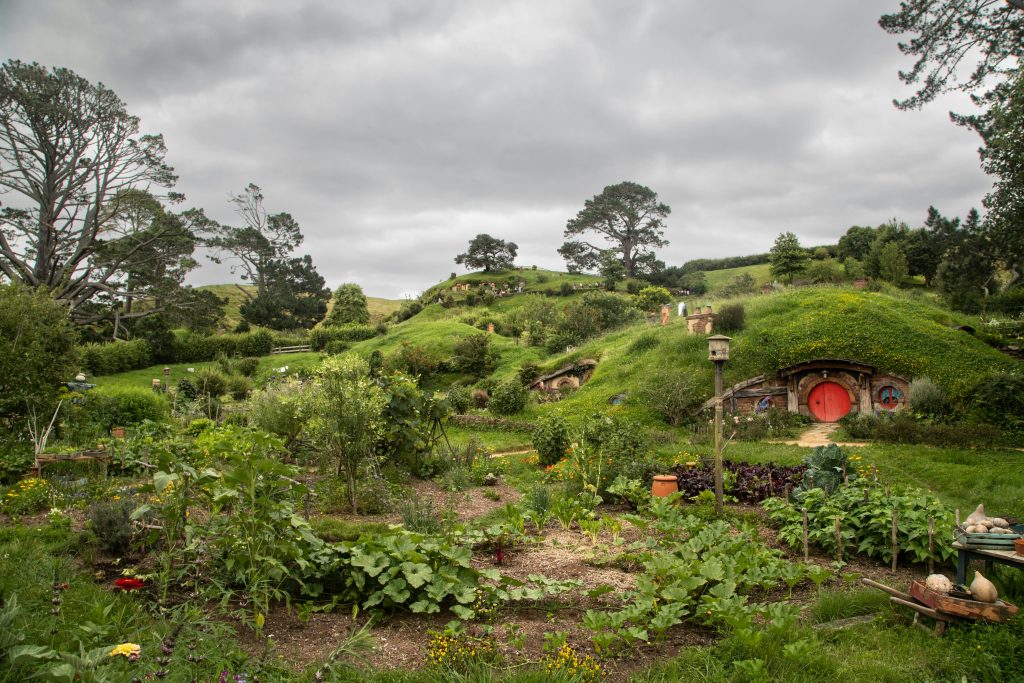
But I must say that our visit to Hobbiton, where The Fellowship of the Ring begins, was the high point of the entire tour for all of us, and might interest anyone who loves the art of moviemaking, even if he or she doesn’t care at all about the works of Tolkien. As we approached the hills of the Waikato region near Matamata on the North Island, we could see we were entering a very unusual landscape.
The undulating green hills of Waikato are perfect for local dairy farming with fertile soil, lots of sunshine and a temperate climate. But what is unusual is the relatively small size of the overlapping hills, an extended series of gentle rises like ocean waves on a relatively calm day, just right for a land of hobbits (or “halflings”) about 3 ½ feet tall who build their homes right into the hills behind distinctive round doors.
When the three “Ring” films and three Hobbit films were completed, demolition of the round hobbit doors and hobbit landscaping began so that the land could be returned to the farmer who owned it in its original condition, as promised. A great stroke of luck, however, arrived in the form of heavy rains which halted the demolition process. During the pause, the founder of Red Carpet Tours realized that the set of Hobbiton could become a major tourist attraction and convinced all involved that what was left should be preserved.and even enhanced.
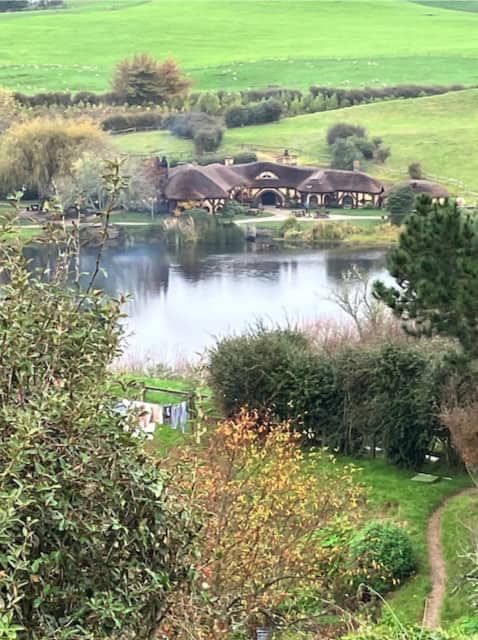
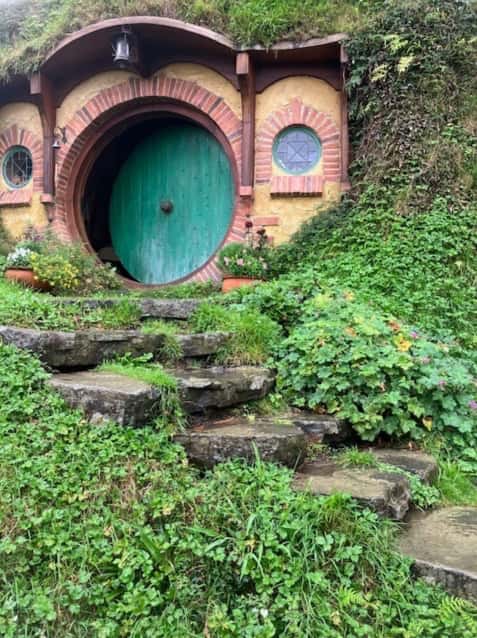
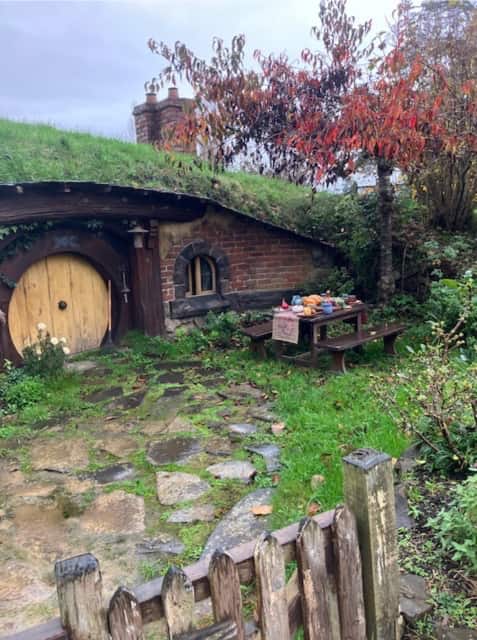
If we had taken a Red Carpet Tour in the early years following the debut of the LOTR and Hobbit movies, we would have seen the round doors to hobbit houses in bright shades of azure, celadon, orange, and gold, and perhaps some vegetable patches and garden décor, chess boards, pipes, picnics laid out on trestle tables, rustic wells, hobbit clothes hanging on a line, a hobbit newspaper peeking out of a mailbox, and the like.
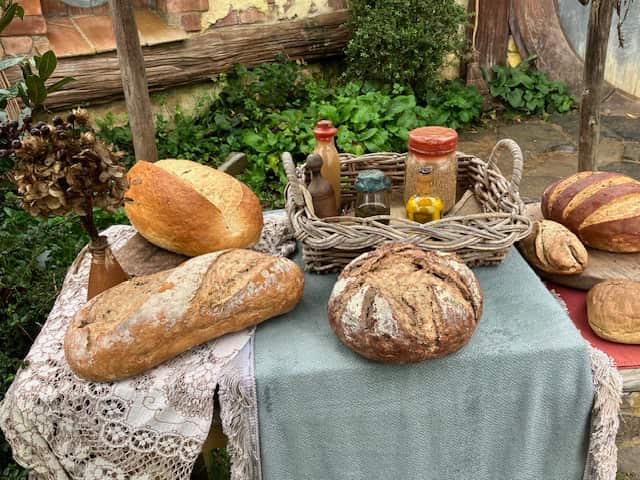
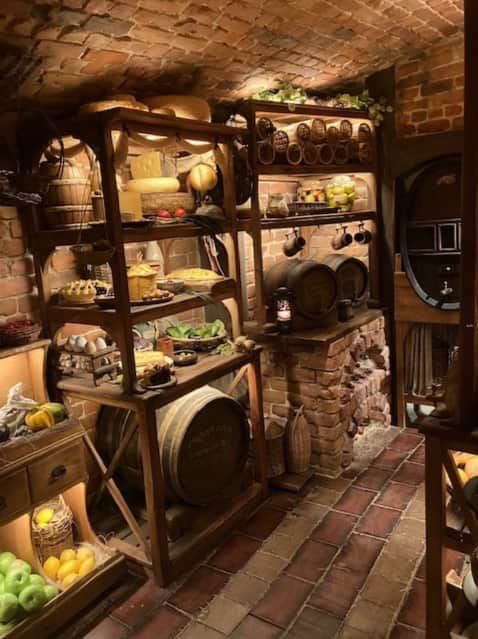
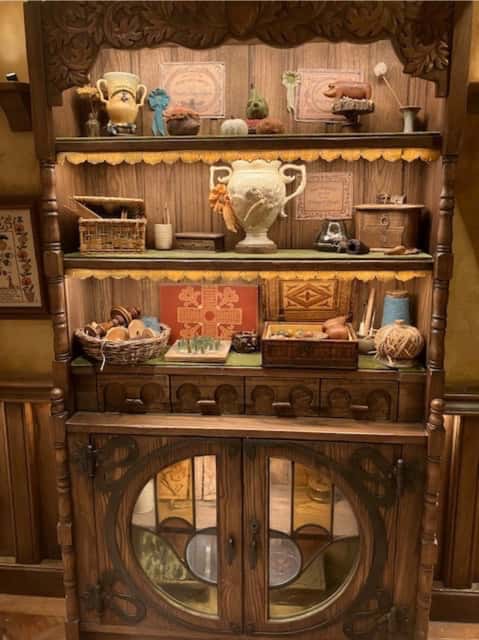
But the outfitting of hobbit houses has been taken a big step beyond mere exteriors with two of the hobbit houses now fully dressed in astounding detail on the inside. Before visitors were visiting a movie set representing Hobbiton. Now it feels as if we are visiting the real Hobbiton, one hobbit village located in The Shire, which is hobbit country in Middle Earth, right out of the books!
A cupboard displays a sewing basket and prizes for Prettiest Piglet, Best Vegetable and Best Bee Song. A desk features books, rolled-up scrolls, snacks (to fortify a hungry writer), quill and ink, a wall sconce with candles, and a mockup of Bilbo Baggins’ monumental work There and Back Again, open to Chapter One “An Unexpected Party.”
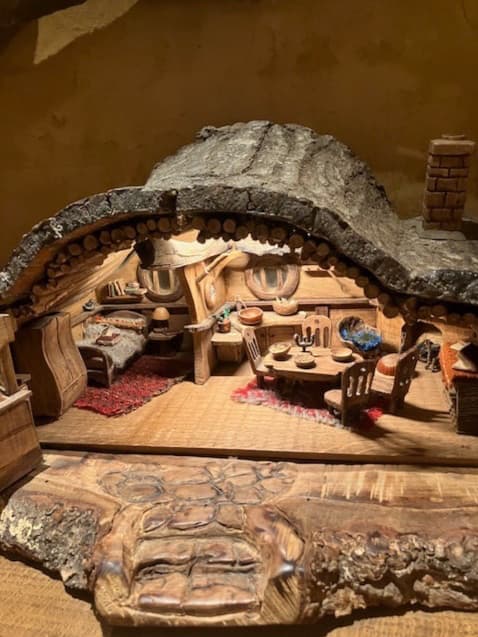
The children’s bedroom is outfitted with bunk beds with patchwork quilts and marionettes hanging on pegs, and the bathroom has a metal, Saturday-night style bathtub. In the kitchen are wheels of cheese, pies, eggs, leafy greens in a large bowl, kegs of beer, pie dough rolled out on a counter, and a recipe book open to recipes for Mrs. Grub’s Best Apple Pie and Apple and Myrtle-berry Pie. My favorite item of all, however, is probably the hobbit one-room dollhouse with flagstone entryway, bed, book, crib and table set for dinner.
Red Carpet Tours are obviously intended primarily for fans of the J.R.R. Tolkien books and films, but they also provide a comprehensive introduction to a unique and beautiful land “down under.” Tolkien lovers will enjoy not only the features relating directly to Tolkien but also a fine introduction to a faraway country unlike any other in the world.
Where to Stay in New Zealand, New Zealand
For a Hobbiton Movie Set visit centered in Matamata, book accommodations in town or the surrounding Waikato region. The Matamata area offers bed and breakfasts, small hotels, and farm stays within easy driving distance of the set. Local options tend toward intimate, character-filled properties rather than large chains, which fits the rural charm of the region. Many travelers stay in nearby Hamilton, a larger city about 45 minutes south, if they prefer more dining and shopping options alongside their accommodation.
Queenstown and Arrowtown serve as primary bases for exploring the Lord of the Rings filming locations across Central Otago. Queenstown sits on Lake Wakatipu and offers everything from budget hostels to luxury lodges, making it accessible for most travelers. Arrowtown, a smaller historic gold-rush town just 45 minutes away, provides a quieter alternative with guesthouses and small hotels that capture the region’s heritage character. Both towns fill quickly during the tourist season, so booking several weeks ahead is practical.
Rotorua, on the North Island’s geothermal plateau, connects you to volcanic landscapes featured in the films and offers strong accommodation variety. Hotels range from mid-range chains to thermal resort properties where you can soak in hot pools after a day of filming-location exploration. The town itself has historical significance as a Maori cultural center, which adds depth to a stay beyond just the movie connection.
Wellington, the capital city, works well as a base for visiting Weta Workshop and related film-production sites. The city has extensive hotels across all price ranges and excellent public transport and dining. From Wellington, many travelers add day trips to nearby filming locations around the Hutt Valley and Haywards Hill region, making it a practical headquarters for a multi-day Lord of the Rings itinerary.
Recommended Reading
Fiction
- The Hobbit and The Lord of the Rings trilogy by J. R. R. Tolkien. These books started the whole modern craze for elaborate, world-building fantasy. To this day, I can open these books anywhere and I am immediately engrossed. Later writers have added lots of sex, cruelty, and blood and gore to the fantasy formula, but, as far as I’m concerned, even the very best, and, yes, I mean you, George R. R. Martin, whose work I adore, no one has yet outdone Tolkien.
Tolkien never visited New Zealand, but Peter Jackson’s movies mean LOTR will forever be identified in part with this magical land “down under.” - The Luminaries by Eleanor Catton won the 2013 Booker Prize and the author, at 28, was the youngest writer ever to win it. The story is set in the 1860s gold rush on the South Island of New Zealand. In some ways, it’s very Victorian in length and style. The book follows multiple characters, uses a confusing, broken timeline, and throws in a lot of astrology with characters representing signs of the Zodiac and celestial bodies–which I tried to ignore. Deadwood through a glass darkly
- The Bone People by Keri Hulmel. Hulmel is a Māori poet and novelist in New Zealand. This book won the Booker Prize in 1985. It is beautifully written, but a very disturbing view of three outcast characters, a woman who lives alone and is estranged from her family, a mute boy who survived a shipwreck, and a man who tries to act as a parent for the boy but suffers from alcoholism and sometimes veers into extreme violence against him.
- The Garden Party and Other Stories by Katherine Mansfield, who was born and raised in an elegant suburb of Wellington, but later moved to England and knew many of the writers who were part of the Bloomsbury Group. Her stories deal with the discomforts of class consciousness, social inequality, gender roles and modern-day isolation. Sometimes lyrical, sometimes comic and often compassionate, Mansfield set her tales in New Zealand, as well as England and the French Riviera.
An earlier collection, Bliss and Other Stories includes a story called “Prelude,” set in New Zealand, which uses stream of consciousness. Mansfield may have been an important influence on Virginia Woolf.
Non Fiction
- An Angel at My Table by Janet Frame is the second volume of her autobiography which describes her struggles growing up, poverty, the deaths of two sisters by drowning, her eventual commitment to a mental institution after a suicide attempt, and how writing became her salvation.
- Come On Shore and We Will Kill and Eat You All by Christina Thompson is a memoir which resulted from Thompson’s marriage to a Māori man. The book covers history, travel, anthropology and personal experience, from the arrival of the first European, Abel Tasman, in New Zealand to Thompson’s own life.
- Wars Without End: New Zealand’s Land Wars, a Māori Perspective by Danny Keenan. Keenan is a senior Māori historian who writes about the struggles between Māoris and British forces over land in the 1840s and 1860s. The Māori people remembered these wars long after others had forgotten, as tribes tried in different ways to recover lands taken by the Crown.
- The Penguin History of Aotearoa New Zealand by Michael King. This book has been generally praised as “definitive, accessible and balanced,” focusing primarily on Māori/Pākehā (white/European) relations, though it doesn’t cover history after 2003
- A Short History of New Zealand by Gordon McLauchlan. This is a more recent, readable and concise history.

Patricia Bernstein earned a Degree of Distinction in American Studies from Smith College. She has published three non-fiction books, the most recent of which, Ten Dollars to Hate, was a finalist for a major award from the Texas Institute of Letters. Noble Cunning: The Countess and the Tower, Patricia’s debut novel, is based on the true story of a woman who rescued her husband from the Tower of London. The book has been awarded gold medals by the American Bookfest and the IPPY awards and first place in the Catholic novel category by the Catholic Media Association.
Patricia first fell in love with The Hobbit and The Lord of the Rings as a teen and the books became a secret passion. She read them to her three daughters, two of which joined her on the trip. Patricia’s treasured takeaway from Tolkien’s book is that “even the smallest person can change the course of the future.”