
By Rebecca Branch
This article helps visitors see and understand their environment when touring Rome. Everyone walks through the archaeological park of the Forum, Palatine, and the Colosseum valley. Only the Colosseum remains sufficiently grand to engage all the senses and inspire wonder at its construction and longevity. The surroundings, however, proved equally impressive. The statue of Nero—the Colossus—stood here. It was so impressive that it lent its name to the amphitheater beside it, forever naming it ‘The Colosseum’. The remains of the Meta Sudans, a giant fountain, were bulldozed by Mussolini to open the street before the Arch of Constantine. But here I am writing about the magnificent Temple of Venus and Rome, which architecturally anchors the end of the Forum Romanum and completes this grouping.
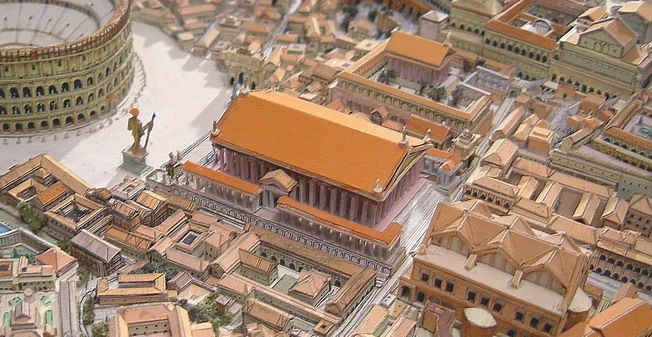
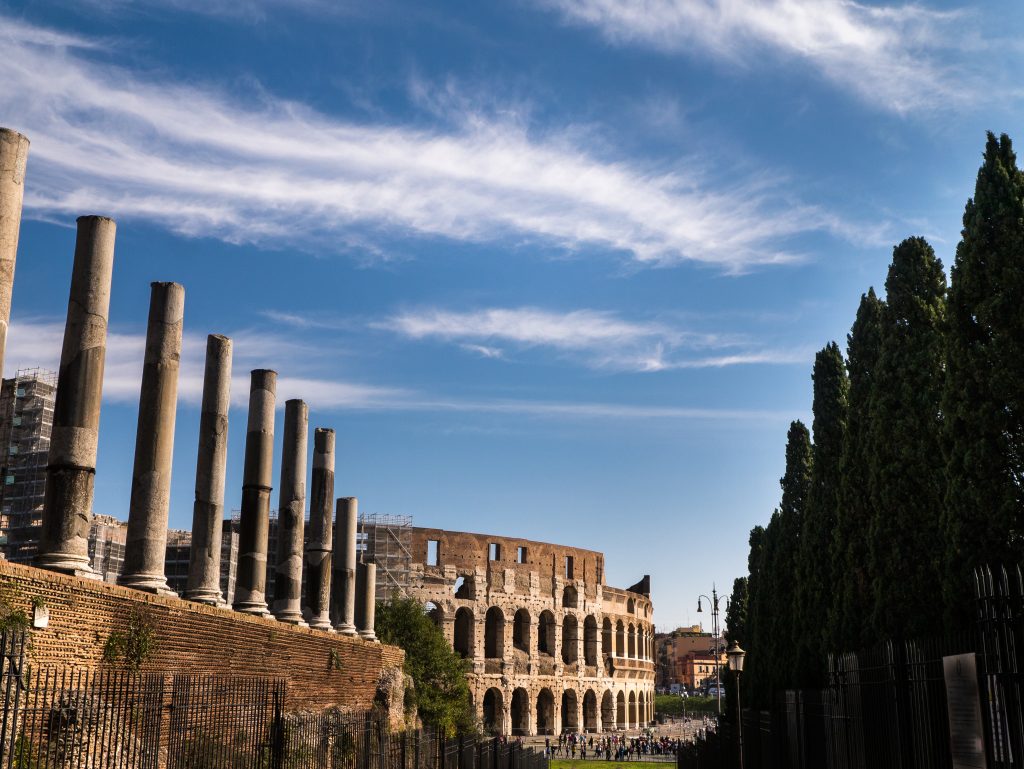
This largest temple in Rome was built by Hadrian, architect, engineer, soldier, poet, and one of Rome’s five greatest emperors. Construction began in 121 CE and was inaugurated in 135. It was completed in 141 under the next emperor, Antoninus Pius. The building, or what remains of it, stands opposite the Colosseum and marks where the Roman Forum ends between it and the Capitoline Hill. It was an immense structure and yet today it hardly registers with the multitudes who stand in endless lines to enter the Colosseum.
The Great Colossus
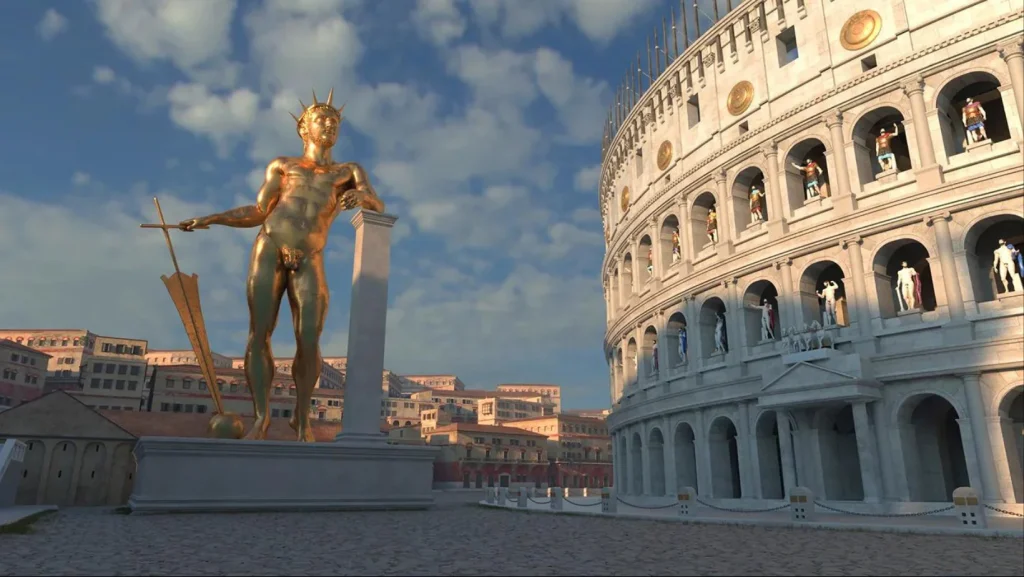
Here, to its front, also stood the great Colossus, which initially depicted the hated emperor Nero but was transformed into the god Sol Invictus (unconquered sun) after his suicide in 68 CE, when its head was severed and replaced. One hundred years later, the mad emperor Commodus replaced the head with his own, and the Romans—ever the arbiters of recycling—stored away the head of Sol Invictus and replaced it after his death. The sculptural head’s storage for future use amazes me. This statue matched the height of our Statue of Liberty from head to toes. It was moved a short distance to make room for the great temple, requiring lifting and rolling by twenty-four elephants. The statue still stood in the eighth century, long after Rome’s fall. Also in front of the temple stood the great Meta Sudans, a conical fountain forty feet tall and fifty feet wide, which sweated water through hundreds, if not thousands, of tiny holes.
Religious Worship
Temples were not used exclusively for religious rites. Most Romans regarded their own religions with skepticism, treating pagan rites as part fantasy and part tribute to a nameless, faceless higher power rooted in nature and tradition. The gods were worshipped for their attributes. You would approach Venus for love, Roma for wisdom and courage, Jupiter for fatherly advice, and so on. One thing was certain: the Romans permitted worship of any and all gods, but Christianity’s demand for sole worship ended the pantheon of ancient rites, on pain of death.
Temple Architecture
Classical temple architecture evokes the earliest times of civilization, when archaic peoples inhabited forests. For all its structure and marble and gold-covered bronze fittings, the columns surrounding most edifices are meant to represent nature, the forests and trees. A temple saw use for religious services perhaps twenty percent of the time. The balance was used for public needs, commerce, politics, debate, Senate meetings and deliberations, mayoral administration, and various associations.
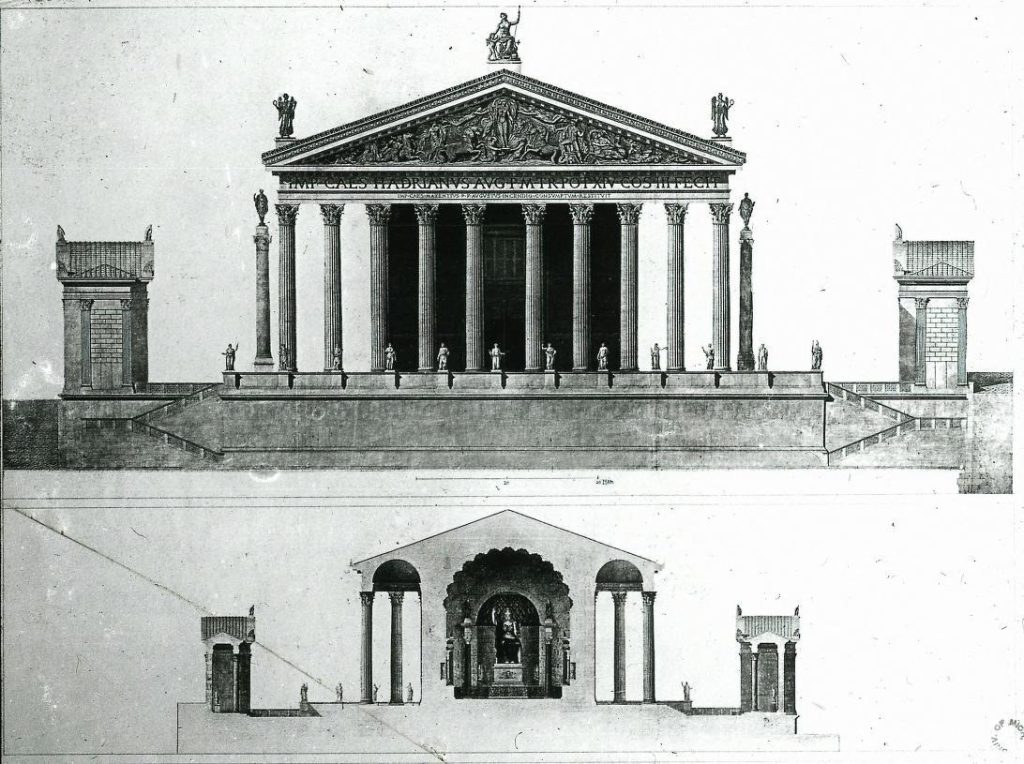
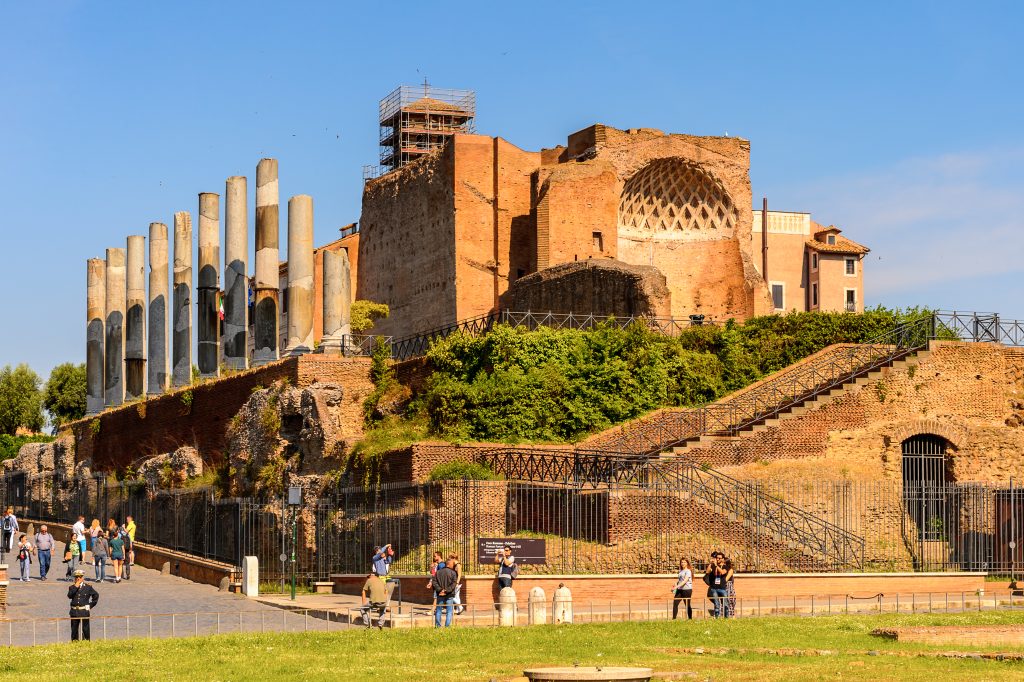
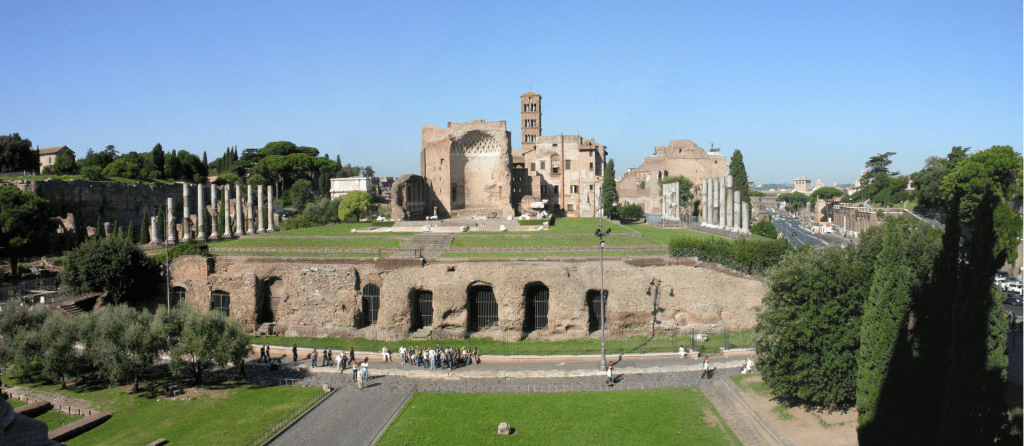
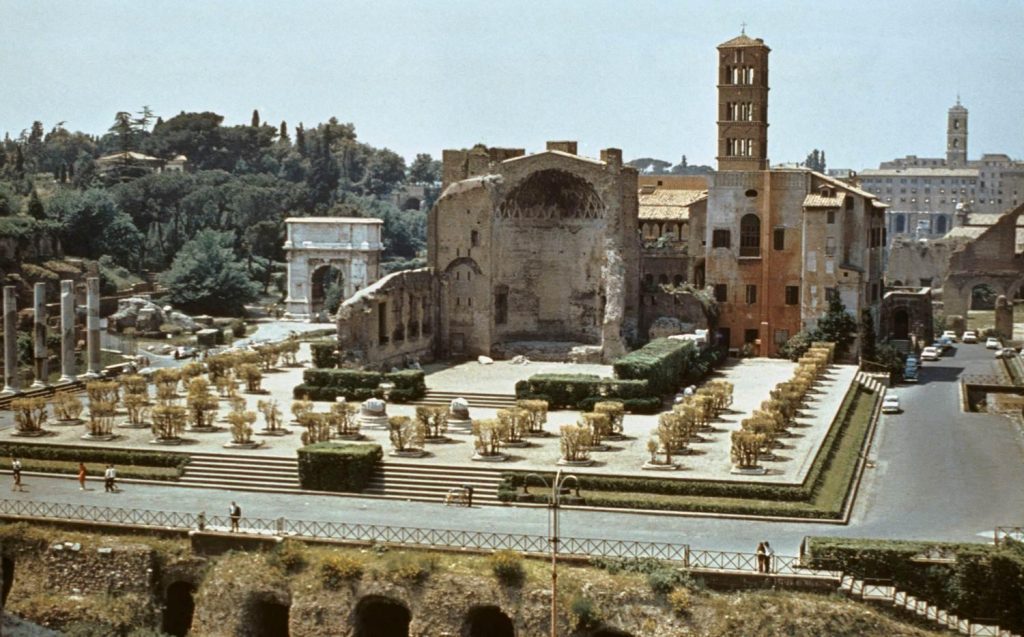
I adore this building. It was two temples created and built back-to-back, one for Venus and one for Roma. That of Roma, facing the Forum, is now the apse of a medieval church restored in the seventeenth century and named Santa Francesca Romana. The part that celebrated Venus is now an empty space. The temple was damaged by fire in 307 and later restored by Emperor Maxentius. Damaged by fire again and restored in 392-394 by the Christian emperor Eugenius, who tolerated paganism. The Pope stripped its gilt-bronze roof in 630, and much of the building collapsed after an early 9th-century earthquake. That same earthquake destroyed many of Rome’s great public buildings, most already abandoned and crumbling with age.

Epic Dimensions
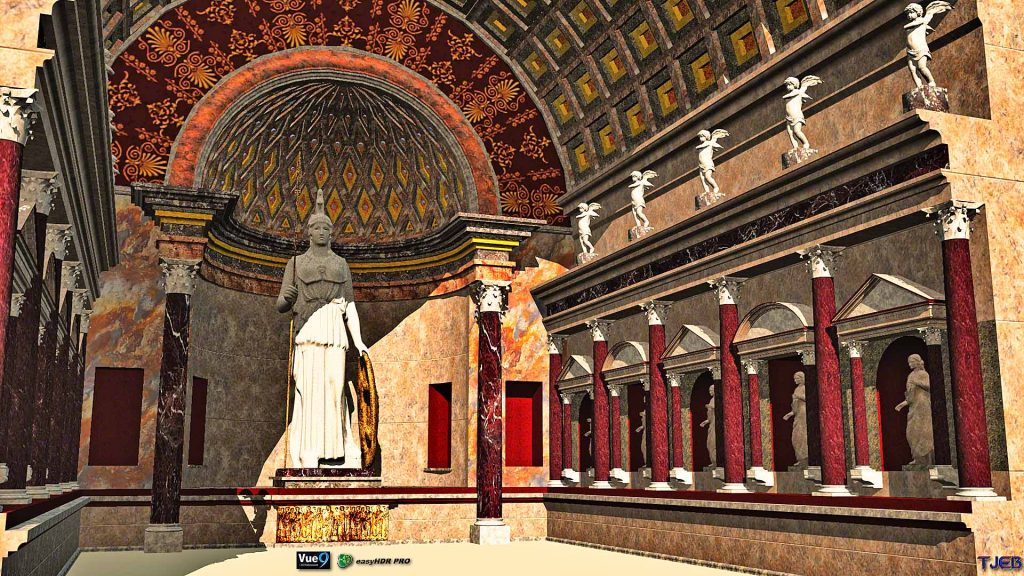
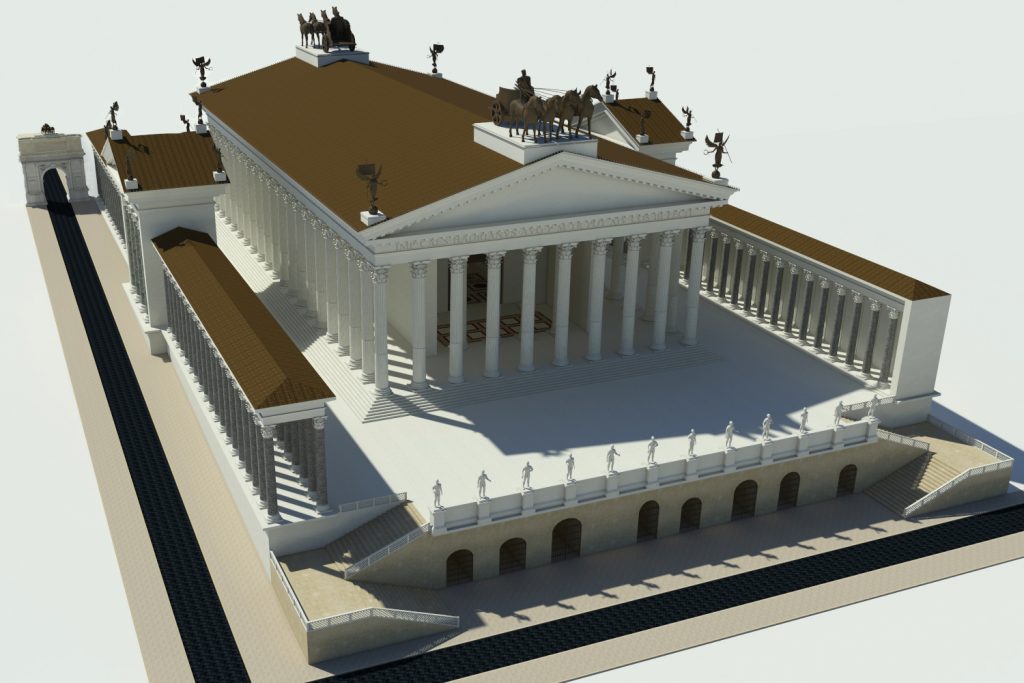
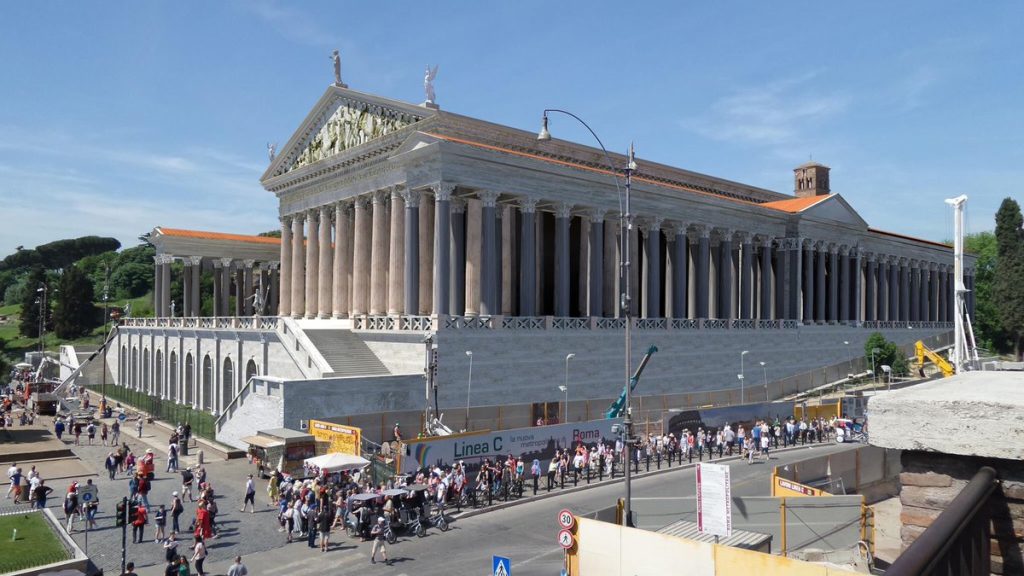
A senior senator and author of the late empire, Ammianus Marcellinus wrote extensively, and we retain some of his histories. He guided Emperor Constantius II through Rome, and the man was astounded by this temple, as well as the Forum of Trajan (look for a detailed description in a later post). Both possessed epic dimensions. The temple platform measured 475 feet by 330 feet, with the temple itself spanning 360 feet by 175 feet. The building was divided in half, one side for each deity. Ten columns fronted each short side, with twenty running the length of the north and south sides. These six-foot-wide columns were made of white marble. By comparison, the Pantheon’s massive columns measure four feet eleven inches across and weigh sixty tons each. The interior featured red porphyry columns alternating with niches of statuary. Each temple half contained a massive statue of the deity.
We know newly married couples would make sacrifices to Venus in her sanctuary. The entire structure was flanked by two long porticos, each two columns deep, that provided shelter from the weather. This was primarily an exhibition of architecture as art. It’s not difficult to imagine the beauty of these two long double rows of gray granite columns flanking a magnificent temple, rivaled only by Bernini’s colonnade in Piazza San Pietro.
City of Pilgrimage
Rome’s population plummeted from one-and-a-half million in the early second century to just thirty thousand by the eighth century, reducing its center to a ghost town, yet Rome remained a city of pilgrimage. The devout from all over Europe and beyond came to Rome to visit the great churches, places of martyrdom, and reliquaries holding splinters of the true cross or the bones of saints.
So, imagine a city abandoned except for select locations. You have a tour guide and perhaps hired toughs to escort you through the broken and collapsed city. Of course, your escort might also kill or ransom you. The Popes abandoned the city from 1309 to 1376, relocating to Avignon in southern France. For over a century, multiple claimants competed for the seat of St. Peter’s schism in the West. During this time, without a Pope in Rome, documented evidence shows the ancient ruins were frequented by the worst of humanity, and only armed groups could safely traverse the pilgrimage roads.
Still, pilgrims flocked and tours flourished. Your tour guide knew little about the ancient city. After the emperors ceased to exist, the Popes became caretakers of the imperial capital. Your guide to the monuments is likely a member of the clergy. He invents what he doesn’t know. We found an exceptional place called the Mirabilia. Written by a monk named Benedict in the 1140s, this itinerary of classical Rome through the eyes of a literate man of the dark ages remains an amazing document. It reviews the ancient monuments, arches, theaters, baths, temples and palaces, sometimes identifying them correctly and sometimes quite fancily. He speaks of the classical Romans as giants, for only giants could have built structures like the Colosseum.

Disappearing Rome
We examine the magnificent temple’s remains and wonder where all the material went. It is nothing but a few walls, some columns, and the foundation. The elaborate staircase descending to the Colosseum’s level remains. On the grounds, a lime pit has been found. It was here that all that stone, the columns, the roof line and entablature, the marble veneers everywhere, and the hundreds of classical statues were burned for quick lime to make concrete or stollen for building material elsewhere. This despoliation of the city was not uncommon. The Forum lay buried beneath up to thirty meters of Tiber silt, then lost to memory until its rediscovery in the 15th century. The Pope sold rights to disassemble a dozen buildings, buried underground but intact, for their materials. Rome had become a quarry unto itself.
Reimaging Rome at Its Peak
The images I’ve selected come from several sources. The French School of the nineteenth century was the first. Students of architecture could study ancient buildings and sketch them as imagined in antiquity throughout the Forum and other sites. Many of the artists were true scholars who used varied methods to recreate the buildings they drew. Some information survives in imperial coinage, some in relief sculpture showing architectural backgrounds, and some in ancient authors’ descriptions. Many buildings, though mostly gone with only foundations remaining, still showed column bases or impressions of walls, columns, and pilasters. The second source of illustrations comes from Atavistic. This company has rebuilt the classical world within our twenty-first century. Look carefully at contemporary people and street scenes alongside the monuments rebuilt in all their glory!



Rebecca Branch is the author of eleven published books and lives in New York City and Hudson, New York, with her girlfriend of eight years, top model Jessica Rossi. She writes romance, time-travel romance, contemporary women’s fiction, and memoir. She is the mother of two young women, one a scientist, the other an educator. She is a professional architect who trained in art history and archaeology as an undergraduate at UC Berkeley and completed her postgraduate work at Columbia. Although she modeled occasionally for Donna Karan and Calvin Klein into her early thirties, her first professional job was as an assistant curator of Greco-Roman Art at the Metropolitan Museum of Art in New York. She lectures on Roman architecture and urban planning, and practices interior design and architecture at an international firm in New York City.
Where to Stay in Rome, Italy
For visits to the Temple of Venus and Rome, staying within walking distance of the Roman Forum keeps you near the site while offering central access to other major attractions. The Colosseum neighborhood and surrounding area offer numerous hotels ranging from budget guesthouses to mid-range chains, many within a ten to fifteen minute walk of the temple ruins. Book accommodations on the east side of the Colosseum or along Via dei Fori Imperiali for the shortest walk to the Forum entrance.
The Centro Storico district, just northwest of the Forum, offers a wider selection of hotels and a more residential feel than the immediate archaeological zone. This area sits between the Pantheon and the Forum, so you can explore both major sites from the same base. Prices tend to be moderate, with a good mix of family-run hotels and smaller properties alongside larger establishments.
If your budget allows, the area around Piazza Venezia has upscale hotels with Forum views and is within walking distance. This neighborhood offers better restaurants and services than the immediate Forum area, though it sits slightly farther back. Most hotels here are within a fifteen to twenty minute walk from the Temple of Venus and Rome.
Budget travelers should seek guesthouses and hostels east of the Colosseum or in the nearby Monti district to the north. These areas are affordable, walkable to the Forum, and far less touristy than the immediate perimeter. Book in advance during peak season, as central Rome fills quickly and summer prices rise sharply.
