

Every October, Columbus Day asks us to look backward—but perhaps not always carefully enough.
The old story was simple: three ships, a brave crossing, a cry of land, and a “New World.” But history is rarely so tidy, and the Caribbean certainly was not new to the people already living there. Columbus did not arrive on empty shores. He entered island worlds inhabited by the Lucayan and Taíno peoples, with their own languages, leaders, agriculture, trade networks, spiritual traditions, and relationship to the sea.
So perhaps the most honest way to follow Columbus today is not to celebrate him blindly, nor to erase him altogether, but to travel the route with both curiosity and humility. His voyages opened a new age of global exchange—but also conquest, forced labor, disease, enslavement, and cultural devastation. The places he touched still carry both histories: the European stonework that followed and the Indigenous memory that preceded it.
This is a journey through the Caribbean not as Columbus imagined it, but as we might better understand it now.

Stop One: Guanahani / San Salvador, The Bahamas
The First Shore

The journey begins in the Bahamas, where Columbus made landfall on October 12, 1492. The island was known to its Lucayan inhabitants as Guanahani; Columbus renamed it San Salvador. National Geographic identifies this landing as the first known European contact with the Americas, while also noting the Indigenous name of the island and the Lucayan presence already there.
There is still scholarly debate about the exact island of the first landfall. Modern San Salvador Island—formerly Watling’s Island—is the traditional candidate, though other Bahamian islands have been proposed. But for the traveler, San Salvador remains the symbolic threshold: the beach where two worlds first stood face to face, each misunderstanding the other almost immediately.
Today, San Salvador is quiet, low, bright, and ringed by the kind of turquoise water that makes one understand why Europeans wrote of wonder. But wonder is not the whole story. The Lucayan people, part of the broader Taíno cultural world, were soon drawn into the machinery of Spanish exploitation. Their world did not vanish because it was fragile; it was shattered by forces no island society could have anticipated.

A thoughtful visit might begin at Long Bay, traditionally associated with Columbus’s landing, where monuments mark the event. Then continue to the San Salvador Museum in Cockburn Town, housed in a 19th-century jailhouse and Commissioner’s Office, where exhibits include Columbus, the Lucayans, plantation history, and 19th-century island life.
This first stop should be approached slowly. The shoreline is beautiful, but it is also an opening sentence to a long and painful chapter.

Stop Two: Cuba
The Island Columbus Mistook for Asia

From the Bahamas, Columbus sailed on to Cuba, arriving on October 28, 1492. He believed he might have reached part of Asia—perhaps the edge of Cathay, the China of European imagination. That error is almost breathtaking in retrospect, but it is also revealing. Columbus was not simply exploring; he was interpreting everything he saw through the map he hoped was true.
Cuba, of course, was not Asia. It was home to Indigenous communities, including Taíno peoples, whose villages, agriculture, fishing, and social life were woven into the island long before European sails appeared offshore.

For the Historic Traveler, Cuba offers a compelling meditation on misrecognition. Columbus looked upon Caribbean mountains, rivers, forests, and villages and tried to fit them into Marco Polo’s Asia. He renamed what already had names. He claimed what was already inhabited. He misunderstood abundance as availability.
To follow this portion of the route today, look especially toward eastern Cuba, where Columbus sailed along the coast. Baracoa, founded later in 1511 as Cuba’s first Spanish settlement, is not a Columbus-founded town, but it evokes the aftermath of his voyages: the Spanish foothold, the collision of cultures, and the transformation of Indigenous space into colonial territory.
This is where the traveler begins to feel the pattern: arrival, naming, claiming, settlement, disruption.
Stop Three: Hispaniola — Haiti and the Dominican Republic
Where Contact Became Colonization
If San Salvador was the first meeting, Hispaniola was where the future darkened.
Columbus reached the island in December 1492 and named it La Isla Española, later Hispaniola. Here, his flagship, the Santa María, ran aground near the northern coast. Its timbers were used to build La Navidad, the first Spanish fortification in the Americas. When Columbus returned on his second voyage, La Navidad had been destroyed—a sign that the Indigenous people had not accepted Spanish intrusion as passively as old histories often implied.
Hispaniola became Spain’s first major base in the Americas. It was also the site of catastrophic loss for the Taíno people through violence, forced labor, enslavement, social collapse, and disease. The Library of Congress notes that the Taíno had complex religious, political, and social systems—an important correction to any lingering notion that Columbus encountered people without structure or civilization.
There are several powerful places to visit.

La Isabela, Dominican Republic
Founded during Columbus’s second voyage in late 1493 or early 1494, La Isabela was the first intentional European colonial town in the New World and was intended as a base for Spanish dominion in the Indies. UNESCO’s tentative listing for the archaeological site notes that it includes remains of buildings from the first European settlement in America.
Today, the ruins are sparse compared to the grand colonial cities that followed, but that is precisely their power. La Isabela is not polished imperial triumph. It is the rough beginning: hunger, disease, ambition, fear, command, resistance, and the first attempt to transplant Europe permanently into Caribbean soil.

Santo Domingo, Dominican Republic

Then there is Santo Domingo, founded in 1498 and later laid out on a grid that UNESCO says became a model for town planners in the New World. Its Colonial City became the site of the first cathedral, hospital, customs house, and university in the Americas.
Here the Columbus impact becomes architectural. Walk the Zona Colonial, and you see the European city taking shape: stone streets, religious institutions, government buildings, fortified spaces, and houses of power. It is beautiful, yes—but beauty here is braided with conquest.
Sites such as the Catedral Primada de América, Fortaleza Ozama, Calle Las Damas, and Alcázar de Colón speak to the world that followed Columbus: one of empire, conversion, extraction, and hierarchy. Santo Domingo is indispensable because it shows how quickly the voyage became a system.


Stop Four: Puerto Rico / Borikén
A Name Changed, A World Transformed

[1948]
Columbus reached Puerto Rico during his second voyage in 1493. The island was known to its Taíno inhabitants as Borikén; Columbus claimed it for Spain and renamed it San Juan Bautista. Spanish colonization under Juan Ponce de León began in 1508, bringing devastating consequences for Taíno civilization.
This is one of the clearest examples of how Columbus’s impact still manifests today through names. The Indigenous name Borikén survives powerfully in Puerto Rican identity—Boricua remains a proud cultural self-description—while the Spanish colonial names San Juan and Puerto Rico reshaped the map.
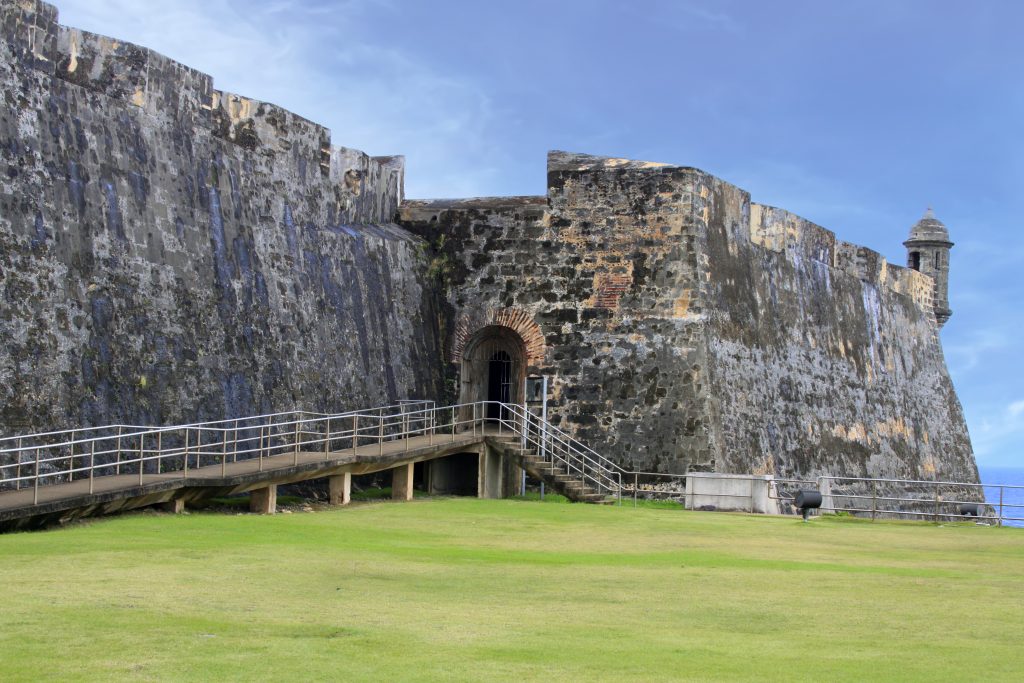
In Old San Juan, the traveler encounters a later but direct legacy of Spain’s Caribbean empire: massive fortifications, colonial streets, churches, plazas, and walls built to defend the island’s strategic value. Columbus did not build El Morro or San Cristóbal, but without his voyages, the Spanish militarized Caribbean world they represent would not have unfolded in the same way.
To deepen the Indigenous thread, pair Old San Juan with visits to sites and museums that interpret Taíno heritage. The point is not to treat Taíno culture as a vanished footnote, but to understand how Indigenous memory endures—in language, foodways, place names, genetic ancestry, art, and modern cultural identity.
Puerto Rico is a place where the Columbus story is not merely past. It is still debated in names, monuments, memory, and identity.


Stop Five: Jamaica

Maima, Seville, and the Meeting of Three Worlds
Columbus arrived in Jamaica in May 1494 during his second voyage, claiming the island for Spain. But one of the most evocative places connected to this history is not simply a Columbus landing monument—it is Seville Heritage Park in St. Ann.


The park is deeply significant because it sits near the Taíno settlement of Maima and is described by the Jamaican heritage site as a place of encounter among the peoples of the Americas, Africa, and Europe. It has seen continuous habitation for more than a thousand years and preserves layers of Taíno, Spanish, African, and English history.
That layering is exactly what makes Jamaica so important in this travel log. Columbus’s voyages did not simply introduce Europe to the Caribbean. They inaugurated a brutal Atlantic system that would eventually bring enslaved Africans to islands where Indigenous societies had already been ravaged. Jamaica’s later history—Spanish colonization, English conquest, plantation slavery, African resistance, Maroon communities, and independence—unfolds from the first breach opened by European contact.
At Seville, you are not standing in one story. You are standing in several.
The Jamaica National Heritage Trust notes that the park’s Great House displays artifacts reflecting the lives of Taíno, African, and European peoples. For a Columbus Day / Indigenous Peoples’ Day reflection, this is one of the most powerful stops because it refuses simplicity. It shows encounter, conquest, adaptation, survival, and cultural layering in one historic landscape.
Stop Six: Trinidad and the South American Coast
When the “Islands” Became a Continent

On his third voyage in 1498, Columbus reached Trinidad and explored the waters between Trinidad and the South American mainland, including the Gulf of Paria and the Orinoco region. This was the moment when the geography began to exceed even Columbus’s imagination. He had not merely found islands off Asia. He had reached the edge of a vast continent.
Trinidad’s Indigenous history includes multiple peoples and cultural worlds connected to both the Caribbean and mainland South America. Columbus saw the land through imperial eyes, but Indigenous peoples already understood these waters as routes of movement, trade, kinship, and belonging.

For travelers, Trinidad offers a different kind of Columbus reflection. It is less about monuments to arrival and more about geography itself: the meeting of island and continent, Caribbean and South America, river and sea. The Gulf of Paria is one of those places where the map itself seems to reveal the scale of what Europe had stumbled into.
The lasting impact here is not only Spanish claim, but the beginning of European awareness that the Americas were not an appendage of Asia. They were something else entirely—and that realization would reorder world history.
What Still Remains

To follow Columbus through the Caribbean is to see that his legacy did not end with landfall. It manifests in the names of islands, the layout of cities, the placement of forts, the dominance of European languages, the spread of Christianity, the collapse and survival of Indigenous cultures, the later plantation economies, and the racial and cultural complexity of the Caribbean today.
It also manifests in what has had to be recovered.
The Lucayan and Taíno peoples were long treated in old histories as disappeared. Yet today, scholars, descendants, museums, archaeologists, artists, and cultural advocates continue to restore Indigenous Caribbean presence to the story. The Caribbean was not a blank page awaiting Columbus’s pen. It was already a manuscript, written in languages Europeans often failed to hear.
That is why this journey matters.
A Historic Traveler following Columbus’s footsteps should look at the churches and forts, yes. But also at the shorelines, caves, archaeological sites, Indigenous names, museum exhibits, and living cultural memory. The deeper route is not merely ship to island. It is from myth to understanding.
Closing Reflection

Columbus’s Caribbean is not one story. It is a crossing of stories.
There is courage in the voyage, certainly. There is navigational daring. There is also blindness, hunger for gold, religious certainty, imperial ambition, and the beginning of immeasurable suffering for the Indigenous peoples who greeted those ships.
To travel these islands today is to stand inside that contradiction.
The beaches are beautiful. The colonial cities are magnificent. The Indigenous history is profound. The consequences are still with us.
Perhaps the best way to mark Columbus Day and Indigenous Peoples’ Day together is to follow the route with open eyes—to remember that the first “New World” shoreline Columbus saw was not new at all.
It was someone else’s home.
Recommended Reading
Fiction
- Encounter by Jane Yolen — A brief but powerful retelling of Columbus’s arrival from the perspective of a young Taíno boy, especially useful for reframing the familiar story through Indigenous eyes.
- Morning Girl by Michael Dorris — A beautifully written short novel set in the Bahamas just before European contact, offering a tender glimpse of Indigenous island life before rupture.
- The Heirs of Columbus by Gerald Vizenor — A satirical, inventive, and challenging novel that reimagines Columbus’s legacy through Native storytelling and survivance.
- Caribbean by James A. Michener — A sweeping historical novel that moves across centuries of Caribbean history, including conquest, colonization, piracy, slavery, and revolution.
- The Viceroy of Ouidah by Bruce Chatwin — Though focused on the Atlantic slave trade rather than Columbus himself, this spare and haunting novel illuminates one of the later systems born from European expansion into the Atlantic world.
Non-Fiction
- The Four Voyages: Being His Own Log-Book, Letters and Dispatches with Connecting Narratives by Christopher Columbus, edited and translated by J.M. Cohen — A primary-source gateway into Columbus’s own words, revealing both the wonder and blindness of his encounters.
- 1491: New Revelations of the Americas Before Columbus by Charles C. Mann — Essential reading for understanding the sophistication, population, and complexity of the Americas before European arrival.
- Conquest of Eden: 1493–1515: Other Voyages of Columbus by Michael Paiewonsky — A focused look at Columbus’s later Caribbean voyages and the early Spanish presence in the region.
- The Rediscovery of America: Native Peoples and the Unmaking of U.S. History by Ned Blackhawk — A sweeping reframing of American history that places Indigenous peoples at the center rather than the margins.
Image Credits: Selected images via Wikimedia Commons: El Alternativo, Merari Rene 0901, Mario Roberto Durán Ortiz, Georg Karl Ell, Joseacaraballo, CaptJayRuffins, and Grueslayer (CC BY-SA 4.0); Frankjh, Paul Postiaux, Maxim Nedashkovskiy, Jaime Olmo, and NordNordWest (CC BY-SA 3.0); Dave Bunnell (CC BY-SA 2.5); Rüdiger Stehn and Diego Tirira (CC BY-SA 2.0); Desox7x (CC0); Dióscoro Puebla, Sebastiano del Piombo, Rémi Kaupp and Claude Zygiel, Patrick Flament, and Marine 69-71 (Public Domain)
