
The following is an edited version of a visit to the Basilica Aemelia in the Roman Forum from my first novel, The Summer of ‘71. The descriptions of architecture are correct. The historical narrative is my imagination, but is based upon what is known from the fifth century fall of Rome.
By Rebecca Branch
I had the good fortune of being the daughter of an American archaeologist and living in Rome through my youth. When I was sixteen, I walked the Forum with two of the great minds of archaeology, the curators of the Metropolitan and the Boston Museum of Fine Arts. We progressed from building to building but stopped in front of the Basilica Aemelia for a story I will never forget and one which I tell my students and guests when I tour this amazing archaeological park. Now, like most of the other buildings and monuments, it was a wreck and no more than the foundation of the original building with a few walls and columns still standing.
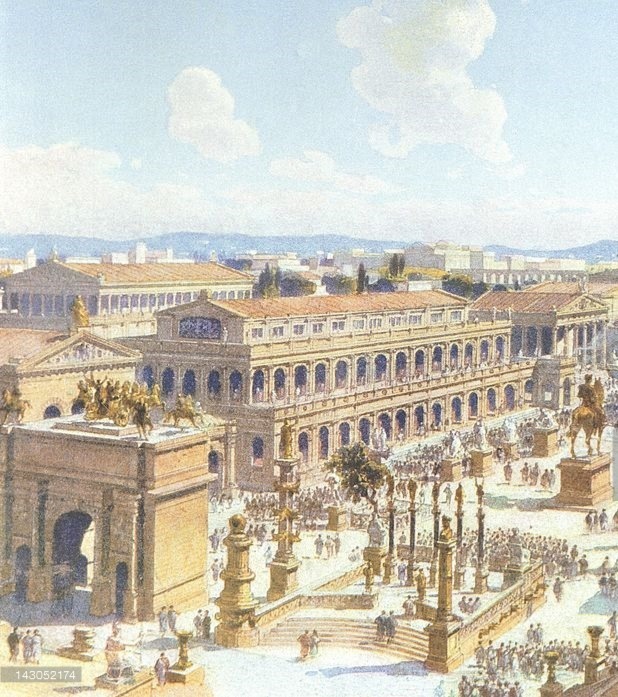
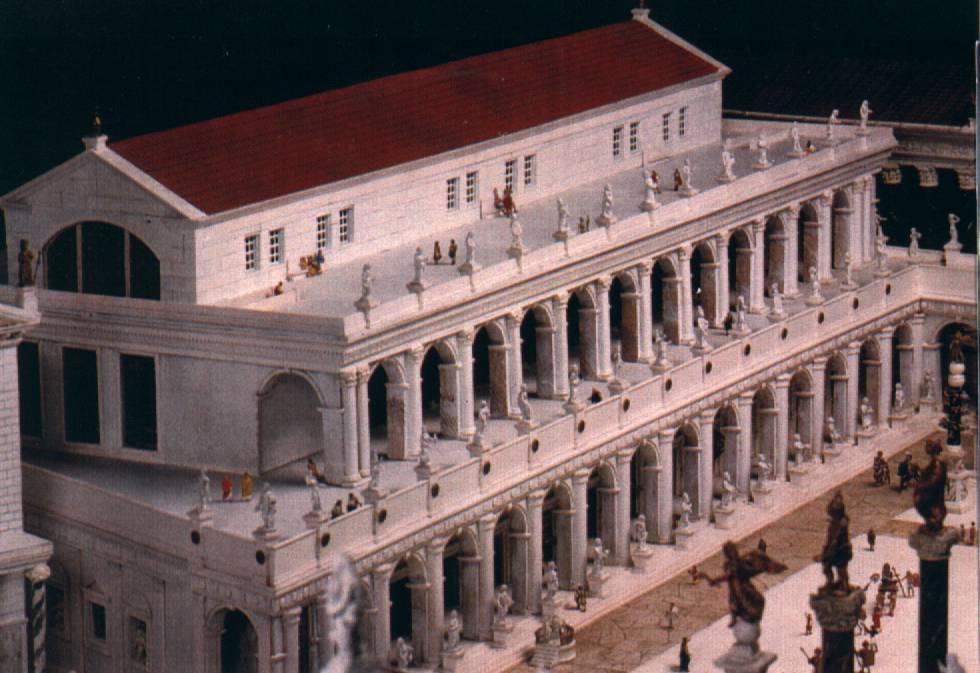
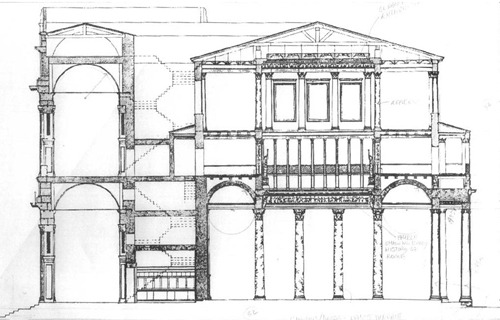
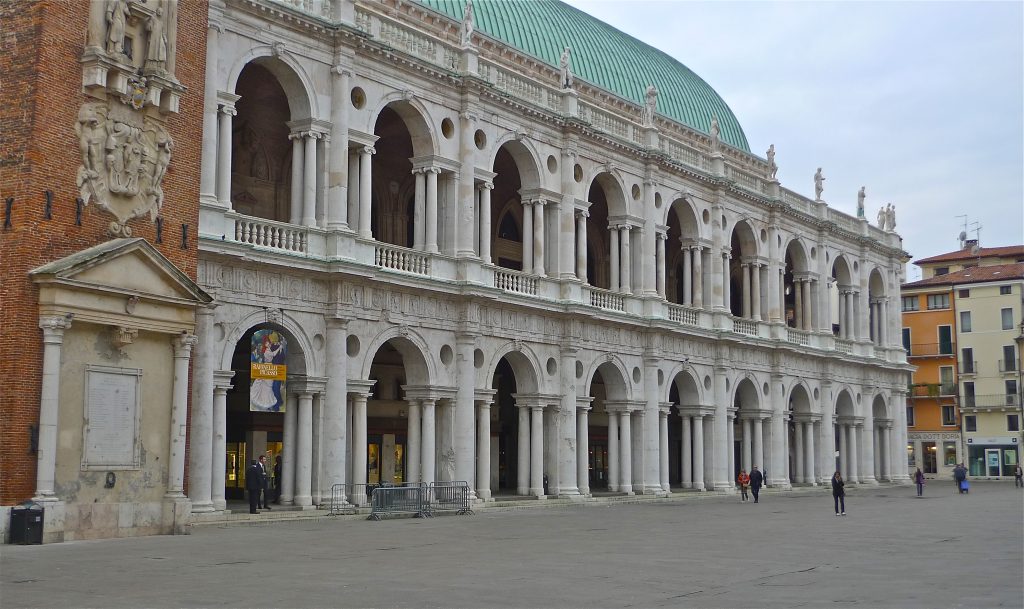
There were many basilicas in Rome. Here in the Forum there were three; Aemilia, Julia, and Maxentius. This was the oldest, and according to contemporary writers, the most beautiful. It was ninety meters by fifty, so as large as a football field. It was three stories tall in the center nave and two stories over the aisles, but the stories were hugely tall. Outside, facing us, was a portico, added by Augustus Caesar one hundred years later, and commemorated for his two dead grandsons, Gaius and Lucius. A portico was a covered extension with repetitive arches, a place to get out of the rain or the intensity of the summer sun.
The Law Courts
This basilica was primarily used as a law court with a capacity of upwards of two thousand. The law courts and businesses all took place outdoors except in inclement weather for the most part. The basilica was divided into three parts by two huge tapestries. Each part was a giant room, or division, and held one court. Wooden chairs were set up for judge, jury, prosecution, defense, and audience. The cases were like those of today, capital offense, treason, fraud, libel, divorce, custody, etc. You came to hear the great legal minds and orators of the day, Caesar, Cicero, and their like.
The floor was pink granite, and columns were of green and red stone imported from Africa and the Middle East. This was chosen, not out of need since local stone was available, but because it confirmed the extent of the empire and the rich resources available to it.”
How It Looked
The basilica was filled with precious art, mostly statuary and relief sculpture. The tapestries were immense, and the beautiful floor was covered in wooden furniture and many wooden chairs and benches for judges, jury, witnesses, legal counsel and audience. The people were in all sorts of colors and fabrics, much like the saris one would see in India today. There were balconies and outdoor loggias where people could look down into the streets and the open space of the forum.
Arrival of Alaric
On August 24th, 410 CE, the Visigothic King, Alaric, was at the gates of Rome demanding payment for the work his army had done in defense of the empire. In the fourth and fifth centuries, Rome took royal hostages from defeated barbarian tribes who lived across the Rhine and Danube rivers. These hostage sons of the rulers across the borders were then raised amongst the Imperial family, trained and educated in the Roman way. Barbarian troops were civilized over time and grew to become mercenary warbands in the Roman army. Later, these units became Romanized in the art of war, led by Roman officers, dressed in Roman uniforms, and given order and discipline which made them more and more dangerous to the empire as their true loyalty was to their German chieftains and not to Rome.
Alaric grew up in the court of the Emperor Theodosius in Constantinople. A barbarian prince, he had his letters and numbers, was Christian, and dressed like a Roman general. Returned to his people, he was the leader of an army of ten thousand Germanic soldiers. They’d been bloodied in many battles, often thrown into the most dangerous places in the line and considered expendables.
The Gothic ten thousand swelled to thirty thousand on his approach to the ancient capital as the Romans arrested and killed several officers of high rank whose backgrounds were also barbarian out of fear of the approaching army and distrust of defending soldiers of barbarian descent, even if Romanized several generations in their past. This was a crazy act, having resulted in tripling the number of soldiers the city would have to face in a siege.
Barbarians Overtake Rome
The imbecilic emperor, Honorius, refused to honor Alaric’s demands for payment, yet the emperor was holed up in Ravenna, tending his pet chickens and leaving Rome to the mercy of the enemy and the governance of the Senate. The people did not want to face a lengthy siege with the pestilence and disease it would bring once the water supply was cut so the gates were opened, and the barbarian army entered the city.
Rome was no longer the capital of the Western Roman Empire. The West now had three imperial capitals, each much closer to the hot spots of the day, so the emperor could act and react quickly to any menace coming from across the borders. Those capital cities were Trier on the Mosel River in Germany, Milan in Northern Italy and Ravenna on the Adriatic coast. Ravenna was especially protected by marshes and was considered nearly unassailable.
Here at the Basilica Aemilia, business went on as usual, the thought that the Goths would enter the city never crossing anyone’s mind. This building had been in constant use for over four hundred years. The portico here was used by the bankers of Rome who negotiated loans, insured shipping, converted currency, etc.
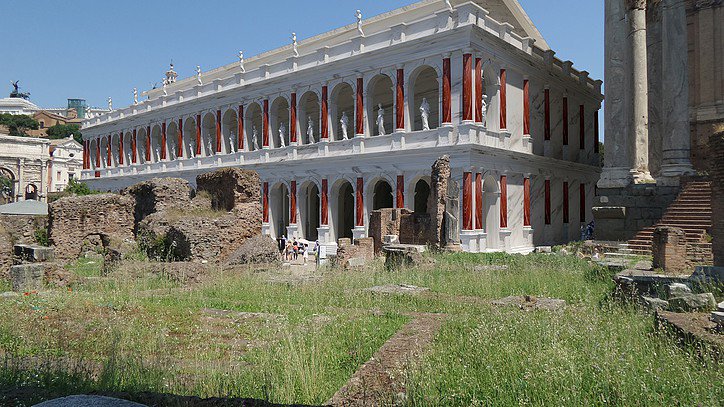
Commerce Interruptus
There were perhaps a dozen bankers here at three huge wooden tables, each covered in mauve fabrics with woven gold symbols. The men were named Marcus and Sidonius, Macro and Lucullus, and foreign names like Gaspar, Aediutorix and Josephus. These men, and others like them, were connected with bankers throughout the empire. A document bearing their signature and pressed wax signet permitting a depositor access to funds from Britain to Arabia. These men were all rich from years of working the financial industry of the city and its world trade. They wore robes of the finest materials, cinched with gold belts. They wore multiple rings and necklaces and had jeweled blades at their hips. Some wore close-cropped beards; most were clean shaven as was the style of the times. A few wore wigs made of human hair over their bald pates. They were attended by tall, muscular guards in tunics, carrying short swords on their hips and silver topped spears at their sides. There were dozens of slaves, mostly young, between twelve and twenty, who bagged the coin, stacked ingots, and carried strong boxes to destinations around the city. There were several scribes, secretaries who wrote on vellum and created contracts and records of transactions.
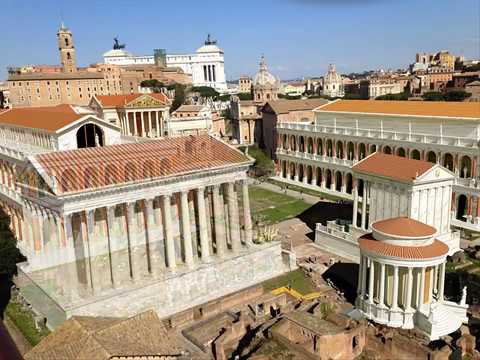
As all these people in this small corner of the basilica worked their trade, the forum around them was filled with people. Some were the wives and children of the bankers, or slaves and retainers available to do their bidding. Some were shopping the local market stalls, others meeting with friends. Children played on the basilica steps under the watchful eyes of governesses and nurses. Men passed the time playing a form of backgammon, the boards incised directly into the steps of the Basilica Julia just across the way.
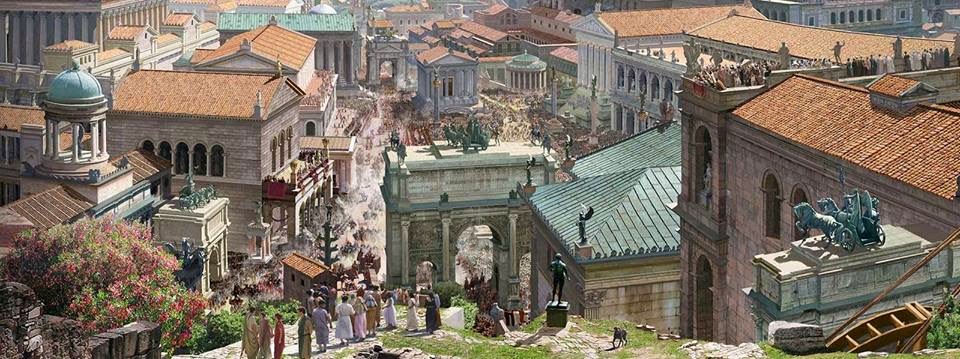
Construction gangs were busy disassembling and removing an equestrian statue of the pagan emperor Diocletian, others were restoring the Temple of Concorde’s leaky roof. Further repair work was being performed on the pavement in front of the Arch of Augustus.
Behind them, the three law courts were in session, judges and juries, advocates and plaintiffs, witnesses, defendants and manacled captives, and the bailiffs to keep watch. Besides them were literally a thousand or more Romans, members of all the classes and all conditions, here for the entertainment of a good trial.
Outside, in the open air of the Forum itself, perhaps ten thousand walked or milled about, maybe more.
The Onslaught Begins
A great deal of noise, at first a hum, now distinguishable as screams and shouting came from the area of the abandoned Colosseum. The great amphitheater had been closed for twenty years along with many of the pagan temples at the order of Theodosius, a Christian emperor.
The second cohort of Imperial Comitatenses, elite troops left in Rome by the emperor to guard the Palace, marched quickly at double time down from the Palatine Hill. Their coordinated mechanical marching steps echoing against all the stone buildings and making everyone look their way. As they passed from view, everyone looked in the direction of the noise, now added to by the sounds of the crashing of swords and armor. Then the City Prefect and his guards flew out of the Basilica of Constantine to add their meager weight to the four hundred men of ‘The Second’.
Women and a few men ran into the upper forum crying the end the world, the Goths were in Rome! This was the signal for all of humanity to flee the area and thousands of forum frequenters from the Basilicas Julia and Aemilia flew in all directions, but mostly south, east, and west.
The panic, followed by the surge of escaping humanity, caught many of the children and elderly off guard and crushed and broken bodies lay limp on the pavement as the tide passed. Many remained, either too stunned, too scared, or too unsure to leave.
The elders of the Senate exit the Curia and stand under the portico on the steps. Groups of huddled women and children, not knowing where to flee fall to their knees and pray. Ambassadors from many foreign lands, dressed in their finery, stand beside the Curia, surrounded by their armed guards and staff.
Tradesmen and shopkeepers abandon their stalls, carts of fruit and vegetables left unattended. More people fall to their knees in tight groups, hands wringing in prayer, rosaries dangling or being pressed and threaded nervously through their fingers.
Then the first of the Gothic warriors break into the forum from near the shuttered Temple of Antoninus and Faustina. They are in a mob, dressed in a variety of armor, some stripped from dead Roman Comitatenses, some in the uniforms of Foederatis and Auxiliaries, others mail-clad, sporting pants, tartan shawls and capes fringed with bear or wolf hides, still others in worn tunics. Most carry spears, some are armed with axes and two-handed swords.
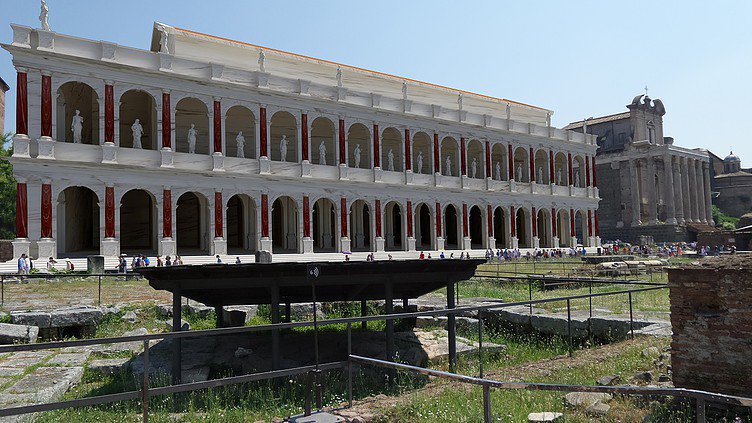
They rush the banker’s tables and are met by the senior guardsman who thrusts his spear into a Goth. Another warrior pummels him in the face with the metal boss of his shield, laying him stunned, flat on his back. An axeman beside him chops off first his right arm and then his left, then standing a foot on his chest, he hacks off both his feet, leaving a writhing mass of bleeding flesh on the polished marble street. The remainder of the guard, some twenty men, rush the barbarians and are similarly hacked to pieces, quickly succumbing to the greater numbers. The guards at the far end of the forum, protecting the Mint, disappear into the fleeing crowd. Screaming is everywhere as the few who fight are reduced to a fleshy pulp.
The bankers pull tight their sacks of gold coins while some of their slaves try to flee with bags of silver. Many are killed at their tables, the gold and silver carried off. Some raise their hands in surrender and are skewered, hacked or smashed in their faces with the pommels of Gothic swords. A woman and her ten-year-old daughter race to one, screaming ‘father and husband’ and they are grabbed by their hair and set to watch as the last banker is knocked to his knees, the three family members reaching for one another. Mother and daughter are gang raped before his eyes then he is cut down, his head hoisted on a spear. Mother and daughter are strangled to death while being repeatedly raped.
Hundreds of women praying on their hands and knees are stripped of their clothes and raped face to face with one another or their husbands or parents, many killed after untold abuse. Heads fall throughout the forum; heads mostly of the weak and the lower classes huddled in their masses. The barbarians approach the Senate, its front row of senior magistrates all old men of great dignity, clad in white. They stand in rows, arms folded, silent, watching the spectacle before them. The Gothic troops stop their forward motion and glare at them in their majesty.
A group of patrician women, bedecked in their finest clothes and jewels stand nearby at the bottom of the Curia steps, all standing proud and haughty. The soldiers approach. One reaches up and tears the necklace off the tallest of the women. She spits in his face, is grabbed by her hair and held upright, unable to move, her feet almost dangling on the ground, while another rips off her clothing. A dagger is thrust from her vagina to the bottom of her ribcage in one quick slice and her intestines spill out as she silently screams her last breath. All the others in her group fall to their knees as the soldiers tear off their jewels and clothing and rape them too, their social status of no protection.
Orders to Cease
Then a chieftain on horseback, huge, horn-helmeted, with dripping mustachios enters the square and a horn sounds. The frenetic motions and activity come to a stop, but not the collective moans of the crowds of abused and dying populace. Orders are issued and obeyed. The warbands, so used to fighting under the orders of Roman leaders, show great discipline and respond to the instructions of their chieftains. The bloodlust ebbs away and the barbarian footmen line up at attention.
Orders are given. The foreign ambassadors from many countries are to be left alone, as are the senators. The rape is to stop. All gold and silver is to be collected and placed in the center of the square beneath the Rostrum. The statue of the emperor Honorius is to be torn down and smashed. One building only is to be burned. He looks around and says ‘this one’ and points to the nearest.the Basilica Aemilia.
Basilica Aemilia in Flames
Gothic soldiers step nimbly over the bodies of the bankers, their slaves and retainers, and the guard’s body parts into the great hall. Two tapestries divide the gigantic space into three and it is these tapestries which are set alight. The fire burns up to the coffered wooden ceiling and the entire thing, dry from hundreds of years of age, bursts into flames and comes crashing down on the floor, the rectangular shell of masonry and stone remaining upright.
For three days the city was laid waste, everything of value that could be moved was stripped from Rome, the Capital of the World. Many are killed, but not so many as might have been. Few are carried off into slavery. Having willingly opened the gates, the city’s populace was, for the most part, spared.
Spoils of Rome Lost to History
Then the Gothic King Alaric, and all his thanes and chieftains and their war-bands moved south towards the toe of Italy’s boot. In a short time, Alaric would be dead of a mysterious disease. The course of a river is diverted from its bed, Alaric and much of the loot of the rape of the city is buried with him, and the river’s course set back again, his burial place unknown and forgotten, the spoils of the great city lost in time.
Professor Von Bothmer of the Metropolitan Museum in New York took me by the arm and walked me over to a spot where he kicked away at the dirt-covered foundation stone. As the dirt was pushed away by his sandal, beneath it you could see the pink granite floor and numerous green circles in the stone.
“There is the record of that terrible day,” he said. “Those are the worthless bronze coins, spilled by the barbarian troops after murdering the bankers of Rome, melted into the floor of the building by the collapsed burning roof. Those coins mark the spot of the deaths of the bankers. Real people who lived and worked right here 1,600 years ago and died on this spot.”
A chill traveled up my back and made the hair on the back of my neck stand on end as I was swept up in the eerie story of death and destruction right where I stood. He told the story with great dramatic effect and timing. It was frightening, but wonderful, and connected me to the time and place.
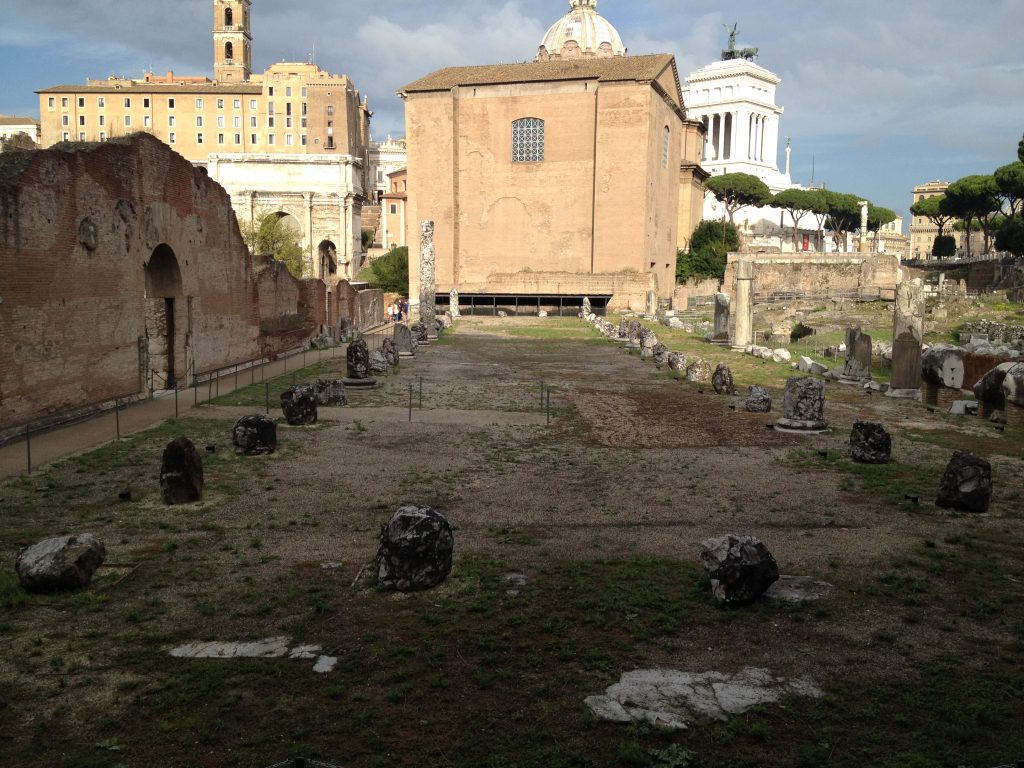
Reconstruction and Dissolution
The building was rebuilt after the fire and continued to be used. Years later Rome suffered many disasters; invasions and sacks, huge floods which left twenty and more meters of silt from the Tiber, earthquakes, fires, plagues, etc. The population of the city shrank from well over a million to 30,000. The great walled city was abandoned and became a ghost town. Vegetation grew everywhere; buildings collapsed or were used as quarries. The Forum was all but forgotten. It had become a cow pasture!
It was used as a dumping ground from the ninth through the thirteenth centuries. Medieval construction in the adjoining neighborhoods were dismantled and their rubble was deposited here. This buried what was left, although several of the temples were converted to Christian churches, like the Senate building, known as the Curia, Temple of Antoninus and Faustina and the Temple of Romulus. That is the reason that those buildings are preserved.
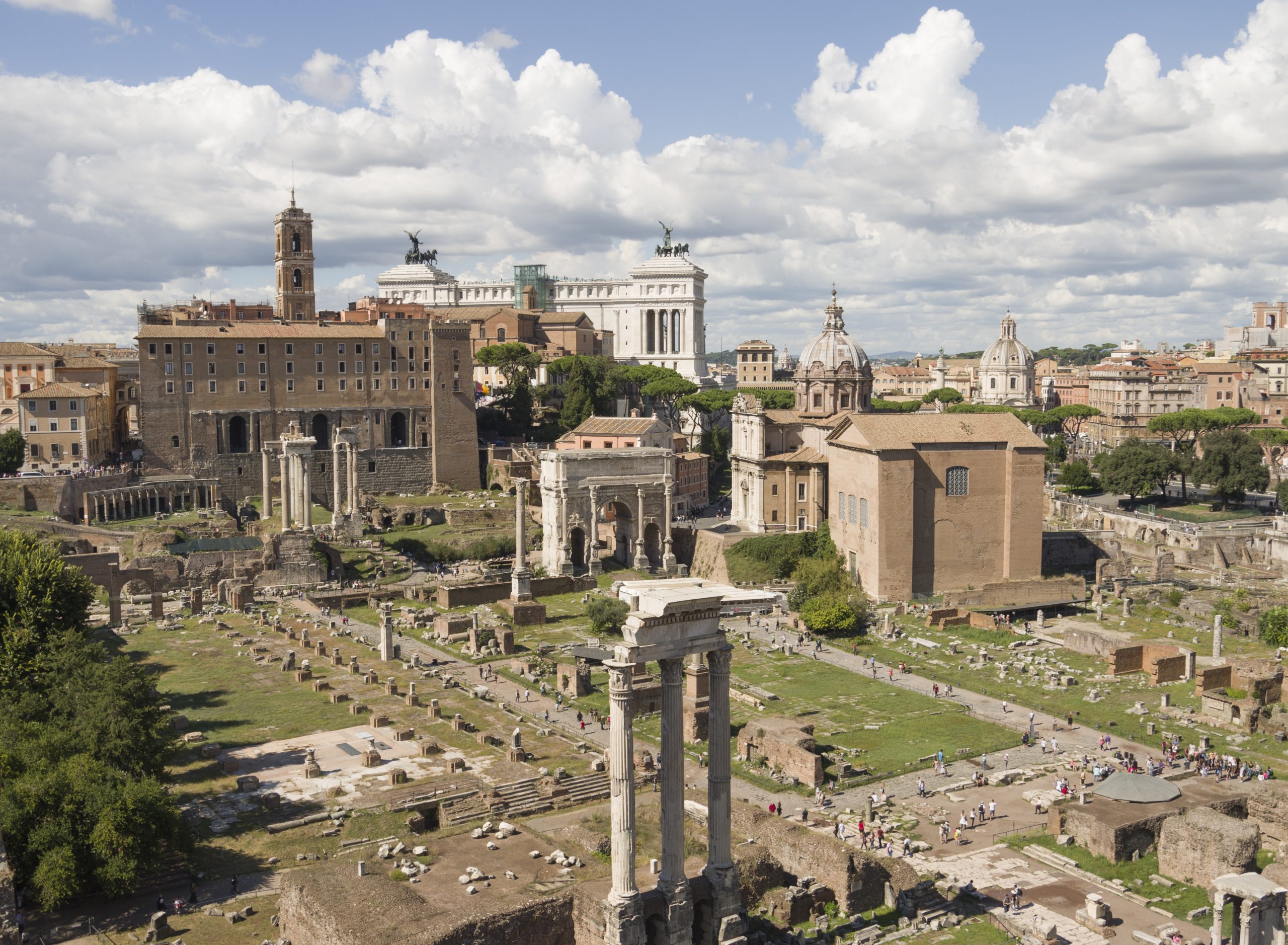
Willful Destruction, Gratitude for What Survives
In the fifteenth century, it was rediscovered by accident when a cow fell through a hole in the ground and into the buried Temple of Julius Caesar. The Popes paid individual family businesses to quarry out all the stone. The Basilica Aemilia was dismantled over a two-month period and its fine marble was used to build the palace of a Roman noble. All the buildings in the forum shared that sad fate. One by one they were dismantled; the basilicas Julia and Aemilia, the temples of Concord, Saturn, Vespasian, Caesar, Vesta, and on and on. It is a sad fact that the most destruction wrought on the city was done by its own population under the Popes. Even worse, what wasn’t needed for building new structures.the precious marble veneers, stone slabs, columns, was burnt to make quicklime, a key ingredient of mortar and concrete. That was the sad fate of literally thousands upon thousands of marble statues. Kilns for the destruction have been found all over the city.
When I take the many groups of architects and select clients through this archaeological park, one of the things I hear most often is, “How awful that so much was destroyed.” My answer is simple. How incredibly fortunate we are to have so much survive. Look at the Pantheon, the Colosseum, the platforms of all the Forum buildings, the grand Markets of Trajan, the imprint of the Circus Maximus and Stadium of Domitian, Baths of Caracalla, but also the entire port city of Ostia Antica. So much survives and with the right guide, it all comes back to life.

Rebecca Branch is the author of eleven published books and lives with her girlfriend of eight years, top model Jessica Rossi, in New York City and in Hudson, New York. She writes romance, time-travel romance, contemporary women, and memoir. She is the mother of two young women, one a scientist, the other an educator. Professionally, she is an architect, but she trained in art history and archaeology in her youth at UC Berkeley for her undergraduate degree and did her post graduate work at Columbia. Although she modeled occasionally for Donna Karan and Calvin Klein up into her early thirties, her first professional job was as an assistant to the curator of Greco-Roman Art at the Metropolitan Museum in New York. She lectures on the architecture and town planning of the Roman Empire and practices interior design and architecture at an international firm based in New York City.
Where to Stay in Rome, Italy
The area around the Basilica Aemilia falls within Rome’s historic center, where lodging options range from upscale hotels to family-run guesthouses. The Forum district itself has limited overnight accommodations, but the adjacent neighborhoods of Monti and the Colonna area offer accessible alternatives within a fifteen-minute walk. These quarters provide direct access to major sites while keeping you close to local restaurants and daily life rather than in the more tourist-focused zones.
For those seeking midrange comfort, consider hotels in Monti, a residential neighborhood with narrow streets, neighborhood trattorie, and modest three-star properties that cater to visitors without premium pricing. This area sits just northeast of the Colosseum and puts the Forum within easy walking distance. Alternatively, staying near Piazza Venezia or along Via dei Fori Imperiali puts you on the main thoroughfare connecting the major archaeological sites, with hotels and smaller inns at various price points.
Budget travelers will find youth hostels and modest guesthouses scattered through central Rome, particularly in the Monti and Esquilino districts. These neighborhoods are well-served by public transport and walking, though rooms can be compact. If you prefer quieter surroundings, the area around Campo de’ Fiori, a short walk south and west, offers boutique hotels and bed-and-breakfasts in Renaissance buildings, though prices tend higher.
Book accommodation well in advance, especially during spring and fall when tourist traffic peaks. The closer you stay to the Forum and Colosseum, the steeper the nightly rate, so consider staying one neighborhood out and budgeting time for short walks between sites. Most hotels in central Rome include maps and staff familiar with routing visitors to archaeological zones on foot or via the local metro.
